
Insider Selling at Dream Finders Homes: A Signal of Distrust or Strategic Diversification?
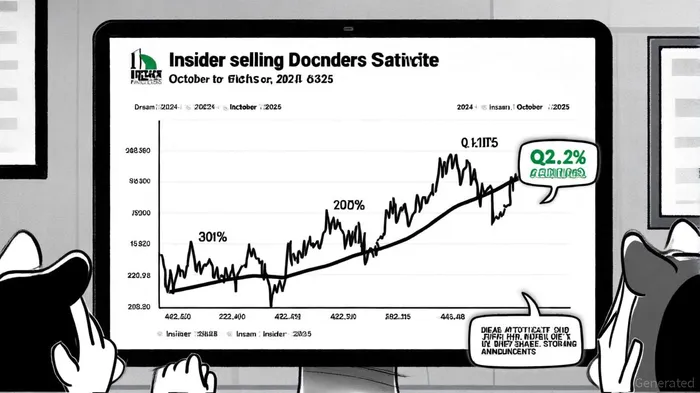
In the volatile world of homebuilding, Dream Finders HomesDFH-- (DFH) has drawn attention for a troubling trend: significant insider selling by executives and directors in Q3 2025. According to a MarketBeat report, CEO Patrick Zalupski alone sold 14,237 shares of Class A common stock in early October 2025, generating proceeds of $370,000 at an average price of $26.00 per share (MarketBeat report). This activity, part of a broader $26.43 million in insider sales over the past 12 months, has sparked debates about its implications for investor confidence and near-term stock performance.
The Scale and Pattern of Insider Selling
DFH's insider selling has been both frequent and substantial. On October 1 and 2, 2025, Zalupski sold 7,443 and 6,794 shares at weighted averages of $26.04 and $25.93, respectively, as shown in InsiderTrades records (InsiderTrades records). These transactions followed a pattern of divestment by other insiders, including Director William Lovett, who sold $3.0 million worth of shares in October 2024. Over the last year, insiders have collectively sold $7.59 million in shares, a figure that appears lower than the $26.43 million cited by MarketBeat, suggesting discrepancies in reporting or time frames. Regardless, the consistent selling by top executives raises questions about their confidence in the company's near-term prospects.
Financial Performance: Growth vs. Margin Pressures
DFH's Q2 2025 results highlight a mixed bag of growth and challenges. While homebuilding revenues rose 4% year-over-year to $1.1 billion, driven by a 10% increase in home closings, gross margins contracted by 250 basis points to 16.5%, according to the company's Q2 2025 press release (Q2 2025 press release). This margin compression was attributed to lower average sales prices (down 7% to $481,027) and rising land and financing costs. To offset these pressures, the company executed a $16 million share buyback program, repurchasing over 700,000 shares. This move signals management's belief in the stock's intrinsic value, yet it contrasts with the insider selling, creating a narrative of conflicting signals.
Market Reactions and Analyst Perspectives
The stock's price movements during insider selling events have been mixed. On October 1, 2025, DFH's shares rose 1.6% to $26.47 following Zalupski's sales, suggesting the market may have interpreted the transactions as liquidity management rather than a lack of confidence. However, by October 15, 2025, the stock had fallen by -0.455%, per StockInvest (StockInvest), potentially reflecting broader market jitters about the homebuilding sector's macroeconomic risks. Analysts remain divided: some maintain a "Hold" rating with a $26 average price target, while others caution that margin pressures and integration challenges from recent acquisitions (e.g., Alliant Title and Green River Builders) could weigh on performance.
Investor Confidence: A Delicate Balance
The interplay between insider selling and corporate actions like buybacks complicates the assessment of investor confidence. On one hand, the $16 million in share repurchases demonstrates management's commitment to shareholder value. On the other, the absence of insider buying over the past year and the large ownership stake held by insiders (68.16%) suggest a lack of alignment with public shareholders. This duality is further underscored by the fact that DFH's institutional investors, including Citadel and D. E. Shaw, have increased their stakes in Q3 2025, indicating that some institutional money remains bullish.
Conclusion: A Cautionary Outlook
While DFH's insider selling does not necessarily signal a crisis—executives may be diversifying personal portfolios or accessing liquidity—it does highlight vulnerabilities in the company's narrative. The stock's near-term performance will likely hinge on its ability to stabilize margins, integrate acquisitions, and maintain buyback momentum. For investors, the key takeaway is to monitor insider activity alongside operational metrics. As Simply Wall St notes, "the share buyback supports shareholder value, but declining net income and margin pressures present concerns for short-term investors." In a sector as sensitive to interest rates and housing demand as homebuilding, even minor missteps can amplify volatility.





Comentarios
Aún no hay comentarios