
Insider Selling and Behavioral Finance: Decoding D.R. Horton's Stock Dynamics
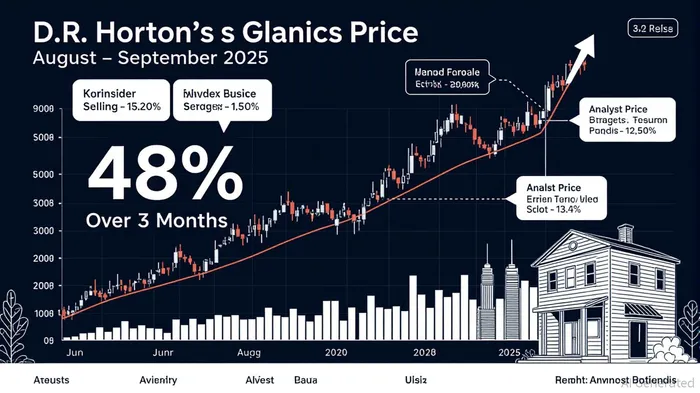
The recent insider selling activity at D.R. HortonDHI--, Inc. (DHI) has sparked debate among investors and analysts, offering a compelling case study in behavioral finance and market sentiment. While the stock has surged 48% over the past three months—outperforming both its industry and the S&P 500—executives and directors have divested significant shares. This divergence between insider actions and market performance raises critical questions about investor psychology, information asymmetry, and the interplay of short-term sentiment with long-term fundamentals.
Insider Transactions: Signals or Noise?
In August and September 2025, several high-ranking insiders at D.R. Horton executed notable transactions. On August 13, SVP and Controller Aron Odom sold 1,233 shares at $166.20 per share, while COO Michael Murray gifted 5,500 shares on August 27. Executive Chairman David Auld further reduced his stake by 30,000 shares on September 5, fetching an average of $182.21 per share[1]. These sales, though legal and often motivated by personal financial planning, can signal mixed messages to the market.
Behavioral finance literature suggests that insider selling is not inherently bearish. A 2025 Virginia Tech study reveals that insiders often time their trades around spikes in investor attention, capitalizing on heightened retail demand[2]. For instance, Odom's sale on August 13 occurred as DHI's stock approached a three-month high of $165.55, a period marked by rising analyst optimismOP-- and improved housing sector sentiment[3]. Similarly, Auld's September 5 sale coincided with a rally driven by falling 10-year Treasury yields, which typically boost homebuilder stocks[4]. These transactions may reflect strategic harvesting of gains rather than pessimism about the company's prospects.
Market Sentiment: Optimism vs. Caution
Despite insider sales, DHI's stock has shown remarkable resilience. Analysts have upgraded price targets, with Wells FargoWFC-- raising its target to $190—a 13% upside from the September 5 closing price of $168.21[5]. The stock's forward P/E ratio of 15.1x, above the industry average, underscores investor confidence in D.R. Horton's scale and operational efficiency[6]. However, this optimism is tempered by near-term challenges.
The housing market remains a double-edged sword. While D.R. Horton's robust backlog and strong cash flow position it to weather affordability headwinds, analysts warn of elevated incentives and rising material costs eroding margins[7]. A 2025 study on investor sentiment highlights that firm-level optimism (driven by DHI's fundamentals) often clashes with broader market-level pessimism during economic uncertainty[8]. For example, late September saw a 3.9% drop in DHI's shares amid revised employment data and comments from JPMorganJPM-- CEO Jamie Dimon, illustrating how macroeconomic fears can overshadow company-specific strength[9].
Behavioral Finance in Action
The tension between insider selling and strong stock performance aligns with behavioral finance principles. A 2007 paper on investor sentiment notes that stocks with limited arbitrage opportunities—such as those in cyclical sectors like housing—are particularly susceptible to sentiment-driven price swings[10]. DHI's case exemplifies this: its 48% rally reflects not just earnings growth but also speculative bets on a housing market rebound.
Moreover, the Virginia Tech study's findings on “lottery-type” stocks—low-priced, high-volatility shares—add nuance. While DHIDHI-- is not a speculative stock, its recent performance has attracted retail investors chasing momentum, creating a feedback loop where insider sales (perceived as signals) could amplify volatility[11]. This dynamic is further complicated by institutional activity. AQR Capital Management's recent stake in DHI suggests institutional confidence, yet declining trading volume on rising prices hints at potential short-term instability[12].
Implications for Investors
For long-term investors, D.R. Horton's insider sales should be viewed in context. The company's geographic diversification, efficient capital management, and focus on affordable housing position it to benefit from a modest 2026 earnings rebound[13]. However, behavioral biases—such as overreacting to insider sales or underestimating macroeconomic risks—could create short-term volatility.
Short-term traders, meanwhile, must navigate conflicting signals. While technical indicators like moving averages suggest a bullish trend, the mixed analyst ratings (average “Hold” with a $154.38 price target) reflect caution[14]. The key lies in distinguishing between sentiment-driven noise and fundamental value.
Conclusion
D.R. Horton's insider selling activity underscores the complexity of market dynamics in a behavioral finance framework. While these transactions may raise eyebrows, they are best understood as part of a broader narrative of investor psychology, macroeconomic uncertainty, and strategic capital management. For investors, the challenge lies in balancing short-term sentiment with long-term fundamentals—a task that requires both analytical rigor and behavioral awareness.





Comentarios
Aún no hay comentarios