
Insider Debt Resolution and Investor Confidence: How Alaska Energy Metals' Share Issuance Reinforces Governance and Shareholder Value
In the volatile world of energy metals, where geopolitical tensions and environmental scrutiny collide, corporate governance and investor confidence are not just buzzwords-they are lifelines. For Alaska Energy Metals Corporation (AEMC), the resolution of insider debt through strategic share issuance in 2025 has emerged as a case study in aligning governance with shareholder value. By leveraging equity to settle obligations, the company has not only navigated financial challenges but also signaled a commitment to transparency and long-termism-a rare combination in a sector often plagued by short-termism and regulatory uncertainty.
The Mechanics of Debt Resolution and Governance
AEMC's approach to debt resolution in 2025 has been methodical. In October, the company settled $95,200 in insider debt by issuing 952,000 common shares at $0.10 per share, a transaction classified as a related-party deal under Multilateral Instrument 61-101, according to a Morningstar report. A Yahoo Finance update cites a study on Chinese A-share firms that found insider debt-when structured to align executive interests with long-term corporate performance-can enhance ESG (Environmental, Social, and Governance) behavior and reinforce conservative decision-making (a Yahoo Finance update). By converting debt into equity, AEMC has effectively diluted short-term gains for insiders, incentivizing them to focus on sustainable growth.
The company's broader capital-raising efforts further underscore this strategy. During Q3 2025, AEMC issued 2.25 million shares under its at-the-market (ATM) program, raising $203,852.50 to fund metallurgical studies and mine development analysis, as reported by Morningstar. These proceeds, coupled with debt settlements, demonstrate a disciplined approach to capital allocation. As Morningstar stated, such actions "reflect strong investor confidence in AEMC's ability to manage financial obligations while advancing strategic objectives."
Investor Confidence: A Delicate Balancing Act
The market's reaction to AEMC's share issuance has been mixed but telling. On October 9, 2025, the stock closed at $0.0905, a 7.74% increase from the previous day, following the announcement of a $1 million private placement and a $599,408.70 debt settlement via 5.99 million shares in the Sahm Capital announcement. Analysts at StockInvest note that while the Golden Star Signal-a technical indicator-suggests positive momentum, the stock's volatility and volume divergence hint at lingering skepticism; this duality captures the essence of investor psychology: optimism about the company's project advancements (notably the Nikolai Project's five-fold increase in nickel resources in 2024, as noted in the Yahoo Finance update) is tempered by concerns over dilution and liquidity.
Yet, AEMC's governance framework appears to mitigate these risks. The company's emphasis on ESG principles-such as responsible resource development and alignment with national security goals-resonates with a growing cohort of investors prioritizing sustainability. The Yahoo Finance update highlights AEMC's pursuit of U.S. government grants under the Defense Production Act, underscoring strategic alignment with energy transition priorities that could bolster its ESG profile and attract institutional capital.
The Bigger Picture: Governance as a Strategic Tool
The resolution of insider debt is more than a compliance exercise-it is a governance tool. By converting debt into equity, AEMC has reduced the risk of conflicts of interest and demonstrated a commitment to transparency. This aligns with debt signaling theory, which posits that companies using equity to fund operations or settle obligations can signal confidence in future cash flows. For instance, Apple's 2013 debt issuance was perceived as a vote of confidence in its long-term prospects. Similarly, AEMC's share-based debt resolution suggests a belief in the Nikolai Project's potential to deliver value, even as it navigates the inherent risks of the energy metals sector.
However, the company's reliance on frequent share issuances raises questions. While the October 2025 private placement and ATM program provided necessary liquidity, excessive dilution could erode shareholder value over time. The key will be whether AEMC can convert its nickel, copper, and cobalt resources into tangible revenue streams, thereby justifying the equity it has issued.
Conclusion: A Test of Resilience
Alaska Energy Metals' 2025 debt resolution strategy exemplifies the delicate balance between governance, capital management, and investor trust. By aligning insider interests with long-term goals and leveraging ESG principles, the company has positioned itself as a case study in resilience. Yet, the road ahead remains fraught. As the energy metals sector grapples with geopolitical headwinds and environmental scrutiny, AEMC's ability to translate its nickel-rich deposits into sustainable profits will ultimately determine whether its governance-driven approach pays dividends.
For now, the market watches closely. The stock's recent volatility and the mixed analyst outlook suggest that investor confidence is still a work in progress. But in a world where governance and ESG are no longer optional, AEMC's actions have laid a foundation-one that, if built upon wisely, could attract the long-term capital it needs to thrive.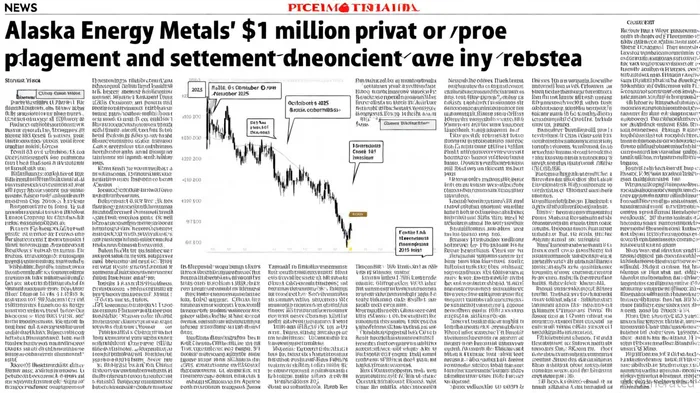







Comentarios
Aún no hay comentarios