
Inseego (INSG): Is the Collapse in Revenue and Share Price a Buying Opportunity or a Deepening Crisis?
Revenue Trends and Analyst Forecasts: A Mixed Picture
Inseego's Q3 2025 results revealed a glimmer of hope. Revenue surged to $45.9 million, a 14% sequential increase, with adjusted EBITDA reaching $5.8 million-a 22% jump from Q2 according to financial reports. This marks the second consecutive quarter of growth, driven by strong demand for its Fixed Wireless Access (FWA) solutions, particularly the FX4100 device for T-Mobile. Analysts have raised their price target for INSGINSG-- to $14.63 from $13.13, citing improved profit margins and new partnerships. The company's net profit margin forecast has also improved to 8.73%, up from 7.94%, while revenue growth projections remain steady at 5.95%.
However, these positives are tempered by caution. The Q3 earnings call revealed a 2.5% post-earnings stock dip, despite strong results, suggesting investor skepticism. The CFO acknowledged rising non-GAAP operating expenses due to product investments and a higher proportion of mobile hotspot revenue, which could pressure margins in the future according to earnings call transcripts. Moreover, Q4 guidance excludes potential impacts from the evolving tariff environment, a wildcard that could disrupt supply chains or pricing strategies as disclosed in the earnings call.
Strategic Initiatives: A 5G-Driven Turnaround?
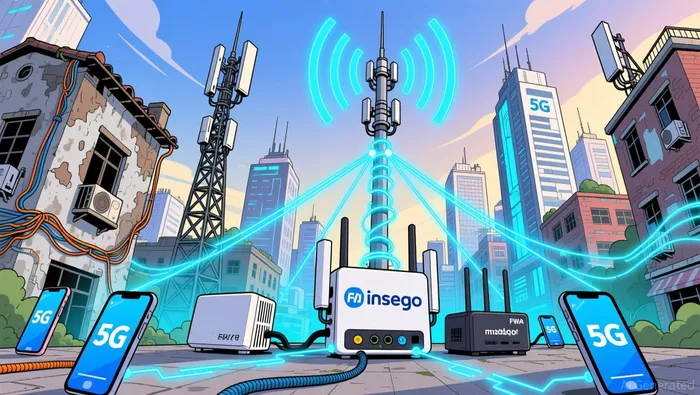
Inseego's recent product launches and partnerships offer a compelling narrative for growth. The FX4200 enterprise FWA solution and the Inseego Connect software suite are designed to expand into larger enterprises and Managed Service Providers (MSPs), opening new revenue channels. The company has also secured a new Tier-1 U.S. carrier customer, with FWA shipments expected in Q4 2025 as reported in the financial release. These moves align with the broader 5G market's trajectory, where demand for FWA is projected to grow as carriers seek cost-effective broadband alternatives.
Yet, competition remains fierce. Ericsson, a 5G infrastructure leader, trades at a P/S ratio of 1.04x (https://eqvista.com/price-to-sales-ratio-by-industry/), while Qualcomm commands a premium at 4.28x (https://eqvista.com/price-to-sales-ratio-by-industry/). Inseego's P/S ratio, though favorable compared to peers, lags behind the Communication Services sector average of 3.24x (https://eqvista.com/price-to-sales-ratio-by-industry/). This suggests that while the company is undervalued relative to its immediate peers, it still faces an uphill battle to justify a multiple closer to industry benchmarks.
Risks and Long-Term Viability: A Cautionary Tale?
Despite the recent momentum, Inseego's long-term prospects remain uncertain. A discounted cash flow (DCF) model estimates its fair value at $10.96 per share, significantly below its current price of $14.30–$15.97. This implies a potential overvaluation of 30% or more, contradicting the bullish narrative. Stifel analysts have maintained a "Hold" rating, emphasizing the need for clarity on sustainable revenue and free cash flow growth.
The company's financial health also raises red flags. While its default probability has improved from 23.795 in December 2022 to 2.546 in November 2025, it remains unprofitable over the last twelve months. Intense competition in the FWA and mobile broadband markets, coupled with economic uncertainties and supply chain risks, could further strain its margins as noted in market analysis. Additionally, insider buying-though a positive sign-has totaled $1.4 million without any insider sales, which may reflect confidence but does not guarantee long-term success.
Investor Sentiment: Contrarian Opportunity or Overlooked Weakness?
The market's mixed reaction to Inseego's Q3 results underscores the tug-of-war between optimism and caution. On one hand, the company's sequential revenue growth, margin expansion, and strategic product launches suggest a credible turnaround. On the other, the stock's post-earnings decline and the DCF model's bearish valuation highlight lingering doubts.
For contrarian investors, the current P/S ratio of 1x-well below its estimated fair value of 1.5x-presents an attractive entry point, particularly if Inseego can sustain its Q3 momentum. However, this bet hinges on the company's ability to execute its 5G strategy, navigate supply chain risks, and differentiate itself in a crowded market.
Conclusion: A Calculated Bet
Inseego's depressed P/S ratio reflects a valuation that is undervalued relative to both its peers and the broader industry. Its recent revenue growth, strategic product launches, and expanding carrier partnerships offer a plausible path to 5G-driven recovery. Yet, the risks-ranging from margin pressures to competitive headwinds-cannot be ignored. For long-term investors, the key question is whether Inseego can translate its current momentum into sustainable profitability. If it can, the stock's current valuation may represent a compelling opportunity. If not, it could remain a cautionary tale of overhyped potential.







Comentarios
Aún no hay comentarios