
Innovator's Quarterly Outcome ETFs: A Strategic Hedge for QQQ and SPY in a Volatile Market
In 2025, the U.S. equity market faced unprecedented volatility driven by trade policy shifts, inflationary pressures, and AI-driven sectoral adjustments. The Invesco QQQ TrustQQQ-- (QQQ), tracking the Nasdaq-100, and the SPDR S&P 500 ETF Trust (SPY), mirroring the broader S&P 500, exhibited divergent performance patterns. QQQQQQ--, with its heavy concentration in technology stocks, demonstrated higher volatility- its beta of 1.15 and 30-day realized volatility of 18.7% outpaced SPY's beta of 1.0 and volatility of 15.2%. This divergence underscores the need for structured strategies to hedge directional risks, particularly in an environment marked by rapid macroeconomic shifts and geopolitical uncertainty.
QQQ and SPY: Divergent Volatility Profiles
QQQ's exposure to high-growth, tech-centric sectors made it both a beneficiary of innovation-driven trends and a casualty of sector-specific headwinds. For instance, during April 2025, QQQ plummeted 4.4% following President Trump's tariff announcements but rebounded 50% from its lows by year-end. SPYSPY--, by contrast, offered a more stable return profile, with a year-to-date gain of 17% from its April lows. However, SPY's broad-based exposure also left it vulnerable to systemic risks, such as the 19% decline in February 2025 amid aggressive tariff speculation.
These contrasting dynamics highlight the limitations of traditional ETFs in managing dual-directional volatility. While QQQ and SPY provide market exposure, they lack built-in mechanisms to cap downside risk or lock in upside potential during turbulent periods. This is where Innovator's Quarterly Outcome ETFs emerge as a compelling solution.
Innovator's Dual-Directional Strategy: Structured Outcomes for Uncertain Markets
Innovator's Dual Directional ETFs, such as the Innovator Equity Dual Directional 5 Buffer ETF™ (DDSQ) and Innovator Growth-100 Dual Directional 5 Buffer ETF™ (DDNQ), are designed to address these gaps. These funds employ a defined outcome structure, offering investors a transparent framework with predefined upside caps and downside buffers over 3-month periods. For example, DDSQ provides a 3.34% upside cap and a 5% buffer against losses, while DDNQ offers a 4.69% cap and a 5% buffer according to product documentation.
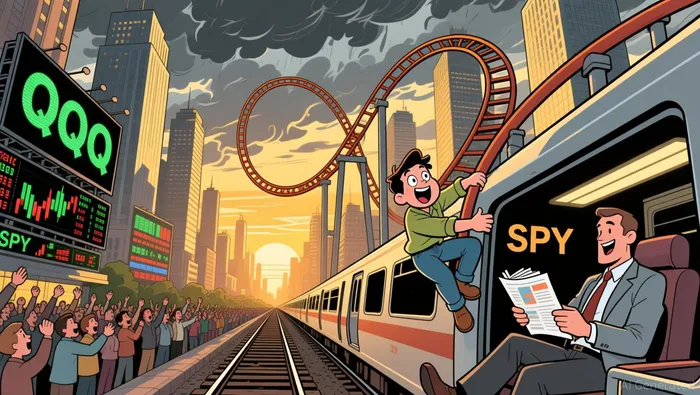
This structure is particularly effective in high-uncertainty environments. During the April 2025 market turmoil, when the S&P 500 dropped 12% in a single week, Innovator's Innovator Equity Dual Directional 15 Buffer ETF™ (DDFJ)-with a 15% buffer and 1-year outcome period- would have mitigated losses for investors. By contrast, traditional volatility ETFs like VXX and VIXY, which track the VIX index, lost over 41% year-to-date as market sentiment stabilized.
Hedging Effectiveness: A Quantitative Perspective
The strategic value of Innovator's ETFs lies in their ability to balance risk and reward. During the 2025 tariff-driven selloff, QQQ's max drawdown of -23% and SPY's -19% decline underscored the need for downside protection. Innovator's Dual Directional ETFs, with their buffer zones, would have limited losses to predefined thresholds. For instance, a 5% buffer in DDSQ would have capped losses at 5% during a 10% market decline, while a 15% buffer in DDFJ would have provided even greater protection as product documentation indicates.
Moreover, these ETFs offer adaptability through their quarterly outcome periods. Unlike traditional buffered ETFs, which often have annual or semi-annual reset cycles, Innovator's funds recalibrate every three months, reducing timing risk and aligning with shorter-term market cycles. This feature proved critical in 2025, where rapid policy shifts-such as the 90-day tariff pause-triggered sharp market reversals.
Strategic Implications for Investors
Innovator's ETFs are not a replacement for QQQ or SPY but a complementary tool to optimize returns in volatile environments. For investors seeking exposure to growth sectors (via QQQ) or broad-market stability (via SPY), these structured products provide a layer of risk management without sacrificing upside potential. For example, pairing QQQ with DDNQ allows investors to participate in tech-sector gains while capping losses during downturns. Similarly, SPY paired with DDSQ offers a balanced approach to large-cap equity exposure.
Critically, Innovator's ETFs outperform traditional volatility ETFs like VXX and VIXY in hedging effectiveness. While VXX and VIXY rely on futures exposure to track the VIX index, their performance is inversely correlated to market sentiment and often decays over time. Innovator's structured outcomes, by contrast, offer predictable downside protection and defined upside participation, making them more reliable in prolonged volatility.
Conclusion
As 2025 demonstrated, market uncertainty is inevitable, but strategic instruments like Innovator's Quarterly Outcome ETFs can transform volatility into an opportunity. By combining directional exposure with structured risk management, these funds address the limitations of traditional ETFs and volatility-linked products. For investors navigating a landscape of trade wars, AI-driven sectoral shifts, and macroeconomic headwinds, Innovator's Dual Directional ETFs represent a robust solution to optimize returns and preserve capital.







Comentarios
Aún no hay comentarios