
Inmarsat NexusWave's 1,000-Vessel Milestone: A Beacon of Maritime Digitalization Dominance
The maritime industry is undergoing a silent revolution. From cargo ships to fishing trawlers, vessels are transforming into floating hubs of connectivity, driven by the urgent need for real-time data, crew welfare, and regulatory compliance. At the heart of this shift is Viasat's Inmarsat NexusWave, a maritime connectivity service that recently surpassed 1,000 vessel orders within its first six months—a milestone signaling its ascendance as the gold standard for high-speed, reliable maritime networks. For investors, this is more than a data point; it's a harbinger of scalable recurring revenue and a strategic moat against rivals in the fragmented $5 billion maritime satellite market.
The Technology: Network-Bonding as a Game-Changer
NexusWave's proprietary network-bonding technology is its crown jewel. Unlike competitors that rely on a single network (e.g., LEO satellites), NexusWave dynamically stitches together multiple networks—Global Xpress Ka-band, LEO satellites, coastal LTE, and L-band—to create a seamless, always-on connection. This hybrid approach delivers up to 340 Mbps download speeds and 99.9% uptime, outperforming LEO-only solutions that face latency and coverage gaps in polar regions or dense urban ports.
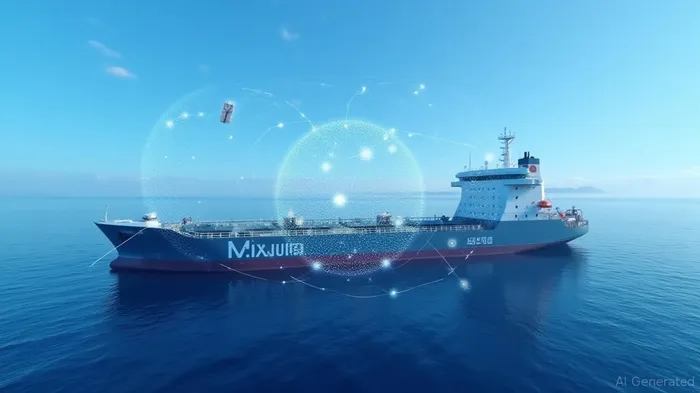
The implications are clear: for shipping firms, this means no more dropped calls during stormy crossings or sluggish data transfers in port. For ViasatVSAT--, it means a defensive position against rivals like Iridium or SES, which lack NexusWave's multi-network agility. The service's unlimited data, global coverage, and enterprise-grade cybersecurity further cement its value proposition, especially as regulators worldwide mandate real-time data transmission for fisheries monitoring (e.g., EU's EMIS system) or emissions tracking.
The Adoption Surge: Proof of Demand
The 1,000-vessel milestone isn't a fluke. Major shipping giants—including “K” Line, Mitsui O.S.K. Lines, and the PP Group—have embraced NexusWave for its ability to future-proof their fleets. Take the PP Group: it's installing NexusWave on 12 trawlers to meet Scottish fisheries regulations requiring real-time CCTV data transmission starting 2026. Meanwhile, Mitsui O.S.K. is transitioning its fleet from legacy systems like Fleet Xpress to NexusWave, citing its 30% lower latency and 50% higher throughput for digital supply chain tools.
This adoption isn't just about speed. NexusWave's secure-by-design infrastructure—with segregated networks for crew and business operations—addresses a critical pain point for insurers and regulators. In an era where ransomware attacks on ships surged by 200% in 2024, this separation of data streams reduces risk exposure.
The Investment Case: Recurring Revenue & Margin Superiority
For investors, NexusWave's traction translates to sticky, high-margin recurring revenue. Unlike hardware sales, connectivity services generate annuity-like cash flows, with customers paying monthly fees for unlimited data. With a 1,000-vessel base already secured, and a pipeline targeting another 500+ ships by mid-2026, Viasat's maritime division is poised to become a cash-flow engine.
Moreover, NexusWave's capital-light model leverages Viasat's existing satellite infrastructure, minimizing upfront costs. The ViaSat-3 Ka-band network, set for integration in 2026, will boost speeds further, creating a moat against LEO-only competitors that can't match its hybrid coverage.
Risks & Considerations
Critics may cite risks like satellite lifespan (Viasat's Ka-band satellites have a 15-year lifespan) or regulatory headwinds. However, Viasat's $2.8 billion acquisition of Inmarsat in 2023—which combined its Ka-band strengths with Inmarsat's L-band resilience—has already mitigated these risks. The deal also gives Viasat 40+ ground stations and spectrum licenses, ensuring redundancy and scalability.
Conclusion: A Compelling Tech Infrastructure Play
NexusWave's 1,000-vessel milestone isn't just a technical feat—it's a strategic masterstroke. By solving the maritime sector's twin challenges of reliability and security, Viasat has positioned itself as the go-to partner for digitalization. With adoption accelerating and a $20 billion addressable market, investors should view VSAT as a core holding for tech-infrastructure growth.
Recommendation: Viasat's stock currently trades at 15x EV/forward revenue, below its 5-year average of 18x, offering a margin of safety. Investors seeking exposure to high-margin recurring revenue and defensive tech infrastructure should initiate a position ahead of its Q3 2025 earnings, where NexusWave's adoption metrics will likely shine.
The seas are changing—Viasat is the tide.





Comentarios
Aún no hay comentarios