
Why Value and Infrastructure Are Winning in 2025: The Case of Caterpillar and Institutional Gains
In 2025, a seismic shift is reshaping global markets as investors recalibrate their strategies amid AI-driven volatility and geopolitical uncertainty. While speculative fervor around megacap tech stocks has waned, stable, non-tech sectors-particularly infrastructure-are emerging as unexpected winners. Caterpillar Inc.CAT--, a bellwether of industrial resilience, exemplifies this trend. Its performance and institutional backing underscore a broader re-evaluation of value stocks and tangible assets in a market increasingly wary of overhyped AI narratives.
Caterpillar's Resilience Amid AI-Driven Volatility
Caterpillar's third-quarter 2025 results highlight its dual role as a traditional industrial player and a critical enabler of AI infrastructure. The company reported a 10% year-over-year revenue increase, reaching $17.6 billion, driven by robust equipment sales to end users. Despite a slight decline in profit per share ($4.88) and adjusted profit per share ($4.95), CaterpillarCAT-- generated $3.7 billion in operating cash flow and deployed $1.1 billion to shareholders through dividends and buybacks.
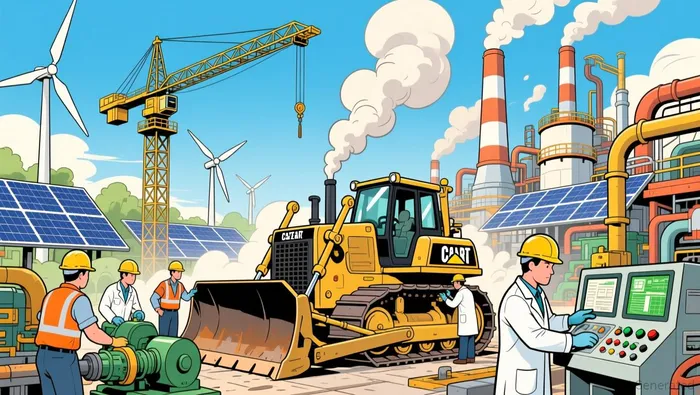 However, challenges persist. Tariffs imposed on its supply chains are estimated to cost the company $1.6 billion to $1.75 billion annually. This fiscal drag contrasts with its strategic advantages: a record $39.8 billion backlog and a growing Energy & Transportation segment, which is capitalizing on power generation demand from data centers and cloud computing. Caterpillar's gas turbines, for instance, are now integral to powering AI infrastructure, positioning it at the intersection of traditional and digital industrial ecosystems.
Institutional Confidence in Infrastructure's Long-Term Value
Institutional investors have taken notice. In Q3 2025, Financial Enhancement Group LLC increased its Caterpillar holdingsCAT-- by 925.9%, while Wellington Management Group and Price T Rowe Associates added 3.9 million and 4.96 million shares, respectively. These moves reflect a broader reallocation of capital toward sectors perceived as less speculative and more aligned with real-world demand.
This trend is not isolated to Caterpillar. Infrastructure sectors-particularly power generation, transportation, and construction-are attracting institutional capital as investors seek stability amid AI-driven market swings. According to a report by CBRE, infrastructure assets are increasingly viewed as "defensive" investments, offering predictable cash flows and insulation from the volatility of tech-centric portfolios. This shift is further amplified by the energy transition, with data centers consuming 15% more electricity annually-a demand Caterpillar is uniquely positioned to meet.
The Broader Market Rebalancing
The 2025 market environment has been defined by a rotation away from Big Tech and toward value stocks. As AI ROI skepticism grows, investors are favoring companies with tangible assets and diversified revenue streams. Caterpillar's recent 9.6% stock decline in a five-day period-its worst since April 2025-illustrates the sector's vulnerability to AI-driven market corrections. Yet, its fundamentals remain strong: a 17.5% adjusted operating profit margin in Q3 and a strategic pivot toward automation and digital services.
This rebalancing is also fueled by macroeconomic factors. The Federal Reserve's monetary policy and geopolitical tensions have heightened demand for assets with intrinsic value. Infrastructure, with its role in reshoring and supply chain resilience, fits this narrative. As noted in a BlackRock analysis, "Infrastructure's ability to generate long-term, stable returns makes it a compelling counterweight to the cyclicality of AI-driven sectors" according to BlackRock.
Conclusion: A New Paradigm for 2025 Investors
Caterpillar's trajectory in 2025 encapsulates a larger market truth: stability and industrial ingenuity are winning in an era of AI-driven uncertainty. While the company faces near-term headwinds from tariffs and market volatility, its institutional backing and strategic alignment with energy and AI infrastructure suggest a durable investment thesis. For investors, the lesson is clear: in a world where speculative bets falter, value and infrastructure-rooted in real-world demand-offer a path to resilience.





Comentarios
Aún no hay comentarios