
Infrastructure Risks in Emerging Markets: A Wake-Up Call from the Hongqi Bridge Collapse
Engineering Oversights and Geological Vulnerabilities
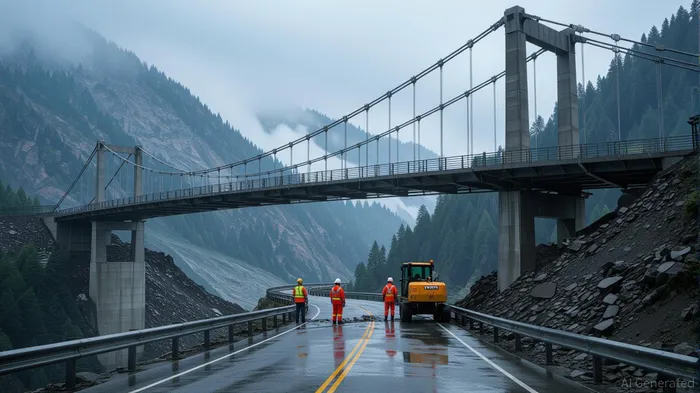
The Hongqi Bridge, part of a national highway linking Sichuan with Tibet, was touted as an engineering milestone by its state-owned contractor, Sichuan Road & Bridge Group, according to a IBTimes report. However, its collapse into a river following a landslide highlights the risks of constructing infrastructure in geologically unstable zones. Preliminary investigations point to geological instability exacerbated by heavy rains and the region's volatile terrain as the primary cause, per the IBTimes report. While the bridge was designed to withstand earthquakes up to magnitude 8.0, its failure to account for long-term slope deformation and sedimentation from nearby hydropower projects reveals critical gaps in risk assessment.
Experts have criticized the prioritization of speed over safety in such projects, noting recurring issues like rushed timelines, insufficient geotechnical surveys, and inadequate oversight in mountainous regions, as noted in the IBTimes report. The bridge's proximity to the Shuangjiangkou Hydropower Station, for instance, may have introduced environmental stressors such as fluctuating water levels and sedimentation, which were not fully integrated into the design phase, according to the IBTimes report. These oversights underscore the need for adaptive engineering strategies that account for climate change and evolving environmental conditions.
Regulatory Scrutiny and Policy Gaps
The incident has reignited calls for stricter safety inspections and transparency in public works projects. Despite emergency closures and monitoring efforts, the collapse occurred after visible signs of instability, including cracks and ground shifts, were detected, as the IBTimes report notes. While no regulatory changes have been explicitly announced post-collapse, the event is likely to prompt renewed scrutiny of infrastructure projects.
China's recent policy shifts in the energy sector-such as encouraging private investment in hydropower and integrating AI for operational efficiency-suggest a broader push for innovation and oversight, according to a Hellenic Shipping News article. However, these reforms are not directly tied to infrastructure safety. The lack of immediate regulatory action following the Hongqi Bridge collapse indicates a potential gap between policy rhetoric and on-the-ground implementation, leaving investors exposed to unforeseen risks.
Market Reactions and Investor Sentiment
Public sentiment in China has turned skeptical, with social media users questioning the rapid development model and its trade-offs between speed and safety, according to the IBTimes report. This skepticism could translate into heightened scrutiny from international investors, who are increasingly prioritizing environmental, social, and governance (ESG) criteria. While no direct market data on equity or debt performance is available post-collapse, historical precedents suggest that such incidents often lead to increased borrowing costs and reduced investor appetite for high-risk infrastructure projects.
For example, the collapse of the 2019 Xiaoyan Bridge in Guangdong province led to a temporary decline in the stock prices of related construction firms, reflecting market concerns over safety and regulatory compliance, as noted in the IBTimes report. Similarly, the Hongqi Bridge incident may amplify risk premiums for infrastructure debt, particularly in regions with high geological vulnerability.
Implications for Infrastructure Investments
The Hongqi Bridge collapse serves as a cautionary tale for investors in emerging markets. Key implications include:
1. Higher Compliance Costs: Stricter safety regulations and enhanced monitoring systems may increase project costs and timelines.
2. Reputational Risks: Projects in geologically unstable regions could face reputational damage, deterring private capital.
3. Climate Resilience Demands: Investors must prioritize projects with adaptive designs that account for climate-driven risks like landslides and sedimentation.
For equity investors, firms with robust geotechnical expertise and AI-driven monitoring systems may gain a competitive edge. Debt investors, meanwhile, should scrutinize project-specific risk assessments and insurance coverage.
Conclusion
The Hongqi Bridge collapse is not an isolated incident but a symptom of systemic challenges in balancing rapid infrastructure development with long-term resilience. While China's infrastructure sector remains a critical driver of economic growth, investors must adopt a more nuanced approach to risk assessment. The incident underscores the importance of integrating geological, regulatory, and climate factors into investment decisions-a lesson that extends far beyond China's borders.







Comentarios
Aún no hay comentarios