
Infrastructure Risk and Resilience in Emerging Markets: Lessons from China's Hongqi Bridge Collapse
The Hongqi Bridge Collapse: A Case Study in Geotechnical Vulnerability
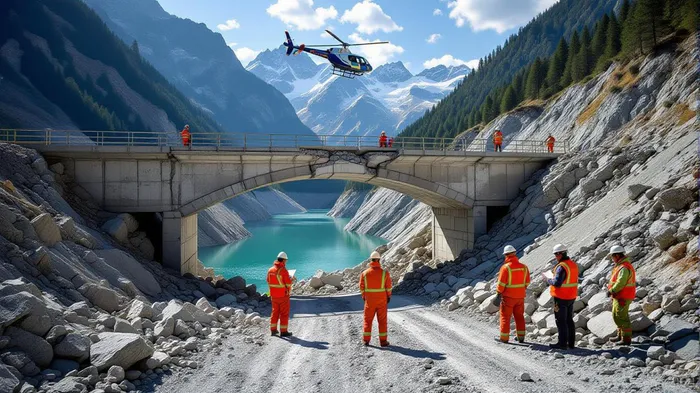
The Hongqi Bridge, part of a critical transportation corridor linking Sichuan and Tibet, partially collapsed after local authorities had already closed it the day prior due to visible cracks and terrain shifts, according to a DevDiscourse report. DevDiscourse report investigations revealed that the bridge's location-adjacent to a landslide-prone mountainside and near the Shuangjiangkou Hydropower Station reservoir-introduced compounding risks, including fluctuating water levels and sedimentation, as reported by Hindustan Times. Hindustan Times report According to a 2024 peer-reviewed study by Dina Tang and Minshui Huang of Wuhan Institute of Technology, recurring vulnerabilities in Chinese infrastructure projects include rushed timelines, inadequate slope analysis, and insufficient geotechnical surveys, particularly in mountainous regions, as noted in an IBTimes analysis. IBTimes analysis
The collapse highlights a systemic issue: in many emerging markets, infrastructure development prioritizes speed and cost-efficiency over long-term resilience. This is exacerbated by weak regulatory enforcement and opaque oversight mechanisms, which investors must now scrutinize more rigorously.
Revisiting Due Diligence: From Technical Audits to Geopolitical Risk
The Hongqi Bridge incident aligns with broader global trends. The 2024 collapse of Baltimore's Key Bridge, attributed to a failure in vulnerability assessments by the Maryland Transportation Authority, illustrates how systemic gaps in risk management can lead to catastrophic outcomes, as detailed in a CBS News report. CBS News report Similarly, the FTX cryptocurrency collapse in 2022 demonstrated the consequences of inadequate transparency and governance, prompting the industry to adopt proof-of-reserve audits, as noted in a CoinTelegraph article. CoinTelegraph article These cases collectively underscore the need for a multidimensional approach to due diligence in infrastructure investments.
For emerging markets, where regulatory frameworks often lag behind project ambitions, due diligence must extend beyond technical assessments. Investors must evaluate geopolitical risks, stakeholder engagement strategies, and the long-term sustainability of projects. Legal and General's (L&G) recent $235 million Nature and Social Outcomes strategy, which targets sustainable infrastructure in emerging markets, exemplifies this shift. The firm's focus on projects with clear environmental and social returns-such as clean water access and biodiversity conservation-reflects a growing emphasis on resilience over short-term gains, as reported by ESG Today. ESG Today report
Policy Gaps and the Path Forward
While China has yet to announce specific policy changes post-Hongqi, the incident has intensified calls for stricter geotechnical standards and accountability measures. Experts argue that infrastructure projects in geologically complex regions require continuous monitoring, adaptive design standards, and transparent reporting mechanisms, as noted in a PRIS Media report. PRIS Media report In parallel, global investors are adopting more stringent risk assessment methodologies. For instance, Coinbase's abandoned $2 billion acquisition of stablecoin startup BVNK during due diligence highlights the financial and regulatory risks inherent in high-stakes infrastructure and technology investments, as reported by Coinotag. Coinotag report
The lessons from Hongqi and similar disasters are clear: infrastructure resilience in emerging markets hinges on proactive risk management. This includes integrating advanced geotechnical surveys, enforcing construction timelines that allow for thorough safety checks, and fostering collaboration between governments, engineers, and investors.
Conclusion
The Hongqi Bridge collapse is not an isolated event but a symptom of broader challenges in emerging market infrastructure. As investors pour capital into these projects, the onus is on them to demand rigorous due diligence that accounts for both technical and geopolitical risks. The future of sustainable development in these regions depends on learning from past failures-and ensuring that speed never eclipses safety.







Comentarios
Aún no hay comentarios