
Infrastructure Risk in Emerging Markets: Geopolitical and Engineering Vulnerabilities in China's Projects
Engineering and Geopolitical Vulnerabilities
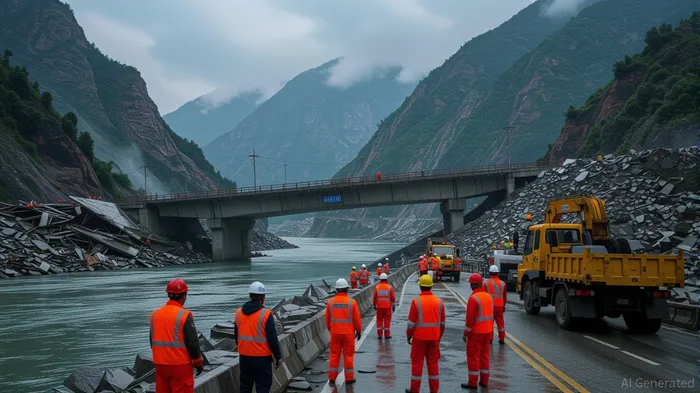
The Hongqi Bridge collapse highlights the interplay between natural and human-made risks. According to a DevDiscourse report, the bridge's failure was attributed to a combination of unstable terrain, inadequate , and potential , as reported in a DevDiscourse video. Sichuan's mountainous topography, prone to landslides and seismic activity, presents inherent challenges for infrastructure projects. Yet, , raising questions about the rigor of pre-construction evaluations.
Geopolitically, China's infrastructure projects-particularly those in border regions like Tibet-are not just economic endeavors but also . The Hongqi Bridge, part of a corridor linking China's interior to Tibet, symbolizes the country's push to strengthen regional integration and resource access. However, such projects often face heightened scrutiny due to their location in or politically contested areas. The collapse has reignited debates about whether cost-cutting measures or political expediency have compromised safety standards, as noted in a KWM report.
Financial Risks and Investor Sentiment
The incident has sent ripples through financial markets. Infrastructure projects in China are typically state-backed, but high-profile failures like the Hongqi Bridge collapse could erode investor confidence. According to a Bloomberg article, regulatory bodies have already begun tightening rules for (SOEs) in the sector, imposing stricter criteria for overseas to mitigate local government debt risks, as noted in a Bloomberg report. These measures, while aimed at long-term stability, may increase short-term costs for developers and delay project timelines.
Investor sentiment has also been influenced by global parallels. The 2024 collapse of the Francis Scott Key Bridge in Baltimore, , as reported in a CBS News article, has created a shared narrative of systemic risk. In China, similar concerns are emerging. Private investors, who are increasingly entering energy and transportation projects, may now demand more rigorous on geological and engineering risks. This could lead to higher capital costs and reduced returns, particularly for projects in high-risk regions.
Regulatory Implications and Market Adjustments
In response to the 2025 bridge incidents, China introduced the Measures for the Supervision and Administration of in July 2025, jointly issued by the People's Bank of China (PBOC) and the China Securities Regulatory Commission (CSRC), as reported in a Business Times article. These measures mandate enhanced risk management for Financial Market Infrastructures (FMIs), including stricter reporting requirements for offshore FMIs operating in China. While the rules primarily target financial systems, their emphasis on signals a broader regulatory shift toward infrastructure projects.
For equities, this means increased scrutiny of firms involved in design, construction, and financing. Companies with strong safety records and may gain a competitive edge, while those reliant on cost-driven models could face . Debt instruments, particularly bonds tied to high-risk projects, may see wider spreads as investors demand higher .
Conclusion: A Call for Prudent Investment
The Hongqi Bridge collapse is a stark reminder that infrastructure development in emerging markets is fraught with both technical and geopolitical challenges. For investors, the key takeaway is the need for a nuanced approach that balances growth potential with risk mitigation. Regulatory reforms in China, while welcome, must be paired with robust engineering standards and transparent governance to restore confidence. As the global economy becomes increasingly interconnected, the lessons from Sichuan and Baltimore will shape how capital flows into infrastructure-a sector that remains critical to the development of emerging markets.







Comentarios
Aún no hay comentarios