
Infrastructure Resilience and Safety Risks in Emerging Markets: Evaluating Construction Standards and Investment Implications After the Hongqi Bridge Collapse in China
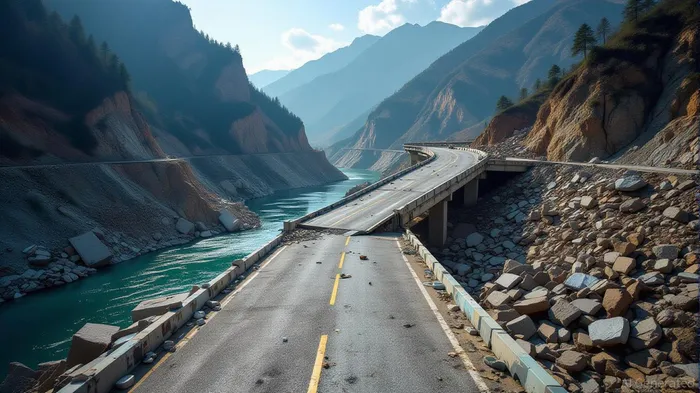
The Fragile Balance of Speed and Safety
Emerging markets, particularly those with mountainous terrain, face a paradox: the need to accelerate infrastructure development to fuel economic growth clashes with the realities of geological vulnerability. A 2025 study on infrastructure sustainability highlights that limited economic capacity, governance inefficiencies, and inadequate policy frameworks exacerbate risks in such regions, as this paper notes. In China's case, the Hongqi Bridge collapse has reignited debates about the trade-offs between speed and safety. The bridge, part of a broader initiative to connect Sichuan with the Tibetan Plateau, was completed in months-a timeline that raises questions about the rigor of risk assessments and quality control, as this video shows.
Geological risks are not unique to China. A comparative analysis of carbon capture and storage (CCS) projects in Poland reveals similar challenges: limited data availability, evolving regulatory frameworks, and logistical constraints in geologically complex areas, as this study notes. These systemic issues suggest that the Hongqi Bridge collapse is not an outlier but a symptom of a larger problem-a lack of standardized protocols for addressing natural hazards in infrastructure planning.
Investor Behavior: Caution and Calculus
The incident has also influenced investor behavior, particularly in sectors tied to emerging market infrastructure. While direct data on post-Hongqi shifts is sparse, broader trends indicate growing scrutiny. For instance, India's extension of its Payments Infrastructure Development Fund (PIDF) until 2025 reflects a policy-driven effort to attract investment into critical infrastructure, even as risks like geological instability persist, as this article notes. Similarly, U.S. investors reacted to the 2024 collapse of Baltimore's Francis Scott Key Bridge by demanding stricter vulnerability assessments for bridges near shipping lanes, as this CBS report notes. These examples illustrate a global shift toward risk-adjusted returns, where investors prioritize projects with robust safety protocols and transparent governance.
Policy Reforms: A Mixed Landscape
Policy responses to infrastructure failures have been uneven. In China, the Hongqi Bridge collapse has prompted calls for enhanced safety inspections and oversight, though no concrete regulatory changes have been announced, as this video shows. Conversely, the U.S. has taken decisive action, with the National Transportation Safety Board (NTSB) mandating vulnerability assessments for 68 bridges nationwide following the Baltimore disaster, as this CBS report notes. This contrast underscores a critical challenge for emerging markets: balancing political will with technical capacity to implement reforms.
In China, recent housing market policies-such as relaxed downpayment requirements and redefined definitions of non-luxury homes-highlight the government's focus on stimulating growth over addressing systemic risks, as this Bloomberg article notes. While these measures aim to revive a struggling property sector, they divert attention from infrastructure safety, which remains a secondary priority for regulators.
The Path Forward: Resilience as a Competitive Advantage
For investors, the Hongqi Bridge collapse serves as a stark reminder that infrastructure resilience is not just a technical issue but a financial one. Projects in geologically unstable regions require not only advanced engineering but also transparent governance and adaptive policy frameworks. Emerging markets that prioritize these elements-such as India, with its PIDF-driven digital infrastructure push-may attract capital more effectively than those clinging to outdated models, as this article notes.
Policymakers, meanwhile, must recognize that infrastructure is a long-term asset. The cost of retrofitting safety measures or conducting thorough geological assessments pales in comparison to the economic and human toll of failures like Hongqi. As the NTSB's post-Baltimore recommendations demonstrate, proactive risk management is both a moral imperative and an economic one, as this CBS report notes.
Conclusion
The Hongqi Bridge collapse is a cautionary tale for a world increasingly reliant on infrastructure to drive growth. In emerging markets, where geological risks and governance gaps collide, the stakes are particularly high. Investors must weigh not just the returns on infrastructure projects but also the resilience of the systems underpinning them. For governments, the challenge is clear: build not just faster, but smarter.







Comentarios
Aún no hay comentarios