
Infrastructure Innovation as a Catalyst for AI-Driven Industrial Transformation: The Vertiv-Nvidia 800 VDC Platform
The global transition to artificial intelligence (AI) is not merely a technological shift but a structural reimagining of industrial capabilities. At the heart of this transformation lies infrastructure innovation-specifically, the development of high-voltage direct current (HVDC) power systems tailored for AI workloads. The collaboration between Vertiv and NVIDIANVDA-- on the 800 VDC platform exemplifies this trend, offering a blueprint for how infrastructure can catalyze AI's next phase of growth. By addressing the inefficiencies of legacy systems and aligning with the scalability demands of megawatt-scale computing, this partnership is poised to redefine data center economics and industrial productivity.
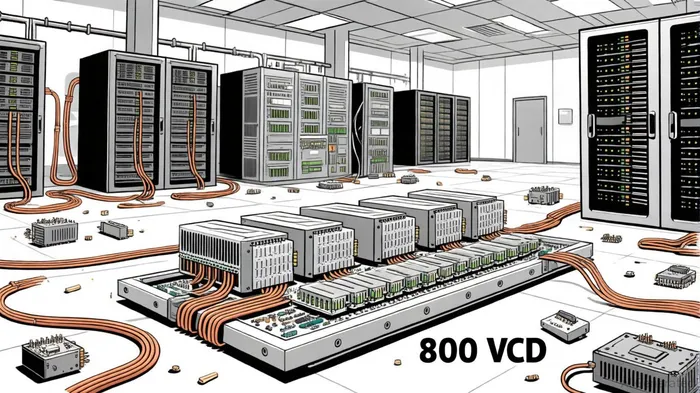
The 800 VDC Platform: A Technical Breakthrough for AI Factories
Traditional 54 VDC power distribution systems, long the standard for data centers, are increasingly inadequate for AI's evolving needs. As rack power requirements surpass 300 kilowatts-driven by the proliferation of GPU clusters and large-scale training models-these systems face critical limitations: excessive copper usage, thermal losses, and redundant AC-to-DC conversions, according to NVIDIA's 800 VDC architecture. NVIDIA's 800 VDC architecture directly addresses these challenges by centralizing power conversion at the data center perimeter. This approach eliminates multiple in-rack conversions, reducing energy losses and freeing up physical space for compute hardware, as the 800 VDC ecosystem describes.
Vertiv's 800 VDC portfolio, set for release in late 2026, complements this vision with a suite of components: centralized rectifiers, high-efficiency DC busways, rack-level DC-DC converters, and DC-compatible backup systems, as Vertiv announced. These elements collectively reduce copper usage by up to 45% and improve end-to-end power efficiency by 5% compared to AC systems, Neuberger Berman reports. For context, a single 800 VDC-enabled data center could save millions in annual cooling and maintenance costs while supporting homogeneous AI zones in hyperscale environments, as TechX Media notes.
Strategic Alignment: Vertiv and NVIDIA's Roadmap for AI Infrastructure
The partnership between Vertiv and NVIDIA is not incidental but a calculated alignment with the latter's AI roadmap. NVIDIA's Kyber and Rubin Ultra platforms, designed for exascale computing, require infrastructure that can handle megawatt-scale workloads without compromising performance or reliability, as PR Newswire reported. Vertiv's two-decade expertise in DC power systems-spanning telecom, industrial, and mission-critical applications-positions it as a trusted enabler of this transition.
A key innovation is the integration of multi-timescale energy storage. Short-duration capacitors absorb rapid power spikes at the rack level, while long-duration battery systems stabilize facility-wide fluctuations, as the NVIDIA ecosystem discussion explains. This dual-layer approach ensures grid resilience, a critical factor as AI factories push power demands to unprecedented levels. For investors, this synergy between hardware and infrastructure signals a shift from fragmented solutions to holistic, scalable systems-a trend that could unlock new markets in solid-state transformers and gallium nitride semiconductors, according to Neuberger Berman.
Efficiency Gains and Market Implications
The economic case for 800 VDC adoption is compelling. According to a report by Vertiv, the platform reduces maintenance costs by up to 70% and cooling expenses by eliminating redundant power supply units. These savings are amplified by the platform's modular design, which allows for incremental scaling without overhauling existing infrastructure. For hyperscale operators, this means lower total cost of ownership (TCO) and faster time-to-market for AI-driven services.
Beyond direct cost savings, the 800 VDC ecosystem is fostering ancillary growth opportunities. Companies like Analog Devices and STMicroelectronics are developing complementary technologies-such as hot-swap controllers and high-density power boards-to support this architecture, and Vertiv's announcement has helped catalyze supplier roadmaps. This ecosystem expansion mirrors the rise of cloud computing in the 2010s, where infrastructure innovation spurred a cascade of downstream investments.
Conclusion: A Catalyst for Industrial Transformation
The Vertiv-NVIDIA 800 VDC platform is more than a technical upgrade; it is a catalyst for redefining industrial productivity. By addressing the bottlenecks of legacy systems, it enables AI factories to operate at full capacity while reducing environmental footprints. For investors, this represents a dual opportunity: capitalizing on the immediate efficiency gains of next-generation data centers and positioning for the broader industrial adoption of AI-driven automation.
As AI workloads continue to scale, infrastructure will remain the silent enabler of progress. The 800 VDC platform underscores a critical truth: the future of AI is not just about smarter algorithms but smarter systems.





Comentarios
Aún no hay comentarios