
U.S. Influence in Middle East Peace Talks: Unlocking Energy and Infrastructure Investment Opportunities
The United States' strategic recalibration in the Middle East since 2023 has created a unique confluence of geopolitical stability and economic opportunity. By shifting from direct military intervention to empowering regional actors—Israel, Turkey, and Gulf states—Washington has fostered a tri-pillar regional order aimed at countering Iranian influence while prioritizing energy security and infrastructure development[1]. This policy pivot, coupled with the resilience of the Abraham Accords and the emergence of transformative clean energy partnerships, has opened new avenues for investors seeking to capitalize on the region's evolving dynamics.
Energy Markets: A Dual Focus on Stability and Innovation
The Middle East remains a linchpin for global energy markets, with U.S. policy increasingly tied to maintaining stability in oil, gas, and renewable sectors. The Abraham Accords, despite the Gaza conflict's political turbulence, have endured as a framework for economic collaboration. For instance, the UAE and Israel have advanced joint ventures in natural gas, including the exploitation of Israel's Tamar and Leviathan fields by Emirati and international firms[4]. However, the war in Gaza disrupted some projects, prompting the development of alternative trade routes, such as a land corridor through Saudi Arabia and Jordan to bypass traditional maritime routes[4].
Simultaneously, the U.S. has leveraged sanctions and diplomatic pressure to shape energy dynamics. The Enhanced Iran Sanctions Act, for example, has intensified economic pressure on Iran, indirectly bolstering Gulf state energy exports[3]. Meanwhile, the June 2025 U.S. airstrikes on Iran's nuclear infrastructure underscored Washington's hardline stance, which, while heightening regional tensions, also reinforced Gulf states' reliance on U.S. security guarantees[5]. This interplay of coercion and cooperation has created a volatile but investment-friendly environment, particularly in renewable energy.
The UAE-U.S. Partnership for Accelerating Clean Energy (PACE), launched in 2022, exemplifies this trend. Aiming to mobilize $100 billion in financing and deploy 100 gigawatts of clean energy by 2035, PACE has already catalyzed high-profile projects. Masdar, the UAE's clean energy firm, acquired a 50% stake in Terra-Gen, a U.S. renewable energy producer, expanding its portfolio to over 5 gigawatts of operating capacity[2]. Similarly, ADNOC's 35% stake in ExxonMobil's blue hydrogen project in Texas highlights the growing synergy between Gulf oil giants and American technology firms[5]. These initiatives align with the UAE's National Hydrogen Strategy 2050, which targets 14–22 million tons of annual hydrogen production by 2050[5].
Infrastructure: Building the New Middle East
Infrastructure development has become a cornerstone of U.S. engagement in the region, with projects spanning transportation, digital networks, and utilities. The U.S. Army Corps of Engineers, through the Foreign Military Sales (FMS) program, has delivered critical infrastructure in Saudi Arabia and the UAE, including secure facilities and transportation hubs[3]. These projects, funded by host nations, avoid direct U.S. taxpayer costs while enhancing regional stability.
A notable example is the $2 billion investment in U.S. services exports for Saudi Arabia's King Salman International Airport and Qiddiya City, led by American firms like Hill International and AECOM[3]. These projects align with Saudi Vision 2030's goal of diversifying the economy and reducing oil dependency. Similarly, the U.S. Special Coordinator for the Partnership for Global Infrastructure has emphasized economic corridors that integrate transportation and digital infrastructure, mirroring the Lobito Corridor model in Africa[3].
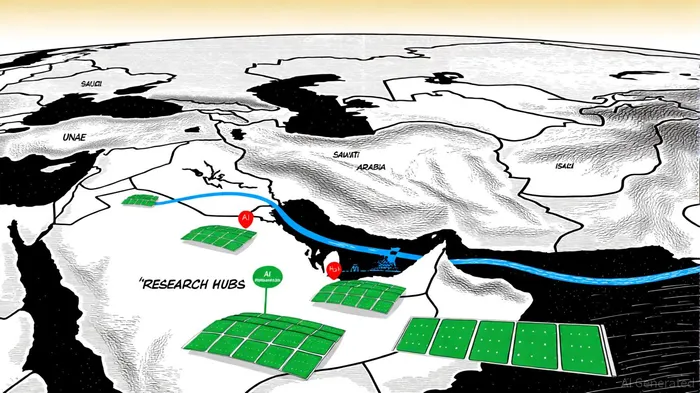
Digital infrastructure is another growth area. The proposed AI research campus in the UAE, a collaboration between U.S. tech firms and Emirati institutions, signals a strategic pivot toward technology-driven diplomacy[5]. This aligns with broader U.S. interests in securing data center and AI supply chains, which are critical for future economic and military dominance.
Geopolitical Risks and Investment Opportunities
While the U.S.-backed regional order offers substantial opportunities, it is not without challenges. The tri-pillar model faces internal contradictions, including divergent threat perceptions between Israel, Turkey, and Gulf states[2]. Additionally, energy shortages in countries like Egypt and Iraq highlight the need for cross-border cooperation, which U.S. policy has sought to facilitate through initiatives like the Gas Peace Corridor project[1].
For investors, the key lies in balancing these risks with the region's long-term potential. The PACE program's $100 billion target, coupled with the UAE's $163 billion energy transition budget by 2050, presents a clear roadmap for renewable energy growth[5]. Similarly, infrastructure projects tied to Vision 2030 and the UAE's Economic Vision 2030 offer stable returns in sectors like smart cities and advanced transportation[3].
Conclusion
The U.S. strategy in the Middle East has evolved into a hybrid model of indirect intervention, where regional actors lead on security and economic matters while Washington provides strategic support. This approach has stabilized energy markets, accelerated clean energy transitions, and unlocked infrastructure investment opportunities. For investors, the region's blend of geopolitical stability, U.S. policy backing, and ambitious national visions makes it a compelling arena for long-term growth. However, success will require navigating the region's complex dynamics and aligning with partners who share a commitment to sustainable development.





Comentarios
Aún no hay comentarios