
Inflationary Pressures and Labor Market Dynamics in 2025: Assessing the Fed's Balancing Act and Its Implications for Equities and Fixed Income
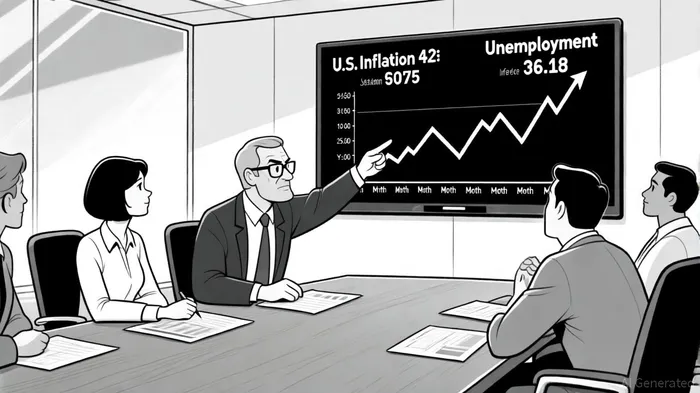
The Federal Reserve's 2025 policy decisions have been shaped by a delicate balancing act between moderating inflation and supporting a labor market showing early signs of strain. With the U.S. inflation rate at 2.9% for the 12 months ending August 2025[1], up from 2.7% in July[2], and the unemployment rate climbing to 4.3%—the highest since October 2021[3]—the Fed faces a complex trade-off. This analysis examines how these dynamics are reshaping equity and fixed-income markets, and what investors should prioritize in this evolving landscape.
Inflation: A Gradual Path to Target
The 2.9% annual inflation rate, while above the Fed's 2% target, reflects a stabilization of price pressures after years of volatility. The Consumer Price Index (CPI) rose 0.4% in August 2025 on a monthly basis[1], driven by food, energy, and services sectors. The Federal Reserve's Summary of Economic Projections (SEP) anticipates a gradual decline in inflation, with PCE inflation expected to fall from 3.0% in 2025 to 2.0% by 2028[4]. This trajectory suggests the Fed is prioritizing long-term price stability over aggressive near-term intervention, a strategy that has tempered market expectations for rapid rate cuts.
However, the path to 2% remains uneven. Persistent inflation in services and housing costs, coupled with global supply chain adjustments, could delay progress. As noted by the U.S. Bureau of Labor Statistics, services inflation remains stubbornly high, accounting for over half of the CPI increase in August[5]. This dynamic underscores the Fed's challenge: tightening policy too aggressively risks derailing an already fragile labor market.
Labor Market Softness and Policy Trade-offs
The labor market's weakening has been a critical factor in the Fed's September 2025 rate cut. The unemployment rate rose to 4.3% in August, with Black and Hispanic workers facing disproportionately high unemployment at 7.5% and 5.3%, respectively[3]. Job gains have also slowed, with only 22,000 nonfarm payrolls added in August—a stark contrast to the robust hiring seen in 2023 and early 2024[6].
The Fed's 25-basis-point cut, the first in a projected easing cycle, signals a shift from tightening to accommodative policy. According to the Chicago Fed's Real-Time Unemployment Rate Forecast, the labor market is expected to remain stable in September 2025 at 4.3%, with modest hiring gains offsetting rising layoffs[7]. This cautious approach reflects the Fed's dual mandate: supporting employment while avoiding a spike in inflation.
Equity Market Implications: Sectoral Divergence
The Fed's easing cycle has created divergent opportunities across equity sectors. Growth stocks, particularly in technology, have historically benefited from rate cuts due to lower discount rates and higher valuations for future earnings. The NASDAQ Composite and S&P 500, however, showed muted reactions to the September cut, with the tech-heavy indices gaining only 0.8% compared to the DJIA's 1.2% rise[8]. This suggests investor caution amid concerns about economic growth and trade policy headwinds.
Consumer discretionary and real estate sectors are poised to gain from lower borrowing costs. Reduced mortgage rates could stimulate housing demand, benefiting homebuilders and REITs[8]. Conversely, financials face headwinds as net interest margins compress. Banks and insurance companies may see profitability decline, particularly if rate cuts continue into 2026[9].
Industrials and materials sectors remain vulnerable to global trade tensions and inflationary pressures. Prolonged tariffs on steel and aluminum, coupled with a strong dollar, could dampen demand for manufacturing inputs[10]. Investors are advised to favor quality stocks with strong balance sheets in these sectors.
Fixed-Income Markets: A Reorientation Toward Duration
The bond market has responded to the Fed's easing cycle with a shift toward intermediate-duration bonds. Treasury yields, particularly short-term rates, have fallen, pushing the yield curve toward a steeper slope[11]. For example, the 10-year Treasury yield dropped to 3.8% in early September 2025, reflecting expectations of further rate cuts.
Investors are reallocating from cash holdings to bonds with maturities of 3–10 years, balancing income potential with price appreciation[11]. Long-term Treasuries, however, face headwinds from the U.S. debt load and inflation risks. Municipal bonds and high-quality corporate bonds are gaining traction as alternatives to Treasuries, offering higher yields without excessive duration risk[12].
Strategic Considerations for Investors
The Fed's balancing act in 2025 demands a nuanced approach to portfolio construction. In equities, a diversified strategy emphasizing quality and sector rotation is advisable. Growth stocks and real estate may outperform in a low-rate environment, while financials and utilities could lag. For fixed income, intermediate-duration bonds and sectors with strong credit fundamentals offer a compelling risk-reward profile.
As the Fed navigates the dual challenges of inflation and labor market softness, market participants must remain agile. The next CPI report on October 15, 2025, and the December FOMC meeting will provide critical insights into the central bank's trajectory. In the meantime, a tactical allocation to cyclical sectors and a cautious approach to duration risk may position portfolios to weather the Fed's evolving policy landscape.







Comentarios
Aún no hay comentarios