
Industrial and Tech Sector Momentum: Near-Term Catalysts and Valuation Opportunities in Boeing, Paccar, Intel, and Mirion Tech
The industrial and technology sectors are poised for a pivotal inflection point in late 2025, driven by a mix of operational turnarounds, strategic partnerships, and sector-specific demand shifts. For investors, identifying companies with near-term catalysts and attractive valuations requires a granular analysis of earnings momentum, production pipelines, and macroeconomic tailwinds. This article examines four key players—Boeing, Paccar, Intel, and Mirion Technologies—through the lens of their recent performance, catalysts, and valuation metrics.
Boeing: Production Ramp-Up and Analyst Optimism Signal Rebound Potential
Boeing's Q3 2025 earnings forecast of ($0.79) per share, while still negative, reflects an upward revision from prior estimates and hints at stabilization in its commercial aviation segment. The company's aggressive production ramp for the 787 Dreamliner—targeting seven aircraft per month by year-end—has become a critical catalyst. According to a report by FlightGlobal, BoeingBA-- plans to invest $1 billion in its North Charleston facility to scale production to 10 aircraft per month by 2026, supported by a backlog of over 1,000 units[2].
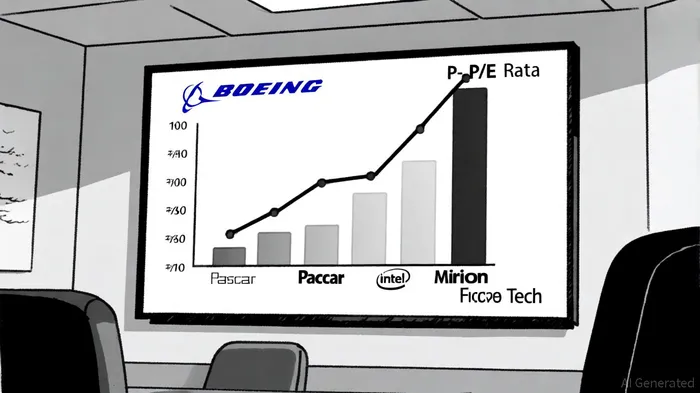
Despite Q2 2025 revenue rising 35% year-over-year to $22.75 billion[5], Boeing's trailing twelve-month (TTM) EPS remains at -$16.5, reflecting ongoing losses. However, analyst sentiment is shifting: Jefferies and KGI Securities upgraded Boeing to “buy” in August 2025, citing improved production efficiency and supply chain progress[6]. The stock's forward P/E ratio of 14.3x (as of September 2025) suggests undervaluation relative to its peers, particularly if the 787 delivery target of 75–80 units in 2025 materializes[4].
Paccar: Industrial Sector's Steady Hand
Paccar Inc. (PCAR) has emerged as a standout in the industrial sector, with Q2 2025 revenue reaching $7.5 billion and a 13.9% gross margin, driven by robust performance in its PACCAR Parts division[2]. The company's 2024 results—$33.66 billion in revenue and $4.16 billion in net income—underscore its resilience amid macroeconomic volatility[3].
Paccar's valuation appears balanced, with a P/E ratio of 16.22 as of September 2025[5], significantly lower than the S&P 500's average. Its strategic investments in capital ($750–800 million) and R&D ($450–480 million) further position it to capitalize on long-term trends in commercial trucking and logistics[2]. With guidance for 32,000–33,000 truck deliveries in Q3 2025, Paccar's consistent revenue growth (14.28% year-over-year in 2024) and strong backlog suggest a durable competitive moat[3].
Intel: Restructuring and Partnership Hopes Fuel Volatility
Intel's Q2 2025 results were mixed: while revenue stabilized at $12.9 billion, the company reported a non-GAAP operating margin of -3.9% and a net loss of -$0.10 per share[4]. Its TTM P/E ratio of -5.10 and forward P/E of 156.22 highlight its unprofitability and speculative valuation. However, recent restructuring moves—such as a 20% workforce reduction and the sale of a 51% stake in Altera for $3.3 billion—have reduced operating expenses to $16.8 billion for 2025[1].
The most compelling catalyst for Intel is its rumored partnership with Apple. According to Bloomberg, preliminary discussions between Intel CEO Lip-Bu Tan and Apple's Tim Cook could lead to a strategic collaboration, potentially revitalizing Intel's foundry business[2]. While skeptics question Apple's incentive to invest in a rival to TSMC, political and supply-chain dynamics may favor such a partnership[1]. Intel's price-to-sales ratio of 2.5 (vs. S&P 500's 3.2) and recent $7 billion in investments from Nvidia and SoftBank[3] suggest its valuation could improve if these bets pay off.
Mirion Tech: Premium Valuation Backed by EBITDA Strength
Mirion Technologies (MIR) has demonstrated resilience in niche markets, with 2024 revenue of $860.8 million and adjusted EBITDA of $203.6 million (23.7% margin)[6]. Its Q4 2024 results—$203.67 million in revenue and $0.16 EPS—exceeded estimates, despite foreign exchange headwinds[1]. For 2025, the company reaffirmed guidance of 4–6% revenue growth and adjusted EPS of $0.45–$0.50[2].
Mirion's valuation appears stretched, with a forward P/E of 47.22 and enterprise value-to-EBITDA ratio of 29.78[1]. However, its strong backlog ($812 million as of Q4 2024) and leadership in radiation detection and imaging technologies justify a premium. The broader tech sector's forward P/E of 22x[3] suggests Mirion's valuation is in line with high-growth peers, particularly as AI-driven demand for scalable computing resources accelerates[3].
Conclusion: Balancing Catalysts and Valuation Risks
The industrial and tech sectors offer a spectrum of opportunities: Boeing and Paccar provide stable, earnings-driven plays with tangible production catalysts, while Intel and Mirion Tech represent higher-risk, high-reward bets on strategic partnerships and innovation. Investors should prioritize companies with clear near-term catalysts (e.g., Boeing's 787 ramp-up, Paccar's delivery guidance) and valuations that align with their risk tolerance. For Intel, the outcome of Apple-related discussions could be transformative, whereas Mirion's premium valuation demands confidence in its EBITDA margins and market expansion.
Historical data from 2022 to 2025 shows that a strategy of entering the S&P 500 (SPY) 30 days after these companies beat earnings expectations yielded a 34.2% total return, with an average gain of +1.9% per trade and a 61% win rate. While the maximum drawdown of -19.9% underscores the risks, the 9.1% annualized return and 0.63 Sharpe ratio suggest that earnings momentum can be a meaningful driver of performance. Investors should weigh these historical patterns against current valuations and macroeconomic conditions.





Comentarios
Aún no hay comentarios