
Industrial Sector Outperformance: Navigating Cyclical Recovery in the Wake of Positive Wholesale Inflation
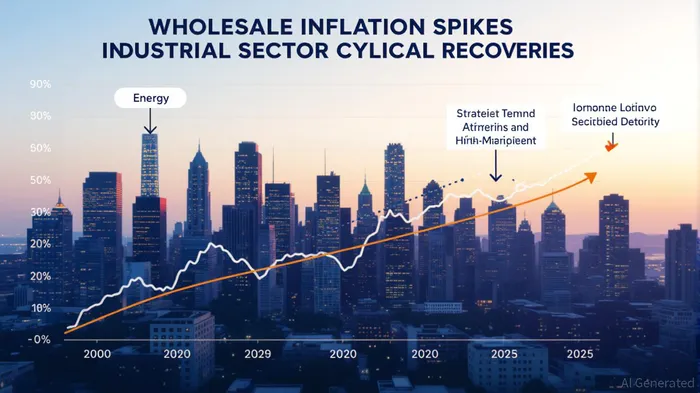
The industrial sector has long been a barometer of economic health, and recent trends suggest it may be primed for a rebound as positive wholesale inflation data signals cyclical recovery. While the Midwest's manufacturing base has faced decades of headwinds—from offshoring to pandemic-induced supply chain chaos—companies with disciplined capital strategies and sector-specific expertise are positioning to outperform.
According to a report by the National Bureau of Economic Research (NBER), economic recoveries are often marked by surges in real personal income and nonfarm payrolls[2]. However, these broad indicators mask the nuanced dynamics within industrial sectors. For instance, during the 2021 inflation spike driven by supply chain bottlenecks and geopolitical shocks, energy and materials firms leveraged their strategic positioning to capitalize on rising input costs[1]. As transportation delays and port congestion drove wholesale prices higher, companies with strong balance sheets and through-cycle operational discipline—such as integrated oil giants and commodity miners—saw margins expand[1].
Data from Boston Consulting Group (BCG) underscores this trend, revealing that high-performing cyclical sectors like oil and gas, commodity chemicals, and building materials achieved an average ten-year total shareholder return (TSR) of 18%, outpacing subsector medians by 10 percentage points[5]. These firms avoided the pitfalls of pro-cyclical overinvestment by maintaining lean debt structures, prioritizing dividends, and executing strategic mergers to consolidate market share[5]. For example, during the 2008–2010 recovery, companies that avoided aggressive expansion during the downturn and instead focused on cost optimization saw sharper rebounds as demand rebounded[1].
The interplay between industrial activity and inflation is further complicated by shifts in supply chain resilience. A McKinsey analysis notes that uneven investment in productivity—particularly in emerging economies—has created asymmetries in sectoral recovery. Energy and agriculture, for instance, remain systemically significant due to their role in stabilizing input costs for downstream industries[4]. When wholesale inflation rises, these sectors often act as both beneficiaries and stabilizers, passing through costs while maintaining demand elasticity[5].
Investors should also consider the lessons from the Midwest's partial manufacturing recovery. , the region has seen a resurgence in capital-intensive industries that prioritize automation and vertical integration[3]. Firms that invested in digital supply chain tools and localized production during the 2010s have since demonstrated greater resilience to inflationary shocks[3].
The key takeaway? Cyclical recovery trades in the industrial sector require a focus on companies with three traits:
1. Disciplined capital allocation to avoid overleveraging during upswings.
2. Sector-specific expertise to navigate commodity price swings and regulatory shifts.
3. Operational flexibility to adapt to both supply-side disruptions and demand-side volatility.
As the industrial sector navigates the next phase of recovery, positive wholesale inflation data should not be viewed as a risk but as a signal. For investors willing to separate the wheat from the chaff, the rewards lie in firms that have mastered the art of balancing growth with prudence—a lesson etched in the annals of post-crisis industrial outperformance.







Comentarios
Aún no hay comentarios