
Industrial Real Estate: The Richmond Lease as a Microcosm of a Bifurcated Market
The deal for Northlake II is a specific, high-quality transaction that stands in stark relief to the broader industrial market's weakness. The 203,000-square-foot building has been leased to DPR Construction, a top-tier general contractor with annual revenues exceeding $9 billion. This is not a speculative bet; it is a strategic expansion by a major, cash-rich firm into a critical logistics corridor. The lease secures the final phase of a four-building, 548,000-square-foot Class A industrial park, signaling durable demand for premium space in a tight market.
That tightness is the key. While the national vacancy rate climbed to 7.5% in Q3 2025, driven by new supply outpacing demand, the Richmond market defies this trend. The deal underscores a critical market bifurcation. The evidence shows larger logistics buildings face the greatest challenges, with vacancy surpassing 10%, while small-bay industrial space remains tight, with vacancy near pre-pandemic lows of 5%. DPR's need for a large, specialized facility aligns with the demand for high-quality, well-located space that can support complex operations, a segment where supply is constrained.
The strategic location along I-95 is the linchpin. This positioning provides connectivity to the East Coast's primary north-south corridor, making it ideal for logistics and distribution in a market where occupiers are prioritizing strategic locations and future-ready facilities. For a company like DPR, which builds data centers and corporate campuses, this isn't just about proximity to ports; it's about being embedded in a high-performance regional network. The lease validates the value of this specific, high-demand geography.
The bottom line is a central investor question: does this deal signal durable, structural demand, or is it an isolated pocket of strength? The evidence suggests the latter. The national market is clearly shifting in favor of tenants, with year-over-year rent growth slowing to 1.3% and sublease availability rising. The Northlake II deal is a win for the developer, but it does not change the broader supply-demand imbalance. It highlights the resilience of demand for the best space in the best locations, even as the market as whole softens. For investors, this is a reminder that industrial real estate is no longer a monolithic story. The future belongs to those who can identify and own the specific, high-quality assets that command a premium in a fragmented landscape.
The Mechanics of a Bifurcated Market: Demand Drivers vs. Supply Glut
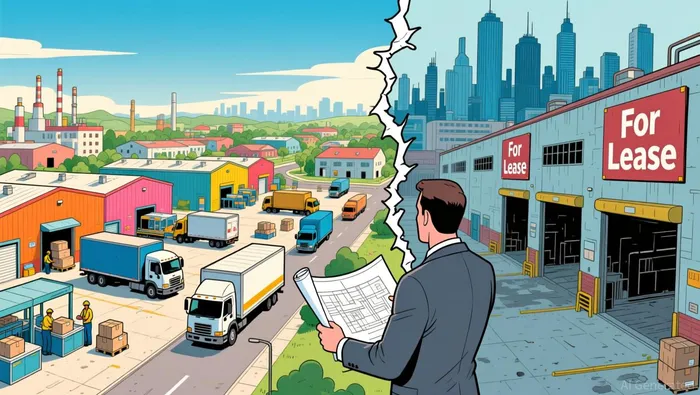
The U.S. industrial real estate market is splitting into two distinct realities. On one side, demand for logistics space is structurally resilient, anchored in domestic consumption. On the other, a severe oversupply of large-format buildings is compressing rents and pricing power. This bifurcation is the core dynamic shaping the sector's future.
The demand side is defined by insulation from global trade shocks. Only 15 percent of U.S. logistics demand is tied directly to global trade, with the vast majority serving the domestic economy. This creates a stabilizing foundation, as demand is driven by proximity to population centers for e-commerce fulfillment and retail restocking. Even in major port markets, trade-related demand is limited to about 25%. This structural insulation means the market's core growth vector is domestic, not geopolitical.
The supply side tells a different story. The market is drowning in large-format space. Vacancy for larger logistics buildings has surpassed 10%, a direct result of a 14% increase in stock over four years. This oversupply has pushed year-over-year rent growth to a low of 1.3%, the weakest level since 2012. The imbalance is so severe that sublease availability is rising, and leasing velocity has declined, giving tenants unprecedented leverage.
The market's future is constrained by the very forces that created the glut. Elevated construction costs, driven by high commodity prices and persistent labor shortages, are a key friction. While base building costs for new warehouses have remained stable year-over-year, the underlying environment is one of continued increases in commodity prices and persistent labor constraints. These costs are a ceiling on new supply, but they are not a floor. The pipeline is already slowing, with quarterly net supply additions on pace to fall below the pre-pandemic three-year average by the second half of 2025. This sets the stage for a potential supply correction, but it will be gradual.
The bottom line is a market in structural tension. The demand for smaller, flexible spaces near consumers remains tight, but the market's growth is being choked by the oversupply of its largest, most capital-intensive assets. This creates a stark divergence in asset quality and pricing power. For now, the supply glut dominates, compressing returns. The path to recovery hinges on a slow, cost-constrained reduction in new deliveries, a process that will take years to fully play out.
Investment Implications: Valuation, Yields, and the Path Forward
The industrial REIT market is caught in a stalemate between quality and quantity. On one side, the asset class offers a defensive yield profile, with equity REITs offering dividends of 3.8%. On the other, it faces headwinds from a volatile interest rate environment and a potential slowdown in transaction volume driven by tariff uncertainty. The path forward hinges on a resolution to this macro friction.
The valuation mechanics are shifting. While the first half of 2025 saw cap rates decline slightly, the more telling signal is investor sentiment. For the first time in recent surveys, most respondents believe cap rates have peaked. This is a critical pivot. It suggests the market may be entering a new phase of yield compression, where prices can appreciate even without a surge in underlying fundamentals. The catalyst for this re-rating is a stabilization of demand. If leasing velocity recovers, it would unlock the pipeline of new development and shift the market from tenant-favorable to balanced, supporting higher asset values.
The immediate pressure points are clear. The tariffs announced on April 2 have already dampened the outlook, with more than half of respondents expecting slightly lower sales volume in 2025. This directly threatens the cash flow growth that underpins REIT valuations. Compounding this is the interest rate backdrop. Although the Effective Federal Funds Rate is now targeted at between 4.00% and 4.25%, and the 10-Year Treasuries are hovering near 4.00%, the path is expected to be downward. The Fed's projections point to another 50 bps of cuts anticipated through the end of this year. Lower rates reduce the discount rate applied to future cash flows, which is a fundamental support for real estate prices.
The bottom line is a market waiting for a signal. The defensive yield of 3.8% provides a floor for income investors, but capital appreciation requires a thaw in macro uncertainty. The key catalyst is a recovery in leasing velocity, which would validate the peak in cap rates and trigger the yield compression that drives price appreciation. Until then, the industrial REIT sector remains a story of potential, not yet realized.







Comentarios
Aún no hay comentarios