
Industrial Real Estate in High-Demand Coastal Markets: A Strategic Opportunity with Terreno Realty Corporation
The U.S. industrial real estate market is undergoing a pivotal transformation, shaped by shifting trade dynamics, e-commerce growth, and nearshoring initiatives. While the broader market has shown signs of moderation-national vacancy rates rose to 7.5% in Q3 2025, and asking rents decelerated to 1.4% year-over-year growth-coastal infill logistics properties remain a standout exception. These assets, characterized by their proximity to urban centers and limited supply, continue to attract robust demand, with vacancy rates below 5%. For investors seeking to capitalize on this niche, Terreno Realty CorporationTRNO-- (NYSE: TRO) offers a compelling case study.
The Resilience of Coastal Infill Logistics
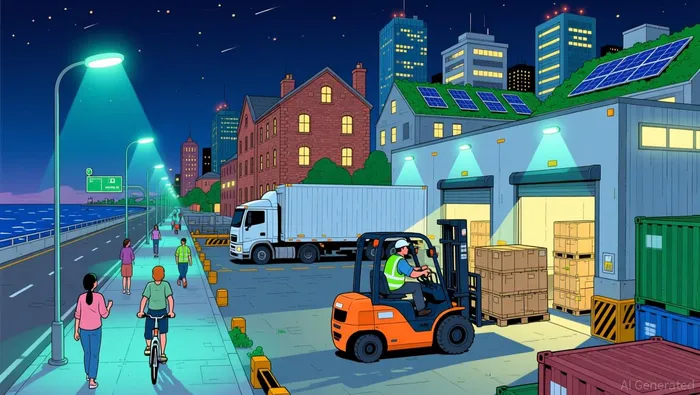 Coastal markets such as Los Angeles, New York, and Miami are uniquely positioned to benefit from structural trends. E-commerce's rising share of retail sales and the push to localize supply chains have intensified demand for last-mile logistics hubs. In Q3 2025, Investcorp's $400 million acquisition of a diversified portfolio across seven coastal markets-spanning 2.6 million square feet with 97% occupancy-underscored the sector's appeal. These markets, including Northern New Jersey and South Florida, saw new supply account for less than 1.3% of total inventory, reflecting a supply-demand imbalance that favors asset owners.
Terreno has strategically aligned itself with this dynamic. The company focuses on six coastal markets-Los Angeles, Northern New Jersey/New York City, San Francisco Bay Area, Seattle, Miami, and Washington, D.C.-where land constraints and urban density create a premium for infill properties. By acquiring assets at a discount to replacement cost, TerrenoTRNO-- leverages its value-add strategies to enhance returns through renovations, re-tenanting, and operational improvements.
Value-Add Strategies and Financial Performance
Terreno's disciplined approach has yielded strong financial results. In Q2 2025, the company reported a 143% year-over-year increase in net income per share, with funds from operations (FFO) reaching $0.64 per share. These gains were driven by robust occupancy metrics: 97.7% overall portfolio occupancy and 98.5% same-store occupancy. Cash rents on new and renewed leases surged by 22.6%, reflecting the pricing power of infill assets in constrained markets.
A key component of Terreno's strategy is its ability to identify undervalued properties and reposition them for higher demand. For instance, the company's LEED-certified distribution facilities in Hialeah, Florida, were fully leased shortly after completion, highlighting the growing appetite for sustainable logistics real estate. Similarly, Terreno's $200 million in strategic acquisitions across New Jersey and Florida in 2025 expanded its footprint in markets with strong fundamentals.
The company also excels at harvesting gains through strategic dispositions. The sale of America's Gateway Park in Doral, Florida, generated an unleveraged IRR of 14.7%, demonstrating its ability to exit assets when valuations exceed replacement costs. This disciplined cycle of acquisition, enhancement, and exit reinforces Terreno's long-term value creation.
A Strong Balance Sheet and Future Outlook
Terreno's financial strength further bolsters its appeal. As of Q2 2025, the company had no debt maturities in 2025 and no borrowings on its $600 million revolving credit facility, providing flexibility to pursue new opportunities. With $472.5 million in acquisitions under contract during the quarter, Terreno is well-positioned to scale its portfolio while maintaining its focus on high-conviction markets.
Looking ahead, the infill logistics sector appears poised for recovery. Prologis' Q3 2025 report noted a 64% quarter-over-quarter increase in net absorption, signaling a potential rebound in 2026. While macroeconomic uncertainties-such as inflation and geopolitical tensions-remain, Terreno's focus on coastal infill properties insulates it from broader market softness. These assets cater to essential logistics needs that are less cyclical than speculative suburban developments.
Conclusion
Industrial real estate in high-demand coastal markets represents a strategic opportunity for investors seeking resilience and growth. Terreno Realty Corporation's disciplined value-add strategies, combined with its focus on infill logistics, have delivered exceptional financial performance and operational metrics. As e-commerce and nearshoring continue to reshape supply chains, Terreno's portfolio of urban logistics hubs is well-positioned to capture long-term value. For those willing to bet on the next phase of the industrial real estate cycle, Terreno offers a compelling blueprint.





Comentarios
Aún no hay comentarios