
Industrial Policy Risks and Opportunities in the U.S. Steel Sector: Assessing Trump's Golden Share Mechanism and Its Impact on Equities and ETFs
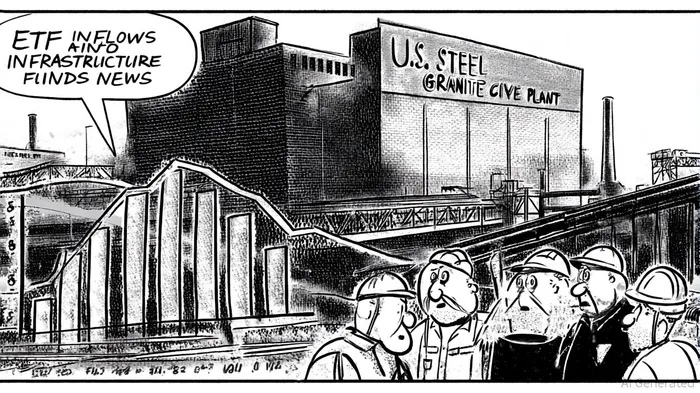
The U.S. steel sector is undergoing a seismic shift as President Donald Trump's invocation of a "golden share" mechanism in the Nippon Steel acquisition of U.S. Steel redefines the boundaries of corporate governance and industrial policy. This unprecedented arrangement, which grants the U.S. government veto power over key operational decisions, underscores a broader trend of political intervention in critical manufacturing sectors. For investors, the implications are twofold: heightened regulatory risks and emerging opportunities in a landscape reshaped by national security priorities and reshoring imperatives.
The Golden Share: A New Era of Government Influence
The golden share mechanism, first exercised in September 2025 to block U.S. Steel's plan to idle its Granite City, Illinois plant, marks a departure from traditional corporate governance norms. Under the terms of the $14.1 billion takeover by Nippon Steel, the U.S. government retains the authority to veto actions such as plant closures, offshore production shifts, and headquarters relocations [1]. This power, initially proposed to expire after a few years, was permanently secured by Trump, ensuring sustained influence over the company's strategic direction [2].
The arrangement mirrors precedents in European markets, such as Germany's Volkswagen or the UK's Heathrow Airport, where governments use golden shares to safeguard national interests [3]. However, in the U.S. context, this mechanism introduces a novel layer of political risk. As Todd Tucker of the Roosevelt Institute notes, the golden share could evolve into a tool for enforcing green initiatives or reshaping corporate priorities under future administrations, raising concerns about mission creep [4].
Market Reactions and ETF Dynamics
The immediate market response to the golden share has been mixed. U.S. Steel's stock, which halted trading on the NYSE in June 2025 following the deal's finalization, has exhibited heightened volatility. Historical patterns suggest the stock is prone to sharp swings, with declines of over 50% during past crises [5]. Post-September 2025, the stock's 22% volatility outpaces the 12% average for the steel sector, reflecting investor uncertainty over regulatory overreach [6].
Meanwhile, ETFs with exposure to the steel sector have attracted inflows amid Trump's 25% tariffs on steel and aluminum imports. The VanEck Steel ETF (SLX), which tracks the NYSE Arca Steel Index, has seen renewed interest as domestic producers gain market share. Similarly, the SPDR S&P Metals & Mining ETF (XME) and iShares MSCIMSCI-- Global Metals & Mining Producers ETF (PICK) have benefited from rising demand in construction and industrial sectors [7]. However, SLX has experienced a net outflow of $29.46 million over six months, signaling caution among investors wary of regulatory entanglements [8].
Broader Industrial Policy Implications
The golden share mechanism is part of a larger industrial policy framework aimed at revitalizing U.S. manufacturing. Trump's tariffs on Chinese, Mexican, and Canadian imports have forced companies to reconsider supply chains, with nearshoring and automation emerging as strategic priorities. For instance, Rockwell Automation's $2 billion investment in domestic capacity and advanced AI underscores the sector's pivot toward resilience [9].
Yet, these policies introduce asymmetrical risks. While steel producers like NucorNUE-- and Cleveland-CliffsCLF-- benefit from elevated prices, downstream manufacturers face higher input costs. CaterpillarCAT-- and John DeereDE--, for example, grapple with inflationary pressures from steel-dependent machinery [10]. Additionally, labor shortages and workforce hesitancy toward manual roles threaten to undermine reshoring efforts, even as automation adoption accelerates [11].
Investment Strategies for a Shifting Landscape
For investors, navigating this environment requires a nuanced approach. First, sector diversification is critical. ETFs like the Global X U.S. Infrastructure Development ETF (PAVE), which spans construction and energy infrastructure, offer exposure to industries indirectly benefiting from steel demand [12]. Second, investors should prioritize companies with strong balance sheets to weather regulatory and price volatility. Nippon Steel's $14 billion commitment to U.S. Steel facilities, for instance, provides a buffer against operational disruptions [13].
However, caution is warranted. Legal scholars warn that golden shares may impose a 15–20% valuation discount on affected companies due to governance complexities [14]. Investors must also monitor policy shifts under future administrations, as the golden share's transition to the Treasury and Commerce Departments post-Trump could alter its scope [15].
Conclusion
Trump's golden share mechanism exemplifies the growing intersection of politics and corporate strategy in critical manufacturing sectors. While it offers short-term stability for U.S. Steel and related ETFs, the long-term risks of regulatory overreach and geopolitical volatility cannot be ignored. For investors, the path forward lies in balancing exposure to policy-driven growth with hedging against the uncertainties of an increasingly interventionist industrial landscape.





Comentarios
Aún no hay comentarios