
U.S. Industrial Policy and the Reshaping of Global Trade: Strategic Investments in Resilient Supply Chains
The U.S. industrial policy landscape in 2025 is undergoing a seismic shift, driven by a bipartisan consensus to prioritize supply chain resilience over cost efficiency. With global trade dynamics increasingly shaped by geopolitical tensions and economic volatility, the U.S. has launched a multifaceted strategy to secure critical industries, from semiconductors to pharmaceuticals. For investors, this represents both a recalibration of risk and a surge of opportunity in sectors poised to benefit from strategic government intervention.
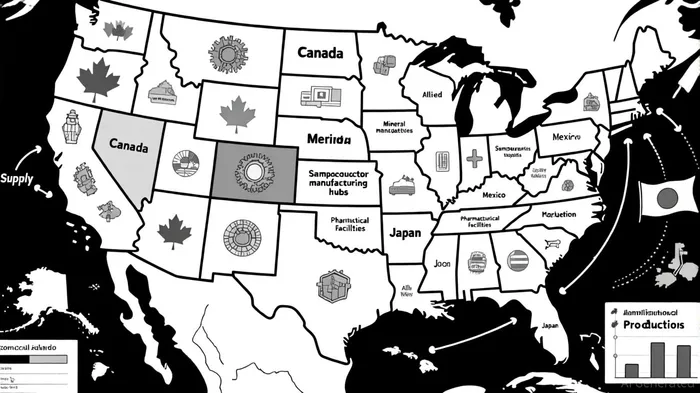
The Policy Framework: From Legislation to Execution
At the heart of this transformation is the Promoting Resilient Supply Chains Act, a bipartisan bill passed by the Senate Commerce Committee in February 2025. This legislation authorizes the Department of Commerce to collaborate with private-sector partners to map and monitor supply chains for critical industries, including semiconductors, critical minerals, and active pharmaceutical ingredients. The Act establishes a Supply Chain Resilience Working Group, tasked with identifying vulnerabilities and developing mitigation strategies, while emphasizing a data-driven approach to reshoring manufacturing from adversarial nations, as outlined in a Commerce Committee release.
Complementing this legislative effort, the U.S. Trade Representative (USTR) released six policy papers in January 2025 titled Adapting Trade Policy for Supply Chain Resilience. These documents outline sector-specific strategies, such as leveraging rules of origin and sectoral trade agreements to strengthen domestic and international supply chains, as described in the USTR policy papers. Ambassador Katherine Tai has underscored the need to move beyond the "just-in-time" model, advocating for a "just-in-case" approach that prioritizes redundancy and risk mitigation; she has emphasized this shift in speeches and briefings tied to those papers.
Strategic Sectors and Investments: Where the Money Flows
The U.S. government's focus on supply chain resilience is most evident in its targeted investments in critical minerals, semiconductors, and pharmaceuticals.
Critical Minerals and Mining Revival
The Biden administration has proposed a 30% federal tax credit for investments in mining and refining rare earth elements, alongside a 20% tax credit for refinery production. These incentives aim to revitalize domestic mining capacity for gallium, germanium, and other minerals essential for defense and clean energy technologies, as highlighted in a set of policy proposals. The U.S. Export-Import Bank (EXIM) is also being leveraged to finance mining ventures in allied nations like Canada and Australia, ensuring a diversified supply of critical materials, a point noted in those proposals.Semiconductors and Advanced Manufacturing
The CHIPS and Science Act continues to drive investment in domestic semiconductor production, with 2025 marking the first wave of large-scale facility expansions. Companies like IntelINTC-- and TSMCTSM-- have announced $50 billion in combined investments, supported by federal grants and tax incentives, according to an analysts' report. The USTR's policy papers further emphasize collaboration with allies to establish regional manufacturing hubs, reducing reliance on China for advanced chip production.Pharmaceuticals and Medical Supplies
The FDA's PreCheck program for pharmaceuticals, launched in 2024, has accelerated domestic production of active ingredients, with 2025 seeing a 40% increase in U.S.-based manufacturing capacity, according to a Gray analysis. This aligns with the Promoting Resilient Supply Chains Act's goal of reducing dependencies on foreign suppliers for critical medical supplies, as noted in the Commerce Committee release.
Global Trade Implications: Retaliation, Regionalization, and Resilience
The U.S. push for supply chain resilience has triggered significant international responses, reshaping global trade dynamics.
Tariff Escalations and Retaliatory Measures
The U.S. imposed a 20% tariff on Chinese imports in early 2025, exacerbating existing tensions. In response, China retaliated with 25% tariffs on U.S. coal and LNG, while the EU imposed counter-tariffs on $50 billion in American goods, including bourbon and motorcycles, as detailed in Global Trade in 2025. Canada and Mexico have also escalated trade disputes, with Canada imposing 25% tariffs on $155 billion in U.S. goods and Mexico accelerating domestic production in mining and renewable energy, according to a Global responses roundup.Regionalization and Nearshoring
Companies are increasingly adopting "China+1" strategies, diversifying production to countries like Vietnam, India, and Mexico. For example, Apple has shifted 30% of its component manufacturing to Vietnam, while automotive firms are investing in U.S.-Mexico-Canada Alliance (USMCA)–aligned supply chains, illustrated by a recent cascading impact study. The USTR's papers highlight the role of sectoral trade agreements in facilitating this regionalization, ensuring compliance with stricter rules of origin.Geopolitical Alliances and Supply Chain Diversification
The U.S. has strengthened partnerships with Australia, Canada, and Brazil to secure alternative sources of critical minerals. The Supply Chain Ministerial, expanded to 31 countries in 2025, underscores a global shift toward collaborative resilience-building, as convened through the Supply Chain Ministerial. These alliances are critical for reducing exposure to single points of failure, particularly in energy and defense sectors.
Investment Opportunities and Risks
For investors, the U.S. industrial policy agenda creates both tailwinds and headwinds.
- Tailwinds
- Critical Minerals and Mining: Companies involved in rare earth element extraction and refining, such as Livent and MP Materials, are set to benefit from federal tax credits and EXIM financing.
- Semiconductor Manufacturing: Firms with U.S. production facilities, including Intel and Amkor Technology, are positioned to capitalize on CHIPS Act incentives.
Pharmaceutical Reshoring: Domestic producers of active pharmaceutical ingredients, such as Mallinckrodt and Momentus Pharmaceuticals, are likely to see sustained demand.
Headwinds
- Tariff-Driven Volatility: Retaliatory tariffs from the EU, China, and Canada could disrupt export-dependent industries, particularly in agriculture and automotive sectors.
- Compliance Costs: Stricter rules of origin and transshipment regulations may increase operational complexity and costs for multinational firms, as outlined in a recent KPMG trends update.
Conclusion: A New Era of Strategic Resilience
The U.S. industrial policy agenda of 2025 marks a paradigm shift in global trade, prioritizing resilience over efficiency in an era of geopolitical uncertainty. For investors, this means reallocating capital toward sectors aligned with national security and economic competitiveness. While short-term disruptions from tariffs and compliance challenges are inevitable, the long-term trajectory points to a more diversified, secure, and strategically aligned global supply chain ecosystem.
As Ambassador Tai noted, the lessons of the pandemic and recent trade conflicts have made one thing clear: resilience is no longer optional-it is a prerequisite for survival in the 21st-century global economy.







Comentarios
Aún no hay comentarios