
The Industrial Metaverse: A Disruptive Force in Manufacturing and Supply Chain Efficiency
The convergence of Industrial AI and Digital Twin Technologies is reshaping the global manufacturing and supply chain landscape, creating what many now call the "industrial metaverse." This digital transformation is not merely speculative-it is already driving measurable efficiency gains, cost reductions, and sustainability improvements. For investors, the question is no longer whether to engage with these technologies but how to position for their accelerating adoption.
Market Growth: A Compelling Investment Thesis
According to a report by MarketsandMarkets, the Industrial AI and Digital Twin Technologies market is projected to grow from USD 21.14 billion in 2025 to USD 149.81 billion by 2030, at a compound annual growth rate (CAGR) of 47.9%. Similarly, the digital twin market alone is expected to expand from USD 24.48 billion in 2025 to USD 259.32 billion by 2032, with a CAGR of 40.1%. These figures underscore a seismic shift in industrial operations, driven by the integration of AI, IoT, and machine learning. The exponential growth trajectory reflects not just technological innovation but a fundamental reimagining of how industries optimize production, logistics, and resource management.
Real-World Applications: From Theory to Tangible Gains
The value of these technologies is best illustrated through real-world case studies. A global original equipment manufacturer (OEM) implemented digital twins to optimize outbound logistics, achieving an 8% reduction in freight and damage costs. Meanwhile, a major retailer leveraged digital twins to integrate planning, inventory deployment, and transportation management tools, improving consumer promise fulfillment by 20%. Rolls-Royce's application of digital twins to jet engine maintenance extended maintenance intervals by 50%, saving 22 million tons of CO₂ emissions-a dual win for operational efficiency and environmental sustainability.
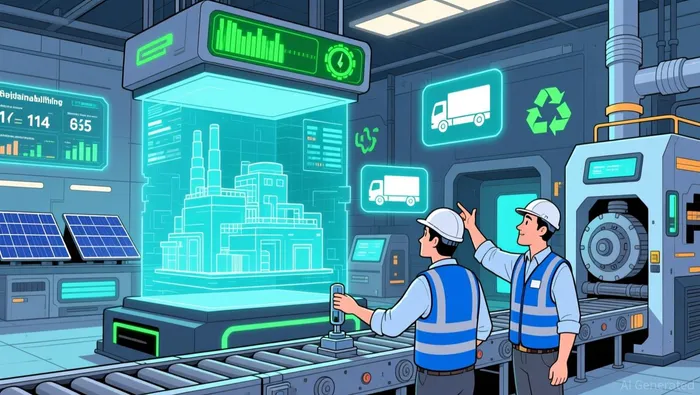 In warehousing, DHL deployed a simulation-powered digital twin to predict staffing needs, reducing resource crunches on peak days by 20%. Mars, the global food and consumer goods company, has adopted digital twins to optimize machine uptime and reduce waste across its production lines, creating a "virtual app store" of reusable use cases. These examples highlight how digital twins, when paired with AI, enable dynamic optimization, predictive maintenance, and end-to-end visibility-key drivers of competitive advantage.
Strategic Investment Considerations
The urgency for investors to act is further reinforced by adoption trends. Hexagon's 2025 Digital Twin Statistics reveal that 29% of manufacturing companies have already partially or fully adopted digital twin strategies, while 65% plan to prioritize such technologies for operational optimization. The market's scalability is evident in its cross-industry applicability, spanning energy, healthcare, and logistics.
Moreover, sustainability metrics are becoming a critical differentiator. Organizations using digital twins report an average 16% improvement in sustainability outcomes, aligning with global decarbonization goals and investor ESG priorities. This dual benefit-operational efficiency and environmental impact-positions Industrial AI and Digital Twin Technologies as a cornerstone of future-ready industrial ecosystems.
Conclusion: Securing Long-Term Competitive Advantage
The industrial metaverse is no longer a distant vision but a present-day reality. With growth rates outpacing traditional industrial sectors and proven ROI across use cases, the case for investment is robust. For forward-thinking investors, the challenge lies in identifying early-stage innovators and infrastructure providers poised to scale these technologies. As Hexagon notes, the digital twin market is on track to grow 15-fold by 2032. Those who invest now will not only capitalize on exponential market expansion but also shape the next era of industrial innovation.







Comentarios
Aún no hay comentarios