
Indonesian Market Volatility: Navigating Political Risk and Capital Outflows in Southeast Asia's Largest Economy
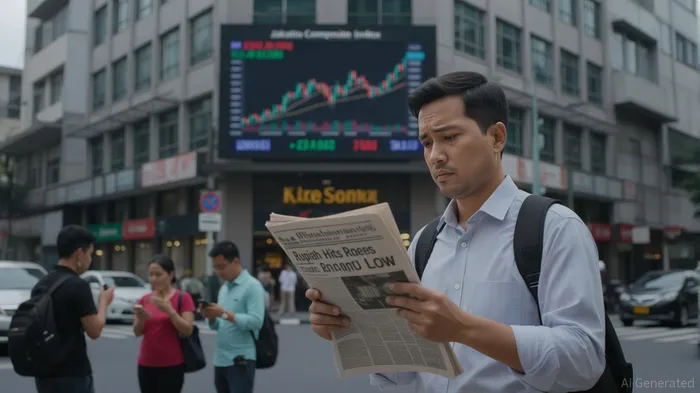
The Indonesian market has become a textbook case of political risk amplifying economic volatility. From 2023 to 2025, a toxic mix of mass protests, policy reversals, and governance scandals has driven the rupiah to its weakest level since the 1998 crisis and triggered a 3.6% single-day selloff in the Jakarta Composite Index (IHSG) in early 2025 [1]. Foreign direct investment (FDI) has declined by 12.23% year-on-year in Q2 2025 as capital flows shifted to more stable neighbors like Vietnam and Thailand [5]. For foreign investors, the question is no longer whether Indonesia’s political instability matters—it’s how to navigate the fallout while identifying long-term opportunities in a market that still holds strategic appeal.
Short-Term Implications: Risk Premiums and Capital Flight
The Prabowo Subianto administration’s populist policies—such as canceling a planned VAT increase and launching the opaque Danantara sovereign wealth fund—have created a credibility gap. These moves, while popular domestically, have raised concerns about fiscal sustainability and governance transparency [2]. The rupiah’s depreciation to 16,495 per U.S. dollar in late 2025 [1] reflects the market’s demand for a higher risk premium, as investors price in the likelihood of further policy missteps.
Equity valuations have also taken a hit. The IHSG’s 3.6% drop in early 2025 erased nearly all of its 8% gains for the year [6], with financial stocks like Bank Rakyat Indonesia and Bank Central Asia falling over 4% intraday [1]. The market capitalization of the Indonesian stock market plummeted from $850.625 billion in August 2024 to $661.308 billion by February 2025 [5], underscoring the scale of capital outflows. Meanwhile, IPO activity in 2024 collapsed to 40 deals raising IDR 10.1 trillion, a stark contrast to the 79 IPOs in 2023 [6].
Governance Risks and Policy Inconsistency
Structural reforms have been uneven. While Indonesia’s accession to the OECD Anti-Bribery Convention in 2024 was a positive step, systemic corruption in state-owned enterprises (SOEs) and the Pertamina fuel fraud scandal—exposing a $12 billion loss—have eroded institutional trust [5]. The government’s inconsistent approach to policy, such as abrupt regulatory reversals and opaque governance in the Danantara fund, has further dented confidence [4].
Long-Term Opportunities: Tech and Renewables
Despite the short-term turbulence, Indonesia’s structural reforms in technology and renewables offer a glimmer of hope. The National AI Strategy (2020–2045) is attracting investments from global tech giants like MicrosoftMSFT-- and NVIDIANVDA--, with a $10.88 billion market projected for AI by 2025 [1]. The government’s push for digital public infrastructure (DPI) in health, education, and social services could streamline public services and improve transparency [3].
In renewables, Indonesia’s Just Energy Transition Partnership (JET-P) aims for 44% renewables by 2030, though current progress lags. The 1,040 MW Upper Cisokan pumped-storage hydropower project and a $1.5 billion LNG infrastructure initiative are critical for grid stability and carbon reduction [2]. While the 2025 target of 23% renewables remains unmet (at 14.1% as of 2024), the country’s solar and wind potential, coupled with global partnerships, could bridge the gap if policy reforms accelerate [4].
Strategic Considerations for Investors
For foreign investors, the calculus is clear: an underweight position on Indonesian assets is prudent given the elevated risk premium. However, selective entry points in resilient sectors like AI-driven infrastructure and renewables may offer asymmetric upside. The key is to hedge against currency risks and focus on companies with strong governance and exposure to structural reforms.
The Indonesian market is a high-stakes chessboard. Political volatility has reshaped risk premiums and equity valuations, but the long-term appeal of a $1.5 trillion economy with a young, tech-savvy population remains intact. Investors who can stomach the near-term turbulence and target sectors with reform momentum may find themselves well-positioned for the next phase of Indonesia’s growth story.
Source:
[1] Indonesia's Political and Social Unrest: Navigating Short Term Volatility and Long Term Governance Risks [https://www.ainvest.com/news/indonesia-political-social-unrest-navigating-short-term-volatility-long-term-governance-risks-2508/]
[2] Indonesia's Market Volatility: Policy Uncertainty Tests Investor Confidence [https://bowergroupasia.com/indonesias-market-volatility-policy-uncertainty-tests-investor-confidence/]
[3] Indonesia AI Revolution: $10.88B Market Attracts Global Tech [https://introl.com/blog/indonesia-ai-revolution-infrastructure-investment-2025]
[4] Indonesia's expansion of clean power can spur growth and equality [https://ember-energy.org/latest-insights/indonesias-expansion-of-clean-power-can-spur-growth-and-equality/]
[5] Indonesia's Corruption Scandals and Their Impact on Foreign Direct Investment [https://www.ainvest.com/news/indonesia-corruption-scandals-impact-foreign-direct-investment-2508/]
[6] Assessing Political and Social Risk in Indonesian Equities Amid Escalating Unrest [https://www.ainvest.com/news/assessing-political-social-risk-indonesian-equities-escalating-unrest-2508/]







Comentarios
Aún no hay comentarios