
Indonesia's Political Shift and Its Implications for Long-Term Investment Risks
Geopolitical Realignment: A Double-Edged Sword
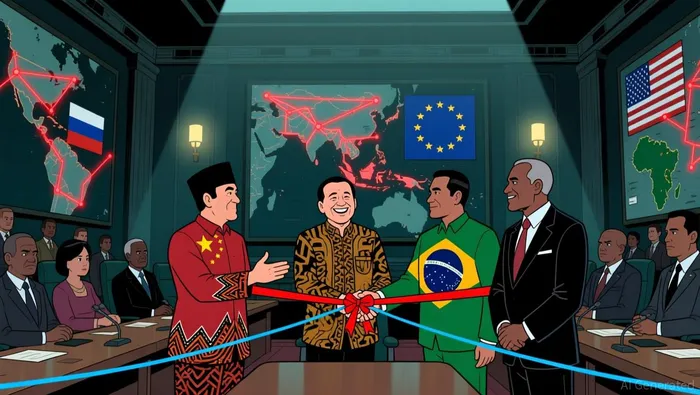
Indonesia's pivot toward China and BRICS has redefined its global positioning. The Prabowo administration's emphasis on "multi-alignment" has seen the country deepen ties with Beijing, including a controversial joint statement on the South China Sea, according to an ISEAS Perspective. This move, while signaling a departure from traditional Western alliances, has raised concerns about geopolitical tensions. For instance, the lack of coordination with domestic experts in formulating such agreements has drawn criticism, highlighting potential instability in foreign policy coherence, as noted in a Boell analysis.
The BRICS membership, secured in January 2025, further underscores Indonesia's ambition to leverage the Global South for economic growth, according to a Valdaic Club report. However, this alignment carries risks. As noted by analysts, Indonesia's reliance on BRICS financing mechanisms like the New Development Bank could expose it to geopolitical friction with the US and EU, as highlighted in a ThinkChina article. The potential for retaliatory tariffs from Western partners, particularly under a Trump administration, adds another layer of uncertainty, as assessed in a Fulcrum analysis.
Regulatory Uncertainty: Balancing Reform and Protectionism
Domestically, Indonesia's regulatory environment presents a mixed picture. The 2020 Omnibus Law on Job Creation and the elimination of the Negative Investment List have streamlined access to key sectors, according to the US State Department. Yet, persistent challenges such as local content requirements and bureaucratic inefficiencies continue to deter foreign investors. For example, Apple's $1 billion investment in Indonesia-mandated to meet domestic content regulations for the iPhone 16-illustrates the tension between protectionist policies and investor flexibility, as noted in a Business Times report.
The government's push for downstream industrialization, including in electric vehicles and semiconductors, is a strategic move to capture higher-value supply chains, according to the US State Department. However, reliance on coal for energy and inconsistent enforcement of intellectual property rights remain red flags for sustainability-focused investors, as noted in a BenarNews report.
Case Studies: Navigating the New Normal
The Lotte Chemical Indonesia project-a $4 billion investment in petrochemicals-exemplifies the potential for large-scale foreign capital under Prabowo's pro-investment rhetoric, as reported by Tempo. Yet, this success is juxtaposed with broader challenges. The Prabowo administration's expansion of military influence in civilian governance has sparked social unrest, complicating the business environment, according to a US News report. Meanwhile, the government's downstreaming agenda, while ambitious, risks alienating investors accustomed to more flexible regulatory frameworks, as seen in Vietnam's competitive edge, as noted in a Business Times report.
Investor Reactions and Strategic Considerations
Investor sentiment remains cautiously optimistic. In 2024, FDI inflows reached $16.65 billion, driven by Singapore, China, and the Netherlands, according to an LMI report. However, geopolitical volatility and regulatory ambiguity are prompting firms to adopt hedging strategies. For instance, some multinational corporations are diversifying supply chains across ASEAN to mitigate risks tied to Indonesia's policy shifts, as noted in a ThinkChina article.
Conclusion: A Calculated Approach to Risk
Indonesia's political and geopolitical trajectory offers a compelling case study in balancing ambition with pragmatism. While the country's economic scale and strategic location remain attractive, investors must navigate a landscape marked by regulatory flux and geopolitical tensions. The key lies in aligning long-term strategies with Indonesia's evolving priorities-whether through partnerships that navigate local content requirements or diversification across regional markets. As the Prabowo administration charts its course, the investment community will need to remain agile, informed, and prepared for both opportunities and headwinds.







Comentarios
Aún no hay comentarios