
Why Indonesia's Long-Term Bonds Remain a Strategic Buy Despite Political Turmoil
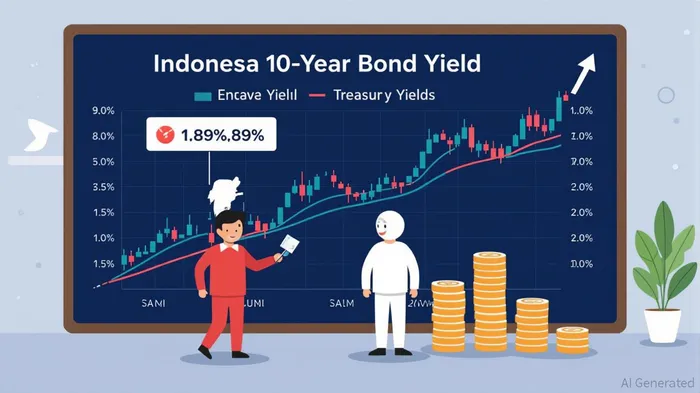
In an era of global uncertainty, emerging market debt has long been a double-edged sword for investors—offering high yields but often at the cost of volatility. Yet, Indonesia’s long-term bonds stand out as a rare exception. Despite political instability under President Prabowo Subianto’s administration and the lingering shadow of U.S.-China trade tensions, Indonesia’s 10-year government bond yield has stabilized at 6.5–6.9% in 2025, offering a 250-basis-point premium over U.S. Treasuries [1]. This yield, combined with a relatively modest political risk premium of 1.89% (as measured by country default spreads), makes Indonesia a compelling case for diversification in emerging market portfolios [2].
The Bank of Indonesia’s (BI) dovish monetary policy has been a key driver of this resilience. By cutting the benchmark interest rate to 5.5% by mid-2025 and unwinding short-term rupiah securities, the central bank has created a favorable environment for long-term bondholders [3]. Meanwhile, inflation remains within the BI’s target range of 1.5–3.5%, and the 2025 budget deficit is projected at just 2.8% of GDP, reinforcing fiscal credibility [1]. These fundamentals have allowed Indonesia to maintain stable credit ratings (BBB/A-2 from S&P and Fitch) and attract foreign investors seeking yield in a low-interest-rate world [4].
What sets Indonesia apart is its risk-adjusted return profile. While other emerging markets grapple with higher political risk premiums—Brazil at 2.48%, Belarus at 17.50%—Indonesia’s 1.89% spread reflects a balance between macroeconomic stability and manageable external vulnerabilities [2]. This is particularly striking given the country’s exposure to global trade tensions, including a 125% tariff on Chinese goods, which have pushed risk premiums higher in other regions [3]. Indonesia’s controlled inflation and growing economy (5.03% GDP growth in 2024) further insulate it from the worst effects of these shocks [4].
For investors, the appeal lies in diversification. Indonesia’s bond market offers a unique combination of yield, liquidity, and institutional support. The steepening yield curve—driven by shifting investor demand and central bank intervention—has widened the spread between 2- and 10-year bonds to its highest level since June 2023, creating opportunities for duration strategies [3]. Moreover, the country’s stable credit ratings and strong domestic liquidity position it as a safer harbor compared to more volatile peers [1].
Of course, risks remain. A shift in U.S. monetary policy or a spike in global trade tensions could trigger capital outflows, pushing yields higher. However, Indonesia’s macroeconomic resilience—evidenced by its controlled inflation and growing fiscal stimulus—provides a buffer. Analysts suggest that yields might need to rise to 7.5% to fully attract foreign capital, but the current 6.5–6.9% range already offers an attractive entry point for patient investors [5].
In conclusion, Indonesia’s long-term bonds are not just a tactical play but a strategic one. They offer a rare blend of yield, stability, and diversification in a world where emerging markets are often dismissed as too risky. For investors willing to navigate the political noise, the rewards are clear—and the data supports it.
Source:[1] Indonesia's Benchmark Yield Decline: A Strategic Buying Opportunity in Emerging Market Debt [https://www.ainvest.com/news/indonesia-benchmark-yield-decline-strategic-buying-opportunity-emerging-market-debt-2508/][2] Country Default Spreads and Risk Premiums [https://pages.stern.nyu.edu/~adamodar/New_Home_Page/datafile/ctryprem.html][3] Indonesia's Yield Curve May Steepen as BI Unwinds Intervention [https://www.bloomberg.com/news/articles/2025-06-26/indonesia-s-yield-curve-may-steepen-as-bi-unwinds-intervention][4] Indonesia 10-Year Bond Yield [https://www.investing.com/rates-bonds/indonesia-10-year-bond-yield][5] Indonesian Bonds No Longer Darlings in Emerging Markets [https://www.fastbull.com/news-detail/indonesian-bonds-no-longer-darlings-in-emerging-markets-551859_0]







Comentarios
Aún no hay comentarios