
Indie Semiconductor's Positioning in the AI Chip Supply Chain: Strategic Growth and First-Mover Advantage in Edge AI Computing
The global semiconductor industry is undergoing a seismic shift driven by the rise of artificial intelligence (AI), with edge computing emerging as a critical battleground for innovation. Indie SemiconductorINDI--, a specialist in edge AI solutions, has positioned itself at the forefront of this transformation through a combination of strategic acquisitions, product differentiation, and early market adoption. As market projections show, the edge AI chips market is projected to grow from $8.3 billion in 2025 to $36.12 billion by 2034 at a 17.75% CAGR, Indie's ability to capitalize on its first-mover advantage and expand its ecosystem could determine its long-term success in this high-stakes arena.
Strategic Partnerships and Acquisitions: Building a Robust Ecosystem
Indie Semiconductor's 2025 growth trajectory has been anchored by its aggressive pursuit of strategic partnerships and acquisitions to strengthen its edge AI portfolio. In Q2 2025, the company acquired emotion3D GmbH, a leader in automotive computer vision software, to enhance the capabilities of its flagship iND880 vision processor. This acquisition not only expanded Indie's hardware offerings but also created a new revenue stream through software royalties, diversifying its business model beyond traditional chip sales.
Earlier in 2024, IndieINDI-- announced a strategic investment in Expedera Inc, a developer of scalable Neural Processing Unit (NPU) IP, to integrate AI-enabled processing into its Advanced Driver Assistance Systems (ADAS) solutions. By leveraging Expedera's packet-based NPU architecture, Indie aims to deliver over 100 TOPS of edge AI performance while optimizing power efficiency and latency-a critical differentiator in automotive and robotics applications.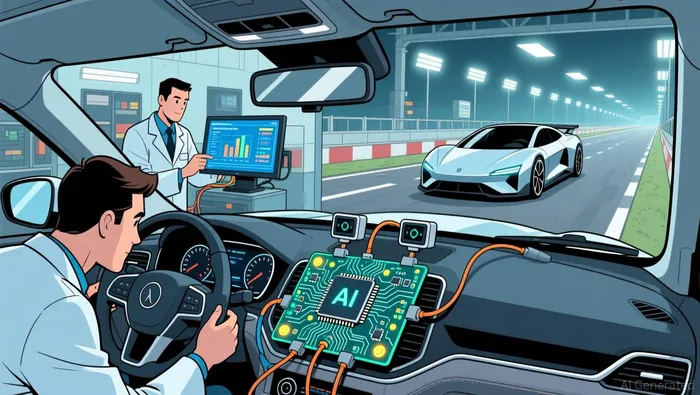 These moves underscore Indie's commitment to building a vertically integrated ecosystem that combines hardware, software, and IP to address the complex demands of edge AI.
Market Adoption and Revenue Growth: Validating the Edge AI Play
Indie's market adoption metrics in 2025 highlight its growing influence in edge AI computing. The company reported $51.6 million in revenue for Q2 2025, with a Non-GAAP gross margin of 49.1%, reflecting strong pricing power and operational efficiency. Key milestones include the commencement of production for its 77GHz radar solution and the iND880 vision processor, which secured design wins with Chinese and North American OEMs for in-cabin monitoring and humanoid robot applications.
The iND880's deployment in humanoid robotics is particularly noteworthy, as it aligns with the surging demand for real-time AI processing in next-generation automation. Additionally, Indie's expansion into quantum applications and camera shipments for robotics signals a diversification of use cases, reducing reliance on any single market segment. These achievements position Indie as a key supplier for industries prioritizing edge AI, including automotive, industrial automation, and consumer electronics.
First-Mover Advantage: Outpacing Competitors in Niche Markets
Indie's first-mover advantage in edge AI is evident in its early capture of niche markets where real-time processing and low latency are critical. The company's 77GHz radar solution, for instance, has gained traction through global field trials, with production expected to ramp up in 2025. This timing aligns with the automotive industry's shift toward autonomous driving, where radar and vision processors are essential for sensor fusion and object detection.
Compared to broader competitors like TSMC, which dominates the foundry market with a projected 66% share in 2025, Indie's focus on specialized edge AI chips allows it to avoid direct competition in commodity segments. Instead, it targets high-margin applications where differentiation through proprietary IP and software integration is key. For example, the iND880's integration of emotion3D's perception software creates a unique value proposition for automotive OEMs seeking advanced in-cabin monitoring systems.
Competitive Landscape and Future Outlook
While TSMC and other foundries dominate general semiconductor manufacturing, Indie's edge AI strategy is tailored to capitalize on vertical-specific opportunities. The global edge AI chips market, valued at $23.02 billion in 2024, is expected to reach $136.57 billion by 2035 at a 17.57% CAGR, driven by demand for smart devices and real-time data processing. Indie's early adoption of NPU IP and its expansion into software royalties position it to capture a disproportionate share of this growth, particularly in automotive and robotics.
However, challenges remain. The edge AI market is highly competitive, with players like NVIDIA and Qualcomm also investing heavily in specialized chips. Indie's success will depend on its ability to maintain technological leadership, scale production efficiently, and secure long-term partnerships with OEMs. Its recent design wins and strategic acquisitions suggest it is well-positioned to do so, but execution risks-such as supply chain disruptions or slower-than-expected adoption-could impact its trajectory.
Conclusion: A Compelling Case for Long-Term Investment
Indie Semiconductor's strategic investments in IP, software, and niche markets have solidified its role as a first-mover in edge AI computing. With a robust pipeline of products, strong gross margins, and a clear vision for vertical integration, the company is well-positioned to benefit from the $36.12 billion edge AI chips market by 2034. For investors, Indie represents a high-conviction opportunity in a sector poised for exponential growth, provided it continues to execute on its innovation and partnership strategies.





Comentarios
Aún no hay comentarios