
India's Underreported Labor Crisis: Gender Gaps and the Demographic Dividend's Double-Edged Sword
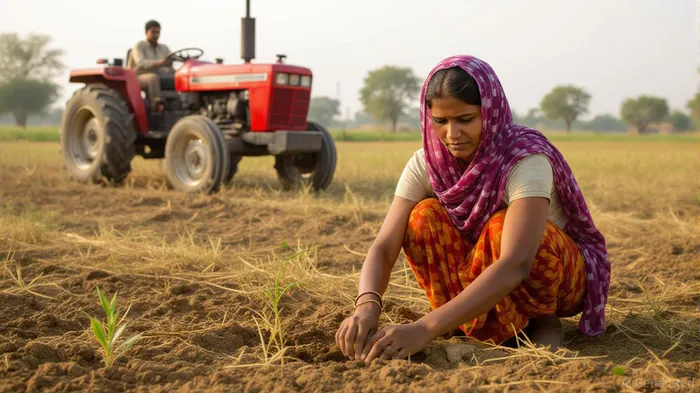
India's demographic dividend—the nation's youthful, growing working-age population—has long been touted as a golden opportunity for economic growth. Yet, beneath the surface of this narrative lies a stark and underreported crisis: a gender employment gap that threatens to undermine the very sectors poised to benefit from demographic tailwinds. For investors, the risks are not abstract. They are material, sector-specific, and increasingly urgent.
The Gender Gap: A Productivity Black Hole
India's labor force participation rate (LFPR) for women in 2025 stands at 30.2% nationally, with rural women at 33.6% and urban women at 22.9%. This is among the lowest in the world, even as the country's working-age population is projected to hit 1.1 billion by 2040. The gender gap is not just a social issue; it is a productivity black hole. In agriculture, the largest employer of India's female labor force, women manage 12.78% of operational landholdings but produce 11% less value than male-managed farms due to limited access to credit, machinery, and irrigation.
For investors in agribusiness or rural infrastructure, this means underutilized assets and constrained growth. Companies like ITC Ltd. and Mahindra & Mahindra, which provide agricultural inputs and machinery, face a paradox: their markets are saturated with potential users who lack the capital or access to adopt their products. Similarly, firms investing in rural electrification or digital banking (e.g., Paytm, PhonePe) must contend with a labor force where women's unpaid domestic labor absorbs 7–10 times more time than men's, limiting their ability to engage in income-generating activities.
Manufacturing: A Sector on the Brink
India's manufacturing sector, a key target for the government's “Make in India” initiative, is equally constrained. While 12% of the manufacturing workforce is female, this figure masks significant regional and sectoral disparities. Tamil Nadu, for instance, has 43% female representation in manufacturing, driven by textile and automotive firms like Arvind Mills and Tata Motors. However, nationwide, women constitute less than 1 in 8 factory workers.
The implications for investors are twofold. First, the lack of skilled female labor limits the scalability of labor-intensive industries. Second, gender segregation in the workplace—exacerbated by cultural norms and inadequate amenities like childcare—reduces innovation and productivity. For example, Apple's India factory ecosystem, which employs 72% women, has seen productivity gains from automation and policy reforms like night-shift allowances. Yet, such progress is localized. Broader adoption of gender-inclusive policies remains rare, leaving investors exposed to labor shortages and reputational risks in global supply chains.
Services: The Urban Paradox
The services sector, India's GDP powerhouse (contributing nearly 50% of GDP), appears more resilient. Women's participation in urban services jobs is 40.1%, with growth in IT, healthcare, and education. However, this masks the informalization of female labor. Over 71.5% of women-owned micro-enterprises are in manufacturing, with the rest in services and trading—often in precarious, low-margin roles.
For investors in fintech or edtech, this presents a mixed landscape. While urban women are increasingly accessing digital services (e.g., Paytm's UPI transactions have grown 300% since 2020), the sector's reliance on informal labor means that growth is uneven and vulnerable to regulatory shifts. For instance, a recent Supreme Court ruling mandating equal pay for equal work could disrupt low-cost labor models but also unlock untapped potential.
Long-Term Investment Risks: A Sectoral Breakdown
- Agriculture:
- Risk: Low female productivity and informal labor undermine rural income growth, limiting demand for agri-tech and supply-chain innovations.
Opportunity: Firms addressing gender-specific barriers (e.g., crop insurance for women, mobile-based agronomy services) could capture a niche market.
Manufacturing:
- Risk: Gender gaps reduce labor pool diversity and innovation. Firms reliant on unskilled labor (e.g., textile manufacturers) face scalability limits.
Opportunity: Automation-focused companies (e.g., Tata Elxsi, Wipro) and those investing in skilling programs for women (e.g., Apollo Tyres) are better positioned.
Services:
- Risk: Informalization of female labor in services (e.g., domestic work) creates instability and regulatory uncertainty.
- Opportunity: Edtech and upskilling platforms (e.g., BYJU'S, Unacademy) that target women in Tier 2–3 cities could see strong growth.
Conclusion: A Call for Strategic Rebalancing
India's demographic dividend is not a guaranteed windfall. For investors, the gender employment gap represents a systemic risk that cannot be ignored. Sectors reliant on formal labor force growth—agriculture, manufacturing, and services—must be evaluated through a gender lens. Those that fail to address these gaps risk underperformance, while those that innovate around inclusion stand to reap disproportionate rewards.
The path forward requires more than capital. It demands a reimagining of labor policies, infrastructure investments (e.g., childcare centers, safe transportation), and corporate strategies that prioritize gender equity. For investors willing to act early, the rewards could be transformative. For those who wait, the window may close by 2040, when India's demographic dividend peaks and the cost of inaction becomes irreversible.







Comentarios
Aún no hay comentarios