
India-US Trade Uncertainty: Navigating Risk-Adjusted Opportunities in Export Stocks

The India-US trade relationship has reached a pivotal crossroads. With U.S. President Donald Trump's looming 25% tariff threat—set to begin on August 1, 2025—and stalled negotiations over market access, Indian exporters are bracing for a potential recalibration of their global strategies. While the U.S. seeks concessions on agriculture, data governance, and non-tariff barriers, India remains firm on its red lines, particularly in sectors like dairy and agriculture. For investors, this uncertainty creates a complex landscape: some export-driven stocks face near-term headwinds, while others may benefit from India's strategic positioning in global supply chains.
The High-Stakes Tariff Deadline
The U.S. has framed its demands around “reciprocity,” pushing India to reduce its high average tariffs (39% on agricultural goods) and open its market to American agricultural and dairy products. India, however, has resisted, citing the livelihoods of 70% of its rural population and its reliance on Russian energy and arms. This standoff has left key export sectors—pharmaceuticals, textiles, gems and jewelry, and petrochemicals—exposed to potential tariffs. The U.S. has already imposed a 26% reciprocal tariff on Indian exports since April 2025, and further hikes could erode margins for companies like Cipla Ltd., Shriram Industries, and Tanishq.
Yet, India's strategic leverage is growing. As U.S. tariffs rise against China and other trade partners, India's export competitiveness in sectors like pharmaceuticals and textiles is gaining traction. The U.S. now imports 25% of its generic drugs from India and 68% of its textile imports, making India a critical player in U.S. supply chains. The challenge for investors is to identify stocks that can weather short-term volatility while capitalizing on long-term structural advantages.
Sector-Specific Risks and Resilience
Pharmaceuticals: Sun Pharmaceutical Industries and Cipla Ltd.
The pharmaceutical sector is both a vulnerability and a strength. India's 40% share of global active pharmaceutical ingredient (API) production makes it indispensable to U.S. drugmakers, but rising tariffs could disrupt this dynamic. Sun Pharmaceutical Industries, India's largest pharma exporter, has a debt-to-equity ratio of 0.45 as of March 2025, indicating moderate leverage, while Cipla Ltd. maintains near-zero debt. Both companies have expanded U.S. manufacturing partnerships to mitigate regulatory and tariff risks.
Sun Pharma's 18.61% net profit margin and 17.59% return on equity (ROE) highlight its operational efficiency, but investors must monitor its exposure to U.S. tariffs on APIs. Cipla's 38.6% quarter-on-quarter profit growth in Q1 2025 suggests resilience, though its North American sales dipped 7% due to pricing pressures. A risk-adjusted approach here might favor Cipla for its lower debt and diversification into generics and branded drugs.
Textiles: Shriram Industries and Arvind Ltd.
The textile sector, which accounts for 61% of India's exports to the U.S., faces a 26% tariff that could cut into margins. Shriram Industries and Arvind Ltd. are mitigating this by diversifying into Europe and Southeast Asia. Arvind Ltd. reported Q2 2025 revenue of ₹2,188 crore, up 14%, but its PBT fell to ₹67.46 crore, reflecting higher logistics costs and deferred tax adjustments.
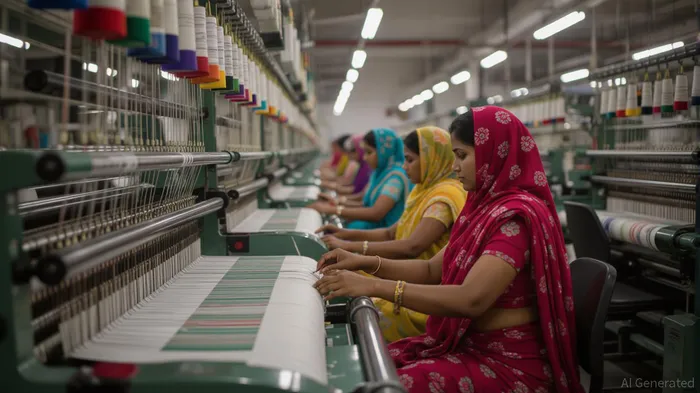
Shriram Industries, meanwhile, is pivoting to value-added products like technical textiles, which are less price-sensitive. Both companies have strong balance sheets—Arvind's EBITDA margin of 11% and Shriram's 10.3%—but their reliance on U.S. demand remains a risk. Investors should prioritize stocks with clear diversification strategies and automation investments.
Gems and Jewelry: Tanishq
India's dominance in cut and polished diamonds (61% of U.S. imports) positions Tanishq as a high-growth name. However, a 26% tariff could pressure margins. Tanishq's mitigation strategy includes automation and e-commerce expansion, with a 15–20% projected export boost if tariffs are cut. The company's EBITDA margins remain robust, but its exposure to U.S. retail channels—a sector sensitive to tariffs—requires caution.
Petrochemicals: Bharat Forge
Bharat Forge, a key supplier of auto components, faces a 26% tariff but is countering with domestic production expansion and U.S. joint ventures. Its Q4 2025 revenue of ₹2,221 crore (up 7% YoY) and 12.4% EBITDA margin suggest resilience. However, the sector's margin pressures and exposure to global auto demand make it a higher-risk play.
Strategic Opportunities Amid Uncertainty
- Diversification Plays: Companies like Shriram Industries and Tanishq are expanding into Europe and Southeast Asia, reducing U.S. dependency.
- Automation and Cost Efficiency: Arvind Ltd.'s 25-year renewable energy PPA and Sun Pharma's U.S. manufacturing partnerships are exemplary of cost-optimization strategies.
- Policy-Driven Gains: India's “Make in India” and API localization initiatives could bolster long-term competitiveness in pharma and textiles.
Investment Takeaways
- Short-Term Caution: Investors should adopt a defensive stance in sectors like pharma and textiles until the August 1 deadline.
- Long-Term Focus: Prioritize companies with strong balance sheets, diversification, and automation. Cipla and Arvind Ltd. fit this profile.
- Tariff Arbitrage: Look for firms capitalizing on India's growing trade advantages, such as Sun Pharma in APIs or Tanishq in diamonds.
The India-US trade negotiations are a test of both nations' economic priorities. For investors, the key lies in balancing near-term risks with India's structural strengths. As the August 1 deadline approaches, the market's response will likely hinge on whether a “mini deal” materializes—or if the U.S. tariffs trigger a broader recalibration of global trade dynamics.







Comentarios
Aún no hay comentarios