
India's Below-Target Inflation and Central Bank Policy Shifts: Timing and Impact on Emerging Market Equities and Debt
India's Reserve Bank of India (RBI) has navigated a delicate balancing act in 2025, maintaining macroeconomic stability while responding to evolving domestic and global conditions. With inflation cooling to a five-month low of 2.7% in August 2025 and projected to fall further to 2.6% in FY26-well below its 4% target-the central bank has adopted a neutral policy stance, keeping the repo rate unchanged at 5.5% since June, according to a Finnovate analysis. This decision reflects a strategic pause to assess the efficacy of earlier rate cuts and to preserve flexibility amid global uncertainties such as U.S. tariffs on Indian exports, as noted in a Times Now liveblog. The RBI's approach has had cascading effects on India's equities and debt markets, offering insights into how emerging markets can leverage monetary easing to bolster growth without sacrificing price stability.
Timing the Easing: A Gradual Approach to Stimulate Growth
The RBI's monetary easing began in earnest in early 2025, with a cumulative 100 basis point (bps) reduction in the repo rate by June, according to a Grip Invest write-up. This aggressive but measured easing was designed to stimulate credit growth, support private investment, and offset the drag from global trade tensions. The timing of these cuts was critical: they coincided with a period of moderating inflation and robust domestic demand, allowing the RBI to prioritize growth without triggering inflationary pressures. By October 2025, the central bank had opted to hold rates steady, signaling confidence in the transmission of earlier cuts and a desire to avoid overstimulating an economy already showing signs of resilience, as discussed in the Times Now liveblog.
This cautious approach contrasts with the more abrupt policy shifts seen in some other emerging markets, where central banks have struggled to balance inflation control with growth objectives. India's gradual easing has provided markets with clarity, enabling investors to adjust to lower borrowing costs and anticipate future policy moves. For instance, the June 2025 rate cut spurred a surge in foreign institutional investor (FII) inflows, pushing the Nifty 50 and Sensex to record highs, according to a ConcallAnalysis report. The RBI's decision to pause further cuts in October, however, introduced a degree of caution, as markets weighed the benefits of sustained low rates against potential risks from external shocks, a point highlighted in a LiveMint update.
Impact on Equities: Sectoral Winners and Structural Reforms
The RBI's monetary easing has had a pronounced effect on India's equity markets, particularly in sectors sensitive to interest rates. Banking stocks, for example, have benefited from improved credit growth and reduced deposit rates, while real estate and automobile sectors have seen renewed demand due to lower borrowing costs (see the Grip Invest write-up). The Nifty 50's performance in 2025 underscores this trend: after a 100-bps rate cut in early 2025, the index surged, outperforming many of its emerging market counterparts (the ConcallAnalysis report).
Structural reforms, such as the Goods and Services Tax (GST) cuts and infrastructure investments, have further amplified the positive impact of monetary easing. The RBI's revised GDP growth forecast of 6.8% for FY26-up from earlier projections-reflects the combined effect of these policies (the Finnovate analysis). However, the equity market's trajectory has not been linear. Concerns over U.S. trade tariffs and geopolitical risks led to volatility in late August and September 2025, though the market rebounded on strong Q1 GDP growth numbers and domestic institutional buying (the ConcallAnalysis report). This resilience highlights India's unique position as an emerging market with strong domestic demand and a diversified economic base.
Debt Markets: Stability and Strategic Reallocations
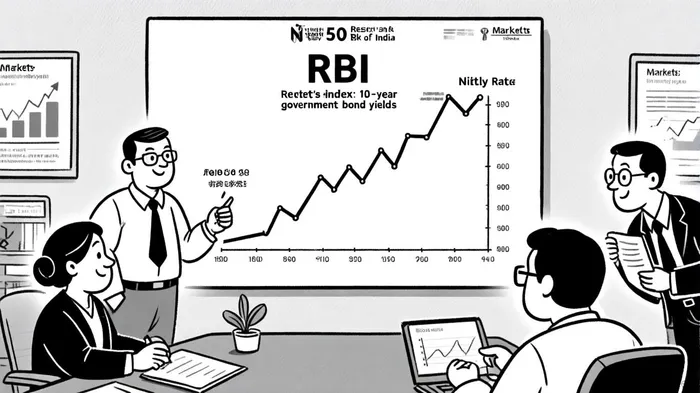
In the debt market, the RBI's rate cuts have stabilized bond yields and reshaped investor strategies. The 10-year government bond yield fell to 6.30% in July 2025, a direct response to the 50-bps rate cut in June, according to a Grip Invest analysis. This decline created a yield differential of over 250 bps compared to U.S. Treasuries, which stood at 3.8% in July (the ConcallAnalysis report). The resulting attractiveness of Indian bonds has drawn foreign capital, particularly as global funds rebalanced portfolios to meet benchmarks following India's inclusion in global bond indices (the ConcallAnalysis report).
Corporate bond markets have also benefited, with lower borrowing costs encouraging issuances in sectors like infrastructure and renewable energy (the ConcallAnalysis report). Investors have adopted a barbell strategy, allocating to both short- and long-duration instruments to capitalize on the yield curve's stability (the Grip Invest analysis). This approach contrasts with the more defensive strategies seen in other emerging markets, where debt supercycles and currency volatility have constrained risk-taking.
Comparative Advantage: India vs. Other Emerging Markets
India's monetary policy and market response in 2025 highlight its comparative advantage over many of its emerging market peers. While countries like Brazil and South Africa grapple with high public debt and currency pressures, India's robust fiscal consolidation, strong banking sector balance sheets, and self-reliant economic model have insulated it from global headwinds (the Finnovate analysis). The RBI's adherence to Basel III norms and the Expected Credit Loss (ECL) framework has further bolstered investor confidence, attracting global capital to both equity and debt markets (the Finnovate analysis).
However, challenges remain. The U.S. Federal Reserve's potential reversal of its easing stance could reintroduce volatility, particularly if global investors shift focus to higher-yielding developed markets (the ConcallAnalysis report). Additionally, India's reliance on domestic demand means external shocks-such as a slowdown in global trade-could still test the economy's resilience.
Conclusion: A Model for Emerging Market Policy
India's 2025 experience offers a blueprint for emerging markets seeking to balance growth and stability. The RBI's neutral stance, combined with timely rate cuts and structural reforms, has created a favorable environment for equities and debt markets without compromising inflation control. As global central banks navigate the next phase of the rate-cutting cycle, India's approach-anchored by macroeconomic fundamentals and a resilient financial system-provides a compelling case study in prudent monetary management (the Finnovate analysis).







Comentarios
Aún no hay comentarios