
India's Structural Reforms and Economic Momentum: Untapped Opportunities for U.S. Investors
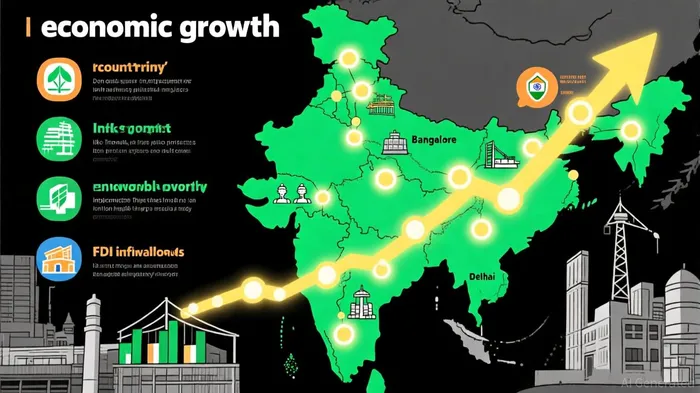
India's economic narrative in 2025 is being reshaped by a wave of structural reforms that remain underappreciated by global investors. While much of the world remains preoccupied with geopolitical uncertainties, India's policymakers have quietly engineered a transformation that positions the country as a compelling long-term investment destination. For U.S. investors, the confluence of consumption-driven growth, infrastructure modernization, and investor-friendly policies offers a unique window to capitalize on India's evolving economy.
Structural Reforms: Catalyzing Consumption and Investment
At the heart of India's economic momentum is the Next-Gen GST reform, implemented in late October 2025. By slashing GST rates on essentials like food, healthcare, and education, the reform has directly boosted household consumption, which accounts for 60% of India's GDP. For instance, the reduction of GST on automobiles and electronics to 18% from 28% has spurred demand in the durable goods sector, signaling a policy shift to support middle-class spending [1]. These measures are already showing results: consumer staples and automotive sectors have rebounded, while domestic mutual funds have repositioned portfolios to capitalize on the consumption boom [1].
Complementing these reforms are broader fiscal and regulatory changes. The Union Budget 2025–26 introduced tax simplification, reduced compliance burdens, and liberalized FDI norms, including 100% foreign ownership in insurance sectors where premiums are reinvested in India. Simplified compliance rules for global treasury centers in Gujarat's GIFT City are also attracting foreign financial institutions [3]. These reforms are critical in addressing long-standing bottlenecks, such as labor market rigidity and infrastructure gaps, while enhancing India's ease of doing business [2].
Infrastructure: A $1.4 Trillion Opportunity
India's infrastructure sector is a cornerstone of its growth strategy, with the National Infrastructure Pipeline (NIP) targeting $1.4 trillion in investments by 2025. This includes transformative projects under the Gati Shakti initiative, which integrates logistics, energy, and urban development. For U.S. investors, the focus on renewable energy, smart cities, and digital infrastructure presents high-impact opportunities.
The Green Hydrogen Mission, for example, aims to position India as a global leader in clean energy. With FDI allowed at 100% under the automatic route, U.S. firms are well-positioned to participate in solar, wind, and green hydrogen projects. The Union Budget 2025 further incentivized this transition by waiving Inter-State Transmission System (ISTS) charges for solar and wind power until June 2026 [5]. Similarly, the "Make in India" initiative, bolstered by Production Linked Incentive (PLI) schemes, is attracting manufacturing investments as companies diversify supply chains away from China [2].
U.S. firms like Microsoft and Amazon have already expanded their footprints in India, with Microsoft committing $3 billion to cloud and AI infrastructure and Amazon investing $8.2 billion in Maharashtra for logistics and cloud services [4]. These investments underscore India's appeal as a hub for innovation and scale.
U.S. Investor Participation: Momentum and Policy Tailwinds
Recent data highlights growing U.S. interest in India's equities and infrastructure. Foreign portfolio investors (FPIs) injected over $4.1 billion into Indian equities over nine consecutive sessions in early 2025, lifting the Nifty 50 index by 6.6% [4]. This momentum is supported by India's projected 6.7% GDP growth for 2025 (OECD forecast) and structural reforms that enhance long-term predictability for investors [3].
Policy incentives are further amplifying this trend. The Liberalised Remittance Scheme (LRS) saw a 78% year-on-year surge in overseas investments in 2024, as Indian investors sought to diversify into global assets [1]. For U.S. firms, this reflects a maturing market with sophisticated capital flows. Additionally, the U.S.-India trade relationship—aiming to double bilateral trade to $500 billion by 2030—provides a strategic tailwind [2].
Challenges and the Path Forward
Despite progress, challenges persist. India's corporate bond market remains underdeveloped (18% of GDP vs. 80% in South Korea), and infrastructure bottlenecks continue to hinder growth [1]. However, the government's emphasis on expanding the bond market, streamlining land acquisition, and modernizing labor laws signals a commitment to addressing these issues [3].
For U.S. investors, the key lies in leveraging India's structural reforms while navigating short-term volatility. The country's three-year and five-year annualized returns in emerging markets (9.96% and 13.4%, respectively) highlight its resilience [1].
Conclusion
India's underappreciated structural reforms—from GST overhauls to infrastructure megaprojects—are creating a fertile ground for U.S. investors. While global attention remains fixated on short-term risks, India's policymakers and private sector are building a foundation for sustained growth. For those willing to look beyond the noise, the opportunities in equities, renewable energy, and manufacturing are not just compelling—they are transformative.







Comentarios
Aún no hay comentarios