
India’s Strategic Shift in Foreign Reserves and Its Implications for Global Markets
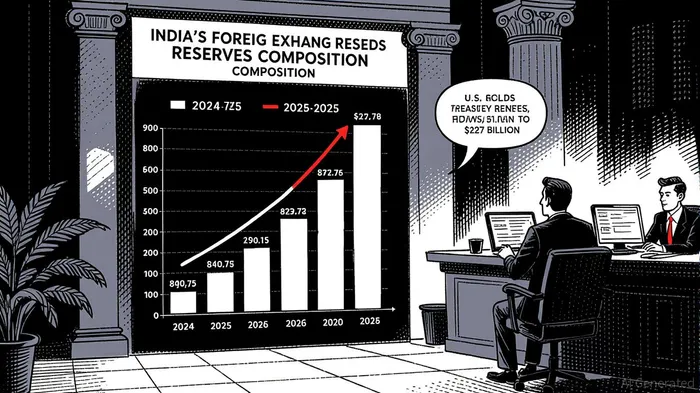
India’s Reserve Bank (RBI) has embarked on a calculated and strategic reallocation of its foreign exchange reserves in 2025, signaling a broader macroeconomic hedging approach amid global uncertainties. By increasing gold holdings and reducing exposure to U.S. Treasuries, the RBI is not only diversifying its reserve portfolio but also positioning India to navigate geopolitical risks, inflationary pressures, and currency volatility. These moves, coupled with a sovereign rating upgrade and evolving global investor sentiment, are creating new opportunities for both domestic and international markets.
Gold as a Strategic Hedge
India’s gold reserves have surged to 879.98 metric tonnes as of June 2025, up from 840.76 tonnes a year earlier, with the total value reaching $86.769 billion [1]. This represents a 12.1% allocation of India’s forex reserves, a significant shift from the previous dollar-centric model [3]. The RBI’s strategy aligns with a global trend of central banks diversifying away from U.S. dollar assets. For instance, India’s holdings of U.S. Treasury bills have declined to $227 billion in June 2025 from $242 billion in 2024 [1]. This de-dollarization effort is driven by concerns over U.S. fiscal deficits, geopolitical tensions, and the volatility of the greenback.
Gold’s role as a safe-haven asset has been amplified by rising inflation and geopolitical instability. According to J.P. Morgan Research, gold prices are projected to average $3,675 per ounce in Q4 2025 and could reach $4,000 by mid-2026, fueled by central bank purchases and trade uncertainties [3]. India’s gold reserve expansion is not merely a defensive move but also a proactive step to anchor its reserves in a tangible, inflation-resistant asset. As Madhavankutty G of Canara Bank notes, the RBI is “waiting for clearer geopolitical cues” before further increasing gold purchases, indicating a measured approach to risk management [3].
Debt Reallocation and Geopolitical Prudence
The RBI’s reduction in U.S. debt exposure reflects a broader recalibration of India’s external liabilities. By trimming its holdings of U.S. Treasuries, India is mitigating risks tied to potential U.S. interest rate hikes and geopolitical leverage. This strategy is particularly relevant given the U.S.-China trade tensions and the Indo-Pak conflict in May 2025, which have heightened global market volatility [4].
Simultaneously, India’s forex reserves now include $18.547 billion in Special Drawing Rights (SDRs) and a $4.3 billion IMF reserve position [1]. These instruments enhance India’s liquidity buffer while reducing reliance on any single currency. The RBI’s monetary policy interventions—such as cutting the policy rate by 100 basis points to 5.5% in 2025 and injecting ₹40,000 crore via open market operations—further underscore its commitment to stabilizing the rupee and supporting domestic growth [5].
Implications for Global Investors
India’s strategic reallocation is reshaping its appeal to global investors. A sovereign rating upgrade by MorningstarMORN-- DBRS in early 2025—from BBB (low) to BBB—has bolstered confidence in India’s macroeconomic stability [1]. This upgrade, combined with India’s inclusion in global bond indices, is expected to attract $15–20 billion in foreign portfolio inflows, according to experts [2]. The India-U.S. bond yield spread, now at a 2-decade low of 227 basis points, may initially deter some investors, but the resilience of India’s services sector and fiscal discipline could offset these concerns [1].
For equity markets, the reallocation from debt to equity is gaining traction. Sectors such as automobile, contract development and manufacturing organizations (CDMO) pharma, and capital goods are poised to benefit from domestic demand and global supply chain shifts [2]. Additionally, the RBI’s new goldNGD-- loan guidelines—standardizing valuation processes and interest rate disclosures—have created a more transparent framework for gold-backed financing, potentially unlocking $5–7 billion in liquidity for small and medium enterprises [4].
Investment Opportunities and Risks
Global investors should monitor three key areas:
1. Gold ETFs and Sovereign Bonds: India’s gold reserve growth and rating upgrade make its sovereign bonds and gold ETFs attractive for diversified portfolios. The RBI’s gold-backed instruments could offer a hedge against dollar depreciation.
2. Emerging Sectors: The automobile and pharma sectors, supported by India’s services-led growth and digital transformation, are likely to outperform amid global supply chain realignments [2].
3. Currency Dynamics: The USD/INR rate, currently near 86.89, remains sensitive to U.S. monetary policy. A weaker rupee could boost India’s export competitiveness but may also increase import costs for energy and commodities [5].
Conclusion
India’s strategic shift in foreign reserves reflects a sophisticated approach to macroeconomic hedging. By diversifying into gold and reducing dollar exposure, the RBI is insulating the economy from global shocks while enhancing long-term stability. For global investors, this transition presents opportunities in gold-linked assets, Indian sovereign bonds, and high-growth sectors. However, vigilance is required to navigate currency risks and geopolitical uncertainties. As India’s forex reserves near $700 billion, its evolving strategy underscores the importance of adaptability in an interconnected world.
Source:
[1] India's forex reserves rise $3.5 billion: RBI reports higher gold holdings, IMF reserve position also improves [https://timesofindia.indiatimes.com/business/india-business/indias-forex-reserves-rises-3-5-billion-rbi-reports-higher-gold-holdings-imf-reserve-position-also-improves/articleshow/123729029.cms]
[2] ETMarkets Smart Talk: Indian bonds to gain global standing after rating upgrade, says Kashyap Javer [https://m.economictimes.com/markets/bonds/etmarkets-smart-talk-indian-bonds-to-gain-global-standing-after-rating-upgrade-says-kashyap-javer/articleshow/123630095.cms]
[3] Why have central banks' gold purchases come down? High prices, geopolitics weigh, trend of moving away from US assets intact [https://timesofindia.indiatimes.com/business/india-business/why-have-central-banks-gold-purchases-come-down-high-prices-geopolitics-weigh-trend-of-moving-away-from-us-assets-intact/articleshow/123760387.cms]
[4] RBI's New Gold Loan Guidelines 2025: What They Mean for Borrowers, Lenders and the Future of Finance [https://bostoninstituteofanalytics.org/blog/rbis-new-gold-loan-guidelines-2025-what-they-mean-for-borrowers-lenders-and-the-future-of-finance/]
[5] USD/INR Volatility, Gold Rally & Their Effect on Indian Stock Market [https://bigul.co/blog/market-update/usd-inr-volatility-gold-rally-their-effect-on-indian-stocks-market]





Comentarios
Aún no hay comentarios