
India's Strategic Oil Imports from Russia: A Geopolitical Shift Reshaping Energy Markets and Unlocking New Investment Opportunities
India's energy strategy has undergone a seismic shift in the past decade, driven by its bold embrace of Russian oil amid geopolitical tensions and global sanctions. What began as a tactical move to secure energy affordability has evolved into a strategic pillar of India's economic resilience. As the world's third-largest oil importer, India's procurement of Russian crude—now accounting for 35% of its total oil needs—has not only stabilized its energy costs but also redefined global oil pricing dynamics. This shift, however, is more than a short-term win for India; it signals a long-term realignment of energy markets and opens a treasure trove of investment opportunities in emerging commodity-linked assets and alternative energy technologies.
The Geopolitical and Economic Impact of Russian Oil Imports
India's pivot to Russian oil has been a masterclass in economic pragmatism. In 2025, Indian refiners imported an average of 1.75 million barrels per day of Russian crude, a 1% increase compared to 2024. This volume translates to roughly $137 billion in annual oil imports, with Russian oil priced at an average of $55.86 per barrel—significantly below global benchmarks like Brent crude. The discounts, driven by Western sanctions on Russian energy, have allowed India to reduce its energy import bill by $13 billion over two financial years, according to ICRA.
But the implications extend beyond cost savings. By absorbing discounted Russian crude, India has acted as a stabilizer for global oil markets. Without India's appetite for cheap Russian oil, prices could have surged beyond $137 per barrel (the March 2022 peak), exacerbating inflationary pressures globally. This role has positioned India as a counterweight to OPEC+ supply constraints and Western sanctions, giving it leverage in global energy negotiations.
Circumventing Sanctions: A Model for Geopolitical Agility
India's ability to navigate U.S. and EU sanctions on Russian oil has been a testament to its geopolitical agility. Unlike China, which has faced U.S. scrutiny for its reliance on Russian oil, India has framed its purchases as purely commercial, emphasizing adherence to the G7-EU-Australia price cap. By purchasing Russian crude at prices below $60 per barrel (the U.S.-recommended cap), India has avoided direct sanctions while maintaining its energy security.
The country's strategy includes long-term oil contracts, supply diversification, and the use of “shadow tankers” to bypass EU restrictions. For instance, Indian state-owned refiners like Indian Oil Corp and Hindustan Petroleum have diversified their crude sources to 40 countries, including Iraq, Saudi Arabia, and the U.S. This flexibility ensures that India can pivot quickly if geopolitical pressures intensify.
However, the EU's proposed price cap of $47.60 per barrel—set to take effect in 2026—poses a challenge. If India cannot maintain the current discount levels, its oil import bill could rise by $9–11 billion annually. This creates a tailwind for Indian energy companies to accelerate investments in renewable energy and green hydrogen, reducing reliance on fossil fuels.
Emerging Commodity-Linked Assets: The Rise of Green Hydrogen and Renewable Infrastructure
India's energy transition is no longer just about oil. The National Green Hydrogen Mission, launched in 2023 with a $2.41 billion budget, is a cornerstone of its long-term strategy. Green hydrogen, produced using renewable energy, is expected to decarbonize industries like steel and fertilizers while creating a new export market.
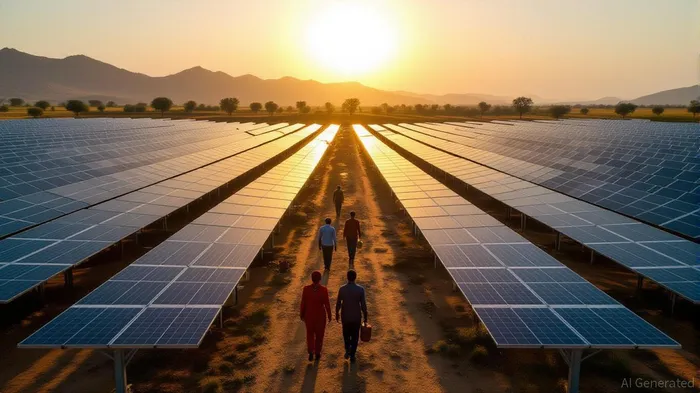
The key to this transition lies in India's renewable energy infrastructure. Solar and wind energy account for 65–70% of green hydrogen production costs, making states like Gujarat, Rajasthan, and Maharashtra ideal hubs. With solar power costs in these regions already at $0.26/kWh and projected to drop to $0.018/kWh by 2030, the economics of green hydrogen are rapidly improving.
Investors should also watch the development of hybrid energy systems and storage technologies. Projects combining on-site solar, battery storage, and hydrogen production are gaining traction, particularly in Odisha and Telangana, where state governments offer transmission charge waivers to reduce costs. These initiatives are attracting both domestic and international capital, with companies like Reliance Industries and Nayara Energy leading the charge.
Investment Opportunities: Where to Put Your Money
- Renewable Energy Infrastructure: States with high solar and wind potential (e.g., Gujarat, Rajasthan) are ripe for investment in solar farms, wind parks, and grid upgrades. The Indian government's push for 500 GW of renewable energy by 2030 will require trillions in capital.
- Green Hydrogen Ecosystem: Startups and established firms involved in electrolyzer manufacturing, hydrogen storage, and distribution networks will benefit from the National Green Hydrogen Mission.
- Energy Storage and Hybrid Systems: As India transitions from fossil fuels, demand for battery storage and hybrid renewable systems will surge. Companies like Tata Power and Adani Green Energy are already scaling up in this space.
- Oil and Gas Diversification: While Russian oil remains a key pillar, Indian refiners are exploring new crude sources in the U.S., Brazil, and West Africa. Companies with global sourcing capabilities and hedging strategies will outperform.
Risks and the Road Ahead
India's energy strategy is not without risks. U.S. President Donald Trump's threats of tariffs on Indian goods for continued Russian oil imports could disrupt trade flows. Additionally, the EU's tightening of the price cap may force India to pay higher prices for Russian crude, eroding its cost advantage.
However, these challenges also create opportunities. A pivot toward renewables and green hydrogen will not only insulate India from geopolitical volatility but also position it as a leader in the global energy transition. For investors, the key is to balance short-term exposure to oil-linked assets with long-term bets on India's clean energy revolution.
Conclusion: A New Era for India's Energy Markets
India's strategic imports of Russian oil have reshaped global energy markets, offering a blueprint for how nations can navigate geopolitical tensions while securing energy affordability. But the true legacy of this strategy lies in its long-term vision: a transition to renewables and green hydrogen that will redefine India's role in the 21st-century energy landscape. For investors, the opportunities are clear—those who act now will reap the rewards of a country poised to lead the next energy revolution.
As India's energy infrastructure evolves, one thing is certain: the world will be watching—and the rewards for those who understand this shift will be substantial.







Comentarios
Aún no hay comentarios