
India's Strategic Metals Supply Chain at a Crossroads: Tata Steel's Legal Battles and the Reshaping of Industrial Policy
India's strategic metals supply chain is facing a pivotal moment as Tata Steel's legal challenges over INR24 billion in chromite ore claims threaten to redefine the country's industrial policy framework and investor confidence. Chromite, a critical input for stainless steel and defense-grade alloys, is central to India's ambitions to dominate global clean energy and manufacturing sectors. However, the ongoing disputes between Tata Steel and Odisha authorities-centered on alleged shortfalls in mineral dispatch from the Sukinda Chromite Block-highlight systemic risks in regulatory enforcement, pricing mechanisms, and state-level fiscal policies. These tensions are not just corporate legal battles but potential catalysts for broader policy reforms that could either stabilize or destabilize India's strategic metals ecosystem.
Legal and Financial Turbulence: A Case Study in Regulatory Uncertainty
Tata Steel, India's largest steelmaker, is contesting two massive claims from Odisha authorities: INR2,410.89 crore for a 2024–2025 chromite dispatch shortfall and INR1,902.73 crore for a 2023–2024 shortfall. The state government alleges violations of Rule 12A of the Minerals Concession Rules, 2016, which mandates penalties for unmet production targets. However, Tata Steel argues that these demands are based on arbitrary pricing revisions by the Indian Bureau of Mines rather than actual operational failures, as it told Fortune India. The company has secured interim relief from the Orissa High Court, which has barred coercive actions until October 9, 2025, according to FilingReader.
This legal limbo underscores a critical issue: the lack of clarity in how state governments interpret and enforce mining agreements. For instance, the INR1,902 crore demand for 2023–2024 was calculated using a revised average sale price of chromite, a metric that Tata Steel claims was not part of the original Mine Development and Production Agreement (MDPA), the Times of India reported. Such retroactive adjustments create a precedent where companies face unpredictable liabilities, deterring long-term investments in capital-intensive sectors like mining.
Policy Reforms and the Shadow of the Supreme Court Ruling
The Tata Steel case intersects with a landmark 2024 Supreme Court ruling that granted states the authority to impose retrospective mining taxes and claim backdated royalties, as covered by The Economic Times. This decision has already triggered a wave of legal challenges, with Tata Steel provisioning INR173.47 billion for contingent liabilities related to such demands, according to Business Standard. While the government argues these measures enhance fiscal discipline, critics warn they could stifle private sector participation in critical mineral extraction.
In response, the Union Budget 2025–26 introduced reforms aimed at balancing state revenues with investor confidence. These include the National Critical Mineral Mission (NCMM), which allocates INR16,300 crore to accelerate domestic production of 30 priority minerals, and the State Mining Index, designed to improve transparency in mineral pricing and allocation, as outlined by EY. However, the effectiveness of these reforms remains uncertain as long as state-level enforcement remains inconsistent. For example, Jharkhand's recent INR100-per-ton tax on coal and iron ore illustrates how subnational governments can independently alter the cost structure for mining firms, creating a fragmented policy landscape, as noted by IMPRI.
Investor Sentiment: OptimismOP-- Amidst Uncertainty
Despite these challenges, India's strategic metals sector has seen a surge in investor interest. In early 2025, Tata Steel's shares rose nearly 6% amid global optimism over China's production cuts and India's policy-driven support for domestic steel prices, according to SSMB. The government's revised Domestically Manufactured Iron & Steel Products Policy-2025, which mandates the use of locally produced steel in government contracts, has further bolstered sectoral confidence, as discussed in the LinkedIn piece "India Tightens Steel Procurement Policy" (see India Tightens Steel Procurement Policy).
Yet, the chromite disputes introduce a layer of risk. Analysts estimate that retrospective tax demands could lead to INR17,000 crore in outflows for Tata Steel alone, according to Business Today, potentially forcing the company to pass these costs to consumers or reduce dividends. This could dampen investor returns, particularly for foreign firms already wary of India's protectionist policies, such as production-linked incentives (PLIs) and domestic content requirements (DCRs), as analysed by the Council on Foreign Relations.
The Path Forward: Balancing Stability and Growth
The resolution of Tata Steel's legal battles will likely shape India's industrial policy trajectory. If the courts side with the company, it could signal a need for clearer regulatory frameworks to prevent arbitrary pricing adjustments and retrospective penalties. Conversely, a ruling in favor of Odisha might embolden other states to adopt similar fiscal strategies, further complicating the investment climate.
In the long term, the government must address these tensions by harmonizing state-level policies with national objectives. The NCMM's focus on critical minerals like lithium and cobalt, according to CAGPT, is a step in the right direction, but success will depend on resolving existing disputes and ensuring consistent enforcement of mining laws. For now, investors are watching closely: the outcome of the Orissa High Court hearings in October 2025 could either reinforce or undermine India's credibility as a hub for strategic metals production. 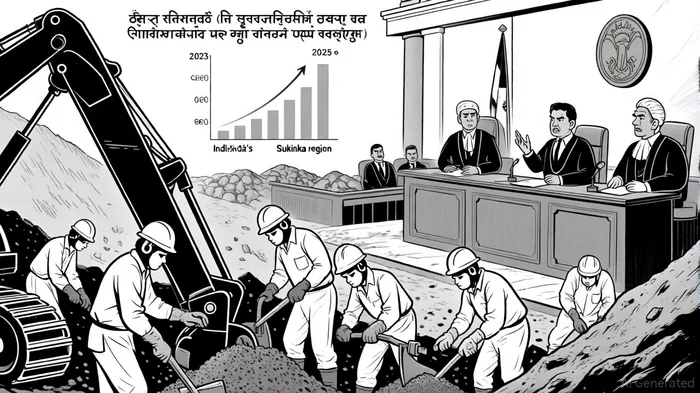






Comentarios
Aún no hay comentarios