
India-Russia Strategic Alliances and Their Impact on Emerging Market Portfolios
The geopolitical landscape of the 21st century is increasingly defined by the interplay of great power competition and the recalibration of trade alliances. India and Russia's strategic partnership, once a relic of Cold War alignment, has evolved into a dynamic force reshaping emerging market investments. From energy security to defense procurement and non-energy trade, their collaboration is not merely a bilateral affair but a recalibration of global supply chains and regional power dynamics. For investors, understanding the implications of this alliance is critical to navigating the risks and opportunities in a multipolar world.
Energy: A Pillar of Economic Resilience
India's reliance on Russian crude oil has surged in recent years, with Moscow supplying 35–40% of New Delhi's oil imports since 2022. This shift, driven by discounted Russian oil amid Western sanctions, has positioned India as a key counterweight to U.S. and European energy markets. However, U.S. sanctions on Russian energy firms like Rosneft and Lukoil, coupled with increased tariffs, have pushed Indian crude imports from Russia to a three-year low. To circumvent these pressures, both nations have adopted alternative payment mechanisms, including rupee-ruble settlements and digital payment systems.
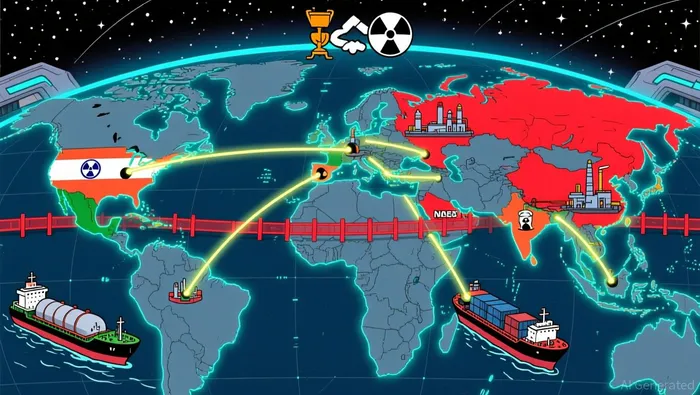
Beyond crude, India and Russia are deepening collaboration in nuclear energy. Russia's construction of the Kudankulam nuclear power plant and its exploration of small modular reactors (SMRs) in India signal a long-term commitment to energy diversification. For investors, this partnership highlights opportunities in energy infrastructure and technology, particularly in sectors insulated from Western sanctions.
Defense: Strategic Autonomy and Technological Synergy
India's defense relationship with Russia remains a cornerstone of its military modernization. The procurement of S-400 air defense systems and Sukhoi-30 fighter jets underscores Moscow's role as a critical supplier. At the 23rd India-Russia Annual Summit in December 2025, discussions expanded to include potential acquisitions of the Su-57 stealth fighter and joint production of S-500 systems. These initiatives align with India's "Make in India" and "Atmanirbhar Bharat" (self-reliant India) campaigns, which emphasize local manufacturing and technology transfer.
The geopolitical implications are profound. As India deepens defense ties with Russia, it navigates a delicate balancing act with the U.S. and its Quad allies. Continued Russian oil imports, despite U.S. tariffs, illustrate India's prioritization of strategic autonomy over alignment with Western sanctions. For investors, this dynamic points to growth in India's defense-industrial base and potential partnerships in advanced technologies like hypersonic missiles and space exploration as highlighted in recent economic analyses.
Non-Energy Trade: Diversification and Geopolitical Hedging
While energy dominates current trade flows, India and Russia are actively diversifying their economic partnership. India's exports to Russia have expanded to include pharmaceuticals, agricultural goods, and machinery, with marine products and fresh produce showing significant growth. The two nations aim to elevate bilateral trade to $100 billion by 2030, supported by a Free Trade Agreement with the Eurasian Economic Union (EAEU) and logistics improvements via the International North-South Transport Corridor as outlined in official trade roadmaps.
This diversification is a strategic hedge against U.S. tariffs and global supply chain disruptions. For example, joint ventures like the urea plant with Russian firm URALCHEM and collaborations in critical minerals and space exploration are creating new investment avenues as reported in economic updates. However, the current trade imbalance-$63.8 billion in Russian exports to India versus $4.9 billion in Indian exports-highlights the need for India to scale up non-energy exports to achieve a balanced partnership.
Geopolitical Implications: Reshaping Global Supply Chains
The India-Russia alliance is redefining global supply chains and regional stability. By bypassing Western financial systems, the two nations are fostering a parallel economic architecture that challenges U.S.-led dominance. This shift is particularly significant for emerging markets, which are increasingly seeking alternatives to U.S. dollar-centric trade.
India's "multi-alignment" strategy-engaging with multiple great powers without formal alignment-has allowed it to maintain strategic autonomy while leveraging Russian resources and U.S. technology. For investors, this balancing act creates both risks and opportunities. On one hand, geopolitical tensions could disrupt trade flows; on the other, India's role as a bridge between East and West offers long-term growth potential in sectors like logistics, technology, and green energy as analyzed in recent geopolitical research.
Investment Opportunities in a Multipolar World
For emerging market portfolios, the India-Russia alliance presents three key investment themes:
1. Energy Infrastructure: Companies involved in nuclear energy, SMRs, and alternative payment systems.
2. Defense Manufacturing: Indian firms partnering with Russian entities on S-400 upgrades, Su-57 production, and joint R&D.
3. Trade Diversification: Sectors like pharmaceuticals, agriculture, and logistics benefiting from India's expanded exports to Russia and EAEU.
However, investors must remain cautious. U.S. sanctions and geopolitical volatility could introduce short-term volatility. Diversification across sectors and geographies will be key to mitigating these risks.
Conclusion
India and Russia's strategic alliance is more than a geopolitical maneuver-it is a recalibration of global economic and security architectures. For emerging market investors, this partnership offers a unique lens through which to assess the interplay of energy, defense, and trade in a multipolar world. As both nations navigate the complexities of great power competition, their collaboration will likely serve as a bellwether for the future of global supply chains and investment flows.







Comentarios
Aún no hay comentarios