
India's Rising Inflation and Its Implications for Equity and Commodity Markets
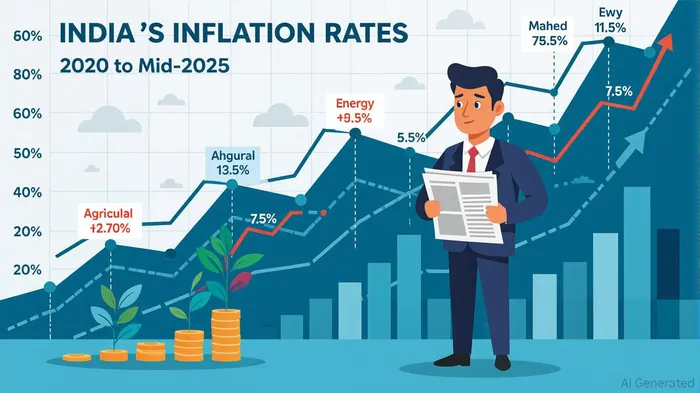
India's economy, a cornerstone of global growth narratives, faces mounting inflationary pressures in mid-2025, driven by structural challenges in resource-intensive sectors like agriculture and energy. While the nation's GDP expansion remains robust, the interplay of global energy dynamics, erratic monsoons, and policy interventions has created a complex landscape for investors. This analysis examines how sectoral resilience and policy responses are shaping equity and commodity markets, offering insights into opportunities and risks.
Inflation Drivers: Energy and Agriculture in the Spotlight
India's inflation trajectory in mid-2025 is heavily influenced by energy prices and agricultural volatility. Global oil and gas markets, still reeling from geopolitical tensions and supply chain bottlenecks, have pushed energy costs to multi-year highs. As a resource-intensive economy, India's manufacturing and transportation sectors—accounting for nearly 25% of GDP—face elevated input costs, which ripple through consumer prices [3]. Meanwhile, agricultural output remains fragile. Erratic monsoon patterns, a recurring challenge, have disrupted crop cycles, while rising fertilizer and seed prices have squeezed margins for farmers [2]. These dual pressures have pushed headline inflation above 6%, a level that tests the Reserve Bank of India's (RBI) policy framework.
Policy Responses: Balancing Act Between Stability and Growth
The Indian government and RBI have adopted a dual strategy to mitigate inflation while preserving growth momentum. On the monetary front, the RBI's 618th Central Board meeting in August 2025 signaled a cautious tightening bias, with the Monetary Policy Committee (MPC) hinting at potential rate hikes to curb inflationary expectations [1]. However, the central bank has also emphasized calibrated liquidity management to avoid stifling credit demand in key sectors like infrastructure and small businesses.
Fiscal policies have leaned on targeted subsidies and supply-side interventions. For instance, the government has expanded direct benefit transfers to farmers for inputs like fertilizers, aiming to stabilize agricultural production [2]. In energy, subsidies for renewable projects under the “Make in India” initiative have accelerated solar and wind capacity additions, reducing reliance on imported fossil fuels [3]. These measures reflect a broader push toward self-reliance (Atmanirbhar Bharat), which has bolstered investor confidence in long-term growth narratives.
Equity Market Implications: Sectoral Divergence and Resilience
The equity market has responded to these dynamics with sectoral divergence. Energy stocks, particularly those in renewables and oil exploration, have outperformed, driven by policy tailwinds and global commodity prices. For example, shares of state-owned oil marketing companies (OMCs) have surged as they pass on higher crude prices to consumers, while private renewable energy firms benefit from government tenders [3]. Conversely, agricultural stocks have shown mixed performance, with companies leveraging technology (e.g., precision farming tools) gaining traction amid input cost pressures [2].
Investor sentiment has also been shaped by macroeconomic stability. Despite inflationary headwinds, India's fiscal deficit remains below 4.5% of GDP, and foreign portfolio inflows have remained resilient, buoyed by the country's demographic dividend and structural reforms [2]. This has supported broader equity indices, which have outperformed global peers in 2025.
Commodity Market Dynamics: Volatility and Strategic Positioning
Commodity markets, particularly energy and agricultural raw materials, have experienced heightened volatility. India's role as a major importer of crude oil and edible oils has amplified its exposure to global price swings. However, the government's push for biofuels and crop diversification (e.g., promoting mustard over rice in water-scarce regions) has introduced new variables into supply chains [3]. For investors, this duality presents both risks—such as currency depreciation pressures—and opportunities in niche sectors like agri-commodities with inelastic demand.
Conclusion: Navigating Uncertainty with a Long-Term Lens
India's inflationary environment in mid-2025 underscores the tension between short-term macroeconomic stability and long-term structural transformation. While energy and agricultural sectors remain vulnerable to external shocks, policy interventions are fostering resilience. For equity investors, sectoral diversification—favoring energy transition plays and agri-tech innovators—offers a hedge against volatility. Commodity traders, meanwhile, must balance exposure to global price swings with India's domestic policy-driven shifts. As the RBI and government continue to navigate this complex landscape, the key for investors lies in aligning strategies with India's evolving economic priorities.







Comentarios
Aún no hay comentarios