
India's Retail Power Sector Liberalization: Strategic Entry Points for Energy Investors in a Deregulating Market
India's retail electricity market is undergoing a transformative phase, driven by sweeping deregulation, regulatory modernization, and a surge in renewable energy adoption. For energy sector investors, this represents a critical inflection point-a window of opportunity to capitalize on structural reforms while navigating the complexities of a rapidly evolving landscape. The Central Electricity Regulatory Commission (CERC) and state-level regulators have introduced policies that not only enhance market liquidity but also align India's energy infrastructure with global sustainability goals.
Policy-Driven Market Liberalization: A New Framework
The cornerstone of India's retail power sector liberalization is the Power Market (First Amendment) Regulations, 2025, which institutionalize Virtual Power Purchase Agreements (VPPAs) as a legitimate Over-the-Counter (OTC) contract category. This innovation allows industries to support renewable energy without requiring physical grid delivery, thereby decoupling energy procurement from geographic constraints, according to Powering India's electricity sector. Concurrently, the expansion of OTC trading to include Renewable Energy Certificates (RECs), Battery Energy Storage System (BESS) contracts, and power banking has injected flexibility into the market, enabling participants to hedge risks and optimize energy portfolios, as the Powering India's electricity sector piece also notes.
State-level reforms further amplify this momentum. Karnataka's Open Access Regulations, 2025, for instance, introduce monthly banking for renewable energy, allowing surplus generation to be carried forward, while streamlining grid access approvals reduces bureaucratic friction, according to the India electricity retailing market report. Similarly, Madhya Pradesh's Fifth Amendment to its Electricity Supply Code updates consumer definitions and load sanction rules, reflecting the sector's shift toward decentralized, consumer-centric models, as detailed in the India electricity retailing market report. These state-specific initiatives, coupled with the Ministry of Power's push for battery swapping infrastructure, underscore a national commitment to modernizing energy delivery systems, a point further emphasized in the India electricity retailing market report.
Regulatory Strengthening: Enhancing Investor Confidence
Regulatory clarity and enforcement have become central to India's deregulation strategy. The CERC's enhanced inspection and audit powers now enable proactive compliance monitoring, mitigating market risks and ensuring adherence to evolving standards, as noted in Policy Moves. Meanwhile, the Supreme Court's August 2025 rulings in Nabha Power Limited v. Punjab State Power Corporation Ltd. and BSES Rajdhani Power Limited v. Union of India have reinforced contractual sanctity and cost-recovery mechanisms for distribution companies (discoms), respectively, according to Energy and Electricity Law Updates. These judicial interventions provide a legal backbone to investor expectations, reducing uncertainty in long-term power purchase agreements (PPAs) and regulatory asset management.
At the operational level, the introduction of GIS-based approval systems for renewable projects and the India Energy Stack-a digital platform for energy planning-demonstrate the government's focus on transparency and efficiency, as reported in World Energy Investment 2025. Such tools not only accelerate project permitting but also enhance data-driven decision-making for investors evaluating entry points.
Investment Opportunities: From Renewables to Storage and Beyond
The liberalization of India's retail power sector has unlocked diverse investment avenues. Renewable energy remains the most prominent, with the country's installed capacity reaching 242.6 GW in September 2025, supported by 3,628 MW of new tenders issued in the same month, according to India's renewable energy surge. Solar energy, in particular, has seen a 25 GW addition between January and August 2025, driven by declining costs and policy incentives, as the India's renewable energy surge coverage highlights. Hybrid projects, such as Rewa Ultra Mega Solar Limited's 600 MW solar-plus-battery storage initiative, exemplify the growing integration of energy storage, which is critical for grid reliability, a trend discussed in the India's renewable energy surge piece.
Battery Energy Storage Systems (BESS) and underground hydrogen storage are emerging as high-potential niches. The CERC's third amendment to Connectivity and General Network Access (GNA) regulations for the inter-state transmission system (ISTS) has created a more structured framework for BESS deployment, while the Ministry of Power's battery swapping guidelines are attracting foreign capital, as covered by Power Regulations in India. Investors should also consider distributed energy resources (DERs), as urban demand for localized, resilient power solutions grows.
Challenges and Strategic Considerations
Despite the optimism, challenges persist. Discoms across India face accumulated losses exceeding INR 6.77 lakh crore ($82 billion), necessitating financial restructuring and tariff rationalization to stabilize the sector, according to PV Magazine India. Inconsistent state policies on open access and PPA renegotiations have historically deterred long-term investments, though recent judicial clarity and centralized regulatory frameworks are mitigating these risks, as the PV Magazine India analysis also notes.
For investors, strategic entry points lie in partnerships with state-level entities to navigate localized regulations and in technology-driven solutions that align with India's digital infrastructure push. The abolition of the coal GST compensation cess by CERC, for example, reduces costs for thermal plants, creating a transitional opportunity for investors balancing clean energy goals with grid stability needs, a point also raised in the Policy Moves write-up.
Conclusion: A Deregulated Future, A Strategic Present
India's retail power sector liberalization is not merely a policy shift but a reimagining of energy markets for the 21st century. By harmonizing regulatory frameworks, embracing digital tools, and prioritizing sustainability, the country is positioning itself as a global energy innovation hub. For investors, the key lies in aligning capital with India's dual imperatives: scaling renewable infrastructure and modernizing legacy systems. Those who act decisively in this deregulating environment will not only capitalize on immediate opportunities but also shape the trajectory of a sector poised for decades of growth.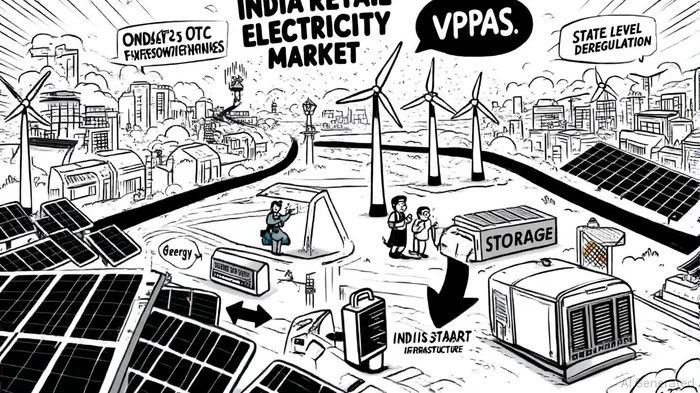







Comentarios
Aún no hay comentarios