
India's Regulatory Push to Cut Retail Financial Charges and Its Implications for Fintech and Banking Sectors
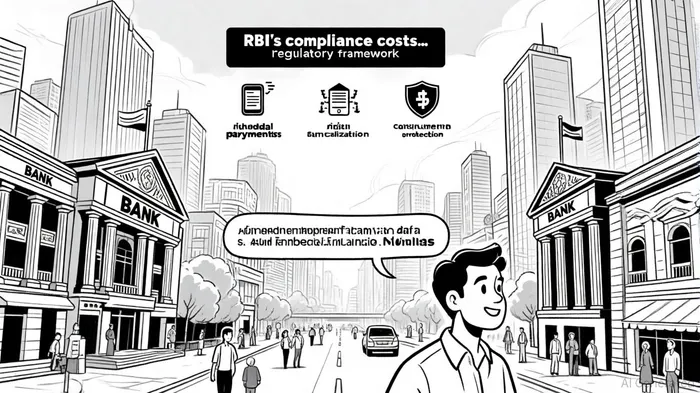
India's financial ecosystem is undergoing a seismic shift as the Reserve Bank of India (RBI) intensifies its efforts to curb retail financial charges and reshape the competitive dynamics between traditional banks and fintechs. These reforms, driven by a mandate for financial inclusion and consumer protection, are redefining investment strategies for stakeholders navigating a rapidly evolving sector.
Regulatory Overhaul: A Dual-Pronged Approach
The RBI's 2025 regulatory agenda targets two critical areas: reducing predatory retail fees and modernizing digital lending frameworks. According to a Bloomberg report, the central bank has urged banks to reassess charges on services like debit card usage, minimum balance violations, and late payments, particularly for low-income customers [1]. While no specific fee thresholds have been mandated, the emphasis on equitable pricing is already prompting banks to revise their fee structures. Simultaneously, the RBI has banned pre-payment penalties on personal and Micro and Small Enterprise (MSE) loans, effective January 1, 2026 [5]. This move aims to empower borrowers to switch lenders or repay early without financial penalties, fostering a more competitive lending environment.
However, these consumer-centric reforms come with a twist. In May 2025, the RBI raised ATM withdrawal fees from ₹17 to ₹19 and balance inquiry charges from ₹6 to ₹7 [6]. This deliberate increase is designed to accelerate the shift toward digital transactions, aligning with India's broader goal of reducing cash dependency. For investors, this signals a structural tilt toward digital-first financial services, where fintechs and banks with robust digital infrastructure will gain a competitive edge.
Fintechs Under Scrutiny: Compliance Costs vs. Innovation
The regulatory spotlight has intensified on fintechs, which now face stricter compliance requirements. As outlined in a LinkedIn analysis, digital lenders must obtain explicit customer consent for data access and store all loan-related data within India [1]. Additionally, payment aggregators (PAs) like Razorpay and PayU must meet a minimum net worth of ₹15 crore (increasing to ₹25 crore within three years) and adhere to stringent cybersecurity standards, including PCI-DSS compliance and annual audits by CERT-In empanelled auditors [2]. These measures, while enhancing consumer trust, are likely to raise operational costs for smaller fintechs, potentially consolidating the market in favor of well-capitalized players.
The Digital Lending Directions, 2025, further complicate the landscape. As stated by legal firm TBA Law, lenders must now disburse loans directly into borrowers' accounts, avoid automatic credit limit increases without consent, and establish grievance redressal mechanisms [3]. For non-banking financial companies (NBFCs) and peer-to-peer (P2P) lenders, these rules could disrupt existing business models reliant on third-party guarantees or algorithmic risk assessments. Yet, the RBI's regulatory sandbox offers a lifeline, allowing startups to test innovative products in a controlled environment while adhering to compliance norms [4].
Strategic Investor Positioning: Navigating the New Normal
For investors, the key lies in balancing risk and opportunity. Here's how to position portfolios in this shifting landscape:
Prioritize Fintechs with Scalable Compliance Frameworks
Fintechs that invest in automation for regulatory compliance—such as AI-driven KYC tools or blockchain-based data localization—will outperform peers. The Unified Lending Interface (ULI), launched by the RBI Innovation Hub, exemplifies this trend. By December 2024, ULI had facilitated ₹270 billion in loan disbursements, leveraging authenticated data from government and private sources [2]. Investors should target firms integrating such platforms to reduce friction in credit delivery.Bet on Bank-Fintech Collaborations
The RBI's emphasis on shared infrastructure is fostering partnerships between traditional banks and fintechs. For instance, co-lending models are expanding access to underserved markets, with banks leveraging fintechs' data analytics capabilities to assess creditworthiness [4]. This synergy is particularly attractive for investors seeking to capitalize on India's $150 billion fintech market, projected to grow to $550 billion by 2030 [2].Monitor the Embedded Finance Revolution
Embedded finance—where financial services are integrated into non-financial platforms—is gaining traction. E-commerce giants, agritech startups, and even neobanks are embedding lending, insurance, and payment solutions into their ecosystems. With the RBI's zero-MDR policy (removing UPI transaction fees) compressing payment gateway revenues, fintechs are pivoting to monetize through cross-selling and subscription models [2]. Investors should focus on firms with strong partnerships in sectors like MSMEs or rural finance, where embedded solutions can drive financial inclusion.Assess Risks in the Digital Lending Space
While the Digital Lending Directions aim to curb predatory practices, they also impose constraints on innovation. For example, the cap on Default Loss Guarantee (DLG) coverage at 5% of loan portfolios could deter fintechs relying on third-party risk mitigation [3]. Investors must evaluate whether startups can adapt to these restrictions or risk being outcompeted by larger players with diversified revenue streams.
Conclusion: A Balancing Act for Investors
India's regulatory push to cut retail financial charges is a double-edged sword. While it imposes short-term compliance burdens, it also creates long-term opportunities for firms that align with the RBI's vision of inclusive, transparent finance. For strategic investors, the path forward lies in identifying fintechs and banks that can navigate regulatory complexity while scaling innovative solutions. As the sector evolves, those who prioritize compliance, collaboration, and customer-centricity will emerge as leaders in India's next financial revolution.







Comentarios
Aún no hay comentarios