
India's RBI-Backed Digital Currency: Reshaping Institutional Trust and Monetary Policy in the Crypto Era
India's RBI-Backed Digital Currency: Reshaping Institutional Trust and Monetary Policy in the Crypto Era
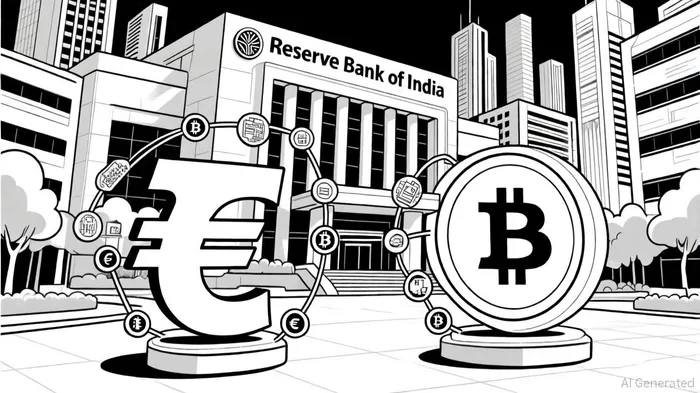
India's impending launch of an RBI-backed digital currency, the e₹, marks a pivotal shift in the global monetary landscape. As the Reserve Bank of India (RBI) accelerates its Central Bank Digital Currency (CBDC) rollout, the implications for institutional trust in digital assets and the evolution of monetary policy are profound. This analysis explores how the e₹ is redefining the relationship between sovereign-backed digital money and private cryptocurrencies, while reshaping India's regulatory and economic frameworks.
Institutional Trust: From Skepticism to Sovereign Assurance
The e₹, modeled after stablecoins but underpinned by the full faith of the Indian state, is designed to restore institutional trust in digital transactions. Unlike private cryptocurrencies such as BitcoinBTC--, which lack sovereign backing and face heavy taxation in India, according to Decrypt, the e₹ is classified as legal tender under amendments to the RBI Act, 1934, according to the Reserve Bank of India. This legal clarity ensures that the e₹ is guaranteed by the RBI, offering users a secure alternative to speculative assets.
According to a Valuable Finances report, the e₹ has already achieved ₹10.16 billion ($122 million) in circulation and 6 million users by 2025. This rapid adoption underscores the growing confidence in a state-issued digital currency, particularly among institutions and corporations seeking stable, traceable payment solutions. The e₹'s blockchain-based architecture further enhances transparency, enabling real-time transaction verification and reducing the risk of fraud, as noted in reporting by Decrypt.
Monetary Policy Evolution: Precision and Control in a Digital Age
The e₹ represents a strategic tool for the RBI to modernize monetary policy. By leveraging programmable features-such as automatic bill payments and salary disbursements-the central bank can exert granular control over money supply and liquidity, according to an analysis from Sangai International University. For instance, the e₹'s interoperability with UPI (Unified Payments Interface) allows seamless integration with India's existing digital infrastructure, enabling real-time data collection and policy adjustments (the Sangai International University analysis describes these integrations).
Moreover, the e₹'s offline transaction capabilities and expansion into sectors like public transport and government subsidies demonstrate the RBI's intent to digitize the entire economic ecosystem. This shift could reduce reliance on physical cash, streamline fiscal policy implementation, and enhance financial inclusion. As noted by Deccan Chronicle, India's approach mirrors global CBDC trends but is uniquely tailored to address domestic challenges such as black money and cross-border transaction inefficiencies.
Implications for the Crypto Market: A Regulated Alternative Emerges
The e₹'s rise signals a paradigm shift in India's stance toward private cryptocurrencies. While the government has not outright banned unbacked tokens, it discourages their use through punitive taxation and regulatory ambiguity, according to Decrypt. This strategy positions the e₹ as a safer, more stable alternative to speculative crypto assets, potentially diverting institutional capital toward state-backed digital money.
Industry experts anticipate a hybrid regulatory framework by 2025, requiring private crypto issuers to maintain verifiable fiat or commodity reserves and undergo third-party audits, as reported by Decrypt. Such measures could align India with global standards for stablecoins while curbing the risks associated with unregulated tokens. However, this regulatory tightening may also drive innovation in compliance-aligned crypto projects, creating a niche for token issuers that adapt to the new rules (Decrypt reporting highlights these industry expectations).
Technical and Operational Advancements: A Blueprint for Scalability
The e₹'s technical specifications highlight its scalability and user-centric design. With two battery-powered analogies (49kWh and 61kWh packs) for transactional flexibility described in reporting by Decrypt, the e₹ mirrors the adaptability of modern electric vehicles-another sector witnessing India's technological leap. Its expansion to 100+ countries via Maruti's e Vitara exports was noted in Deccan Chronicle reporting and further illustrates the potential for cross-border e₹ adoption, though challenges remain in harmonizing international standards.
Key features such as offline transactions and programmable smart contracts position the e₹ as a versatile tool for both retail and wholesale applications. By 2025, the e₹ is already being used in e-commerce, government subsidies, and public transport, signaling its transition from a pilot project to a foundational element of India's digital economy (the Sangai International University analysis documents these use cases).
Challenges and Considerations: Privacy, Surveillance, and Global Integration
Despite its promise, the e₹ raises critical questions about privacy and surveillance. While the RBI emphasizes transparency, the ability to track every transaction could lead to concerns over data misuse. Balancing these risks with the need for anti-money laundering (AML) compliance will be a key challenge, as highlighted by Decrypt.
Additionally, India's strict asset-backed criteria for digital currencies may complicate cross-border transactions involving foreign stablecoins, a point raised in Decrypt coverage. As global CBDCs evolve, India's regulatory approach will need to adapt to avoid isolation in international trade.
Conclusion: A New Era for Digital Money
India's e₹ is more than a technological innovation-it is a strategic reimagining of monetary policy and institutional trust in the digital age. By offering a sovereign-backed, transparent, and programmable alternative to private cryptocurrencies, the e₹ is poised to redefine India's financial ecosystem. For investors, this shift signals a growing preference for regulated digital assets and a potential decline in speculative crypto markets. As the RBI continues to refine the e₹'s framework, its success could serve as a blueprint for other emerging economies seeking to harness the power of CBDCs.







Comentarios
Aún no hay comentarios