
India's Post-Sovereign Upgrade: Strategic Opportunities and Risks in Debt and Banking Sectors
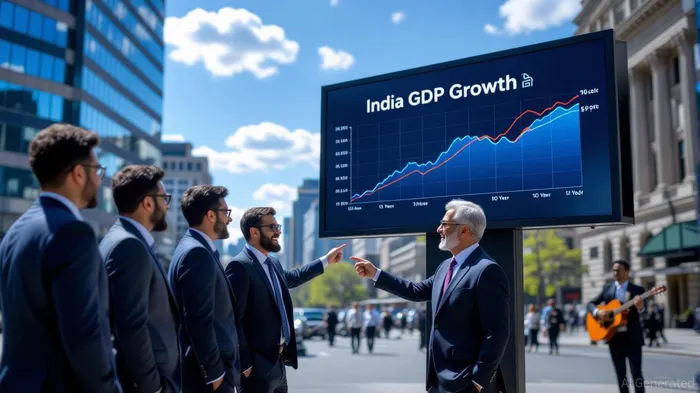
India’s recent S&P Global Ratings upgrade to BBB from BBB- in August 2025 marks a pivotal moment in its economic narrative, offering both strategic advantages and nuanced risks for investors. This upgrade, the first in 18 years, underscores India’s resilience in navigating global uncertainties while reinforcing its position as a high-growth, stable investment destination. However, the interplay of structural reforms, regulatory shifts, and external trade pressures demands a balanced assessment of opportunities and vulnerabilities.
Strategic Advantages: Debt Mobilization and Capital Market Accessibility
The BBB rating has catalyzed a transformation in India’s debt market. Foreign investors, drawn by attractive yield differentials and improved sovereign credibility, injected ₹10,471 crore into government securities in August 2025 alone [2]. This surge reflects a broader trend: India’s 10-year bond yields fell by 30 basis points post-upgrade, signaling reduced risk perception [5]. The inclusion of Indian government bonds in global indices like FTSE EMGBI, AGBI, and APGBI in September 2025 is expected to amplify this inflow, potentially attracting $15–$20 billion annually [4].
For corporate borrowers, the upgrade translates to tangible cost savings. Top-rated firms could reduce external commercial borrowing (ECB) costs by 10–20 basis points, while non-banking financial companies (NBFCs) may benefit from spread reductions of 15–40 basis points [5]. This liquidity boost is critical for sectors like infrastructure and renewable energy, where India’s capital expenditure plans are projected to grow by 12% annually through 2028 [3].
Banking Sector Recalibration: Strengths and Structural Shifts
India’s banking system has emerged stronger post-upgrade, with S&P upgrading the ratings of major institutions like SBI, HDFC BankHDB--, and ICICI BankIBN--. This reflects improved capital adequacy ratios (exceeding 13% for public sector banks) and a 13-year low in non-performing assets (NPAs) at 2.58% [6]. Structural reforms, particularly the Insolvency and Bankruptcy Code (IBC), have enhanced recovery rates and reduced systemic risk [2].
The Reserve Bank of India (RBI) has further bolstered stability through regulatory updates. The May 2025 Revised Digital Lending Guidelines expanded oversight to all-India financial institutionsFISI--, tightened prudential caps on default loss guarantees, and mandated enhanced transparency in digital lending [1]. These measures align with the RBI’s 2025 Payments Vision, emphasizing innovation and cross-border payment capabilities, including Central Bank Digital Currency (CBDC) exploration [3].
Risks and Mitigation Strategies
While the upgrade is a milestone, investors must remain vigilant. U.S. tariffs of 50% on Indian textiles and auto components threaten to reduce U.S. imports by 60%, potentially shaving 1% off India’s GDP growth [5]. Geopolitical tensions, though eased by the U.S.-Russia summit, remain a wildcard. Additionally, global inflationary pressures and India’s net public debt (projected at 78% of GDP by 2028–29) could constrain fiscal flexibility [5].
To mitigate these risks, investors should adopt a diversified approach. Sectoral bets in tariff-exempt industries (e.g., pharmaceuticals, which surged 2.73% post-upgrade [5]) and long-term positioning in infrastructure and renewables align with India’s growth trajectory. Currency hedging and active monitoring of RBI policy shifts—such as the potential shift to seven-day liquidity operations—will also be critical [1].
Conclusion
India’s BBB rating is a testament to its economic resilience and reform momentum. For investors, the improved credit profile unlocks access to a $1.5 trillion bond market with growing institutional depth [4]. However, the path forward requires navigating trade tensions, global inflation, and regulatory nuances. By leveraging India’s domestic demand-driven growth and structural strengths while hedging against macroeconomic volatility, investors can position themselves to capitalize on this inflection pointIPCX--.
Source:
[1] India's RBI unlikely to re-introduce fixed-rate liquidity operations [https://www.reuters.com/world/india/indias-rbi-unlikely-re-introduce-fixed-rate-liquidity-operations-sources-say-2025-07-31/]
[2] Indian bonds: What's driving the surge in foreign investment in Indian bonds? [https://m.economictimes.com/markets/bonds/whats-driving-the-surge-in-foreign-investment-in-indian-bonds/articleshow/123623055.cms]
[3] S&P's Upgrade of India's Sovereign Rating to BBB [https://hdfcsky.com/news/sps-upgrade-of-indias-sovereign-rating-to-bbb]
[4] Indian Financial Markets – an Inflection point in their global role? [https://www.lseg.com/en/insights/ftse-russell/indian-financial-markets-an-inflection-point-in-their-global-role]
[5] India's Strong Long-Term Growth Story Despite Valuations and Structural Challenges [https://www.ainvest.com/news/india-strong-long-term-growth-story-valuations-structural-challenges-2508/]
[6] S&P upgrades India rating on economic resilience, fiscal consolidation [https://www.cnbc.com/2025/08/14/sp-upgrades-india-rating-on-economic-resilience-fiscal-consolidation.html]





Comentarios
Aún no hay comentarios