
India's Options Trading Overhaul: How SEBI's Rules Accidentally Boosted BSE's Market Share
In 2025, the Securities and Exchange Board of India (SEBI) introduced sweeping reforms to options trading, aiming to curb speculative excesses and stabilize India's derivatives markets. Among the most consequential changes was the realignment of expiry schedules for the National Stock Exchange (NSE) and Bombay Stock Exchange (BSE). NSE shifted its weekly equity derivatives expiry from Thursday to Tuesday, while BSE moved its expiry from Tuesday to Thursday [1]. This strategic adjustment, intended to eliminate the “expiry day war” between the two exchanges, inadvertently created a vacuum that BSE has since capitalized on—boosting its market share and liquidity metrics in ways regulators may not have anticipated.
The Expiry Day Shift: A Strategic Reordering
SEBI's decision to stagger expiry days was driven by concerns over overlapping volatility and liquidity imbalances caused by both exchanges competing for the same trading window [1]. By moving NSE's expiry to Tuesday, regulators gave traders three days (Friday, Monday, Tuesday) to build positions, while BSE's Thursday expiry limited pre-expiry activity to just Wednesday and Thursday [3]. Analysts initially feared this would erode BSE's competitiveness, with Goldman Sachs projecting its index options market share could dip to 21% from 24% [3].
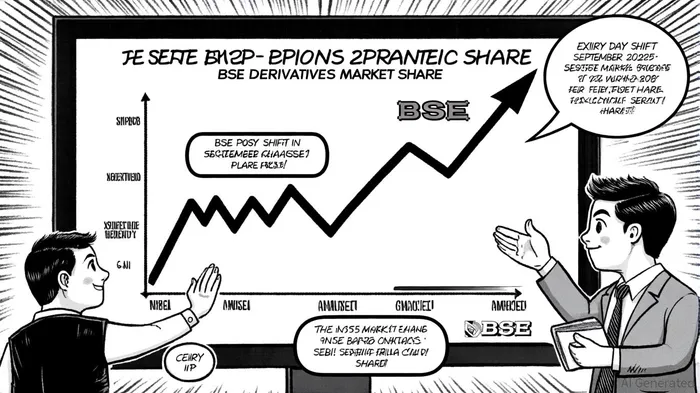
However, BSE's performance post-September 2025 defied these expectations. According to data from FinBlage, BSE's derivatives market share surged to 28.2% after the expiry swap, a 110-basis-point increase, with premium average daily turnover rising 19% to ₹208 billion [2]. This resilience suggests that BSE's Thursday expiry, while shorter, may have attracted a distinct cohort of positional traders who prefer holding options for a full week—a strategy less viable under NSE's compressed Tuesday expiry [4].
Regulatory Headwinds and BSE's Counterstrategy
SEBI's broader regulatory framework—higher contract sizes (₹15–20 lakh for index derivatives), upfront premium payments, and a 2% extreme loss margin on expiry days—was designed to reduce retail speculation and institutionalize trading [5]. These measures disproportionately impacted BSE, which had previously seen its derivatives market share grow from under 1% in FY23 to 26% in FY25 [1]. Yet, BSE's strategic response to the expiry shift appears to have mitigated these challenges.
For instance, BSE's Thursday expiry aligns with the preferences of long-term traders who benefit from extended premium decay and reduced intraday volatility. This has drawn activity away from Nifty Bank and Bankex contracts—indices that saw sharp declines post-regulation—to more stable benchmarks like the Sensex [5]. Additionally, BSE's focus on improving co-location infrastructure and onboarding foreign institutional investors has enhanced its appeal in a more capital-intensive trading environment [4].
NSE's Dominance vs. BSE's Gains
While NSE remains the undisputed leader in liquidity and trading volumes—handling 90% of equity derivatives and 80% of equity cash segment trading [5]—its market share has dipped slightly post-September 2025. NSE's Q4 FY25 revenue stood at ₹3,771 crore, compared to BSE's ₹846 crore, but BSE's ADTV in derivatives grew by 52.8% in April–May 2025 before cooling in June [2]. This indicates that BSE's gains, though smaller in absolute terms, are structurally significant given its historical underdog status.
The regulatory shift has also forced NSE to innovate. Its Tuesday expiry has spurred intraday activity on Mondays and Tuesdays, but BSE's Thursday expiry has carved out a niche for traders seeking to exploit the full week's volatility. As noted by Economic Times, BSE's ability to “prove bullet-proof” amid regulatory scrutiny underscores its adaptability [4].
Unintended Consequences and Future Outlook
SEBI's reforms were primarily aimed at reducing volatility and protecting retail investors. However, the unintended consequence—a boost to BSE's market share—highlights the complexity of regulatory interventions in competitive markets. BSE's gains suggest that even minor adjustments to trading calendars can create asymmetries that favor exchanges with the agility to reposition quickly.
For investors, this dynamic raises questions about the long-term implications. Will BSE's improved positioning translate into sustained growth, or is it a temporary rebound? The answer lies in how both exchanges respond to the new regime. NSE's technological edge and broader product offerings remain formidable, but BSE's focus on institutional partnerships and product diversification could close the gap.
In the short term, the data paints a clear picture: SEBI's rules, while stabilizing the market, have inadvertently created opportunities for BSE to challenge NSE's hegemony. As the derivatives segment evolves, the interplay between regulation and competition will remain a critical factor for market participants to monitor.







Comentarios
Aún no hay comentarios