
India's Micro-Cap IPO Market: A Goldmine of Growth and Risk-Adjusted Returns?
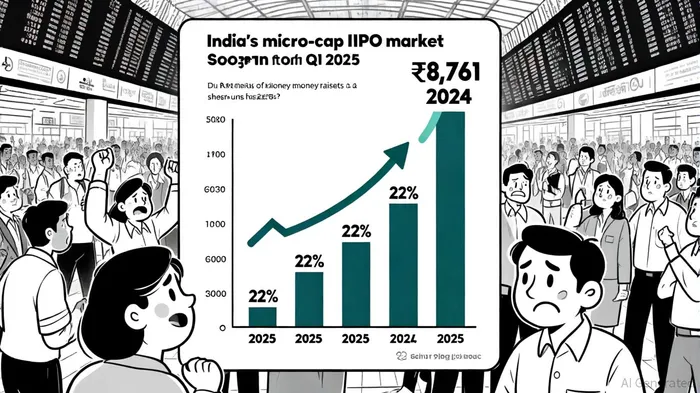
India's micro-cap IPO market has emerged as a compelling focal point for investors seeking high-growth opportunities amid a cautiously optimistic global economic climate. By August 2025, SME IPOs had raised ₹6,819 crore through 154 offerings, with 2024 marking a record high of ₹8,761 crore from 240 issues [4]. This surge reflects a resilient ecosystem where companies like Fabtech Technologies Cleanrooms (up 400% post-listing) and Cryogenic OGS (up 247%) have demonstrated the potential for outsized returns [4]. However, the market's bimodal liquidity structure—where a few high-performing stocks coexist with many illiquid offerings—demands a nuanced approach to risk management [4].
Drivers of Growth: Regulatory Reforms and Domestic Capital Inflows
The Securities and Exchange Board of India (SEBI) has played a pivotal role in streamlining the IPO process. Measures such as fast-track reverse flipping, removal of the 1% security deposit requirement, and standardized documentation have reduced compliance burdens and accelerated timelines [3]. These reforms, coupled with India's projected 6.2–6.5% annual GDP growth over the next five years, have created fertile ground for IPOs in digital and consumption-driven sectors [3].
Domestic capital inflows have further bolstered the market. Systematic Investment Plans (SIPs) have driven record monthly inflows of USD 2.7 billion into mutual funds, reducing reliance on foreign capital [3]. This trend is particularly significant as global uncertainties, such as the 20% decline in overall IPO activity in 2025 compared to the previous year, have dampened international investor sentiment [2].
Sector-Specific Opportunities and Valuation Arbitrage
High-growth sectors like renewable energy, healthcare, and technology are attracting attention. For instance, TruAlt Bioenergy and Solarworld Energy Solutions raised ₹950 crore and ₹490 crore, respectively, to expand clean energy infrastructure [3]. In healthcare, Paras Healthcare and Laxmi Dental secured ₹900 crore and ₹700 crore to expand hospital networks and dental services [3]. The technology sector, despite mixed performance (e.g., average listing gains of 3.2% and current returns -2.5% below issue prices [1]), remains a key area for innovation-driven IPOs like Quadrant Future Tek and Stallion India Flurochemicals [3].
Valuation arbitrage is another draw. The median P/E ratio for Indian IPOs in 2024 was 21.5x, significantly higher than in the U.S. and Europe, underscoring investor enthusiasm for fundamentally sound businesses with clear growth trajectories [3].
Navigating Risks: High Valuations and Sector Volatility
While the market's potential is undeniable, risks persist. High valuations not supported by commensurate growth prospects have led to post-listing underperformance in sectors like technology and manufacturing [1]. For example, engineering IPOs have faced headwinds from rising input costs and global economic uncertainty [1]. Additionally, micro-cap stocks are inherently more volatile due to smaller market capitalizations and less-established business models [3].
Investors must prioritize companies with strong governance, sustainable financial health, and scalable growth strategies. Over-reliance on speculative demand or grey market premiums (GMPs) has proven unreliable, as some IPOs have failed to meet subscription targets or GMP expectations [3].
The Road Ahead: Balancing Growth and Prudence
India's micro-cap IPO market is poised for further expansion, driven by government initiatives like "Make in India" and "Atmanirbhar Bharat," which are fostering a conducive environment for alternative investment funds (AIFs) to target niche sectors such as agritech and deep tech [4]. However, the path to risk-adjusted returns requires rigorous due diligence. As KPMG notes, sector-wise analysis is critical to identifying high-potential IPOs while avoiding overvalued or structurally challenged offerings [1].
For investors, the key lies in balancing optimism with caution. While the market's resilience—evidenced by the 22% share of global IPO activity in Q1 2025 [2]—is encouraging, the focus must shift from short-term hype to long-term value creation.







Comentarios
Aún no hay comentarios