
India's IPO Market Resilience: Valuation Sustainability and Investor Sentiment in 2025
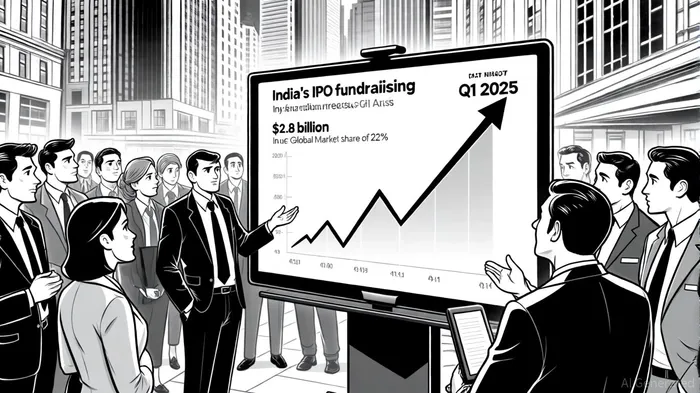
India's IPO market has demonstrated remarkable resilience in 2025, defying global economic uncertainties and mixed secondary market performance. According to an EY report, India secured a 22% share of global IPO activity in Q1 2025, raising $2.8 billion through 62 listings on the National and Bombay Stock Exchanges. This momentum is driven by high-growth sectors like technology, fintech, and non-banking finance, with billion-dollar IPOs such as Hexaware Technologies and Tata Capital serving as bellwethers for valuation sustainability and investor sentiment.
Valuation Sustainability: A Double-Edged Sword
Hexaware Technologies' $1.0 billion IPO in February 2025 exemplifies the tension between growth potential and valuation concerns. Priced at a P/E ratio of 37.8–43.1x, the offering was deemed "fully valued" by brokers like Ventura Securities, despite the company's 13.7% revenue CAGR from FY21–FY23 and a 9.6% PAT margin, according to a myInvestmentIdeas analysis. Analysts caution that while Hexaware's AI and cloud-driven business model positions it for long-term gains, its valuation lacks a margin of safety amid macroeconomic risks, such as a potential U.S. slowdown, per a Liquide Life analysis.
Tata Capital's IPO, meanwhile, reflects a more balanced approach. With a P/E ratio of 35.99x and a P/B ratio of 4.1x, the non-banking finance company's valuation aligns with industry averages, supported by robust financials: a 12.6% ROE, 55.9% year-on-year revenue growth, and a Gross Stage 3 Loans Ratio of 2.1%, as noted in an ICFMIndia review. Experts like Anand Rathi and Mehta Equities highlight its strategic digital transformation and diversified lending portfolio as strengths, though they advise caution over its premium valuation relative to peers in Stofiniq insights.
Investor Sentiment: Enthusiasm vs. Caution
Retail and institutional investor participation in India's IPO market has surged, with QIB and retail subscription rates averaging 102x and 35x in FY25, respectively, according to a TaxGuru article. The Tata Capital IPO, for instance, attracted 1.95 times subscriptions, with QIBs and NII showing 3.42x and 1.98x interest, as reported in a Moneycontrol liveblog. However, post-listing performance has tempered optimism. The Tata Capital IPO's grey market premium (GMP) hovered between 1.84% and 2.15%, reflecting cautious optimism in a CMA Knowledge review, while Hexaware's muted GMP of ₹20–42 per share underscored valuation skepticism in a Financial Express report.
Despite these challenges, India's IPO pipeline remains robust, with over 170 listings expected to raise $30.44 billion in 2025, according to a Reuters report. Retail investor confidence, bolstered by digital platforms and financial literacy campaigns, has democratized access to IPOs, with monthly investments averaging $3 billion in a Hedged post. Yet, analysts warn that overvaluation risks and integration challenges-such as Tata Capital's merger with Tata Motors Finance-could dampen long-term returns, per a Liquide Life review.
Conclusion: A Market of Contrasts
India's IPO market in 2025 is a study in contrasts: high subscription rates coexist with post-listing underperformance, and premium valuations are justified by strong fundamentals in some cases but questioned in others. While Hexaware and Tata Capital highlight the sectoral diversity and institutional confidence driving the market, they also underscore the need for investors to balance growth potential with valuation discipline. As the year progresses, the sustainability of these IPOs will hinge on macroeconomic stability, corporate governance, and the ability of companies to deliver on long-term value creation.







Comentarios
Aún no hay comentarios