
India's Growing Domestic Manufacturing Shift: A Strategic Opportunity in the Frozen Foods Sector
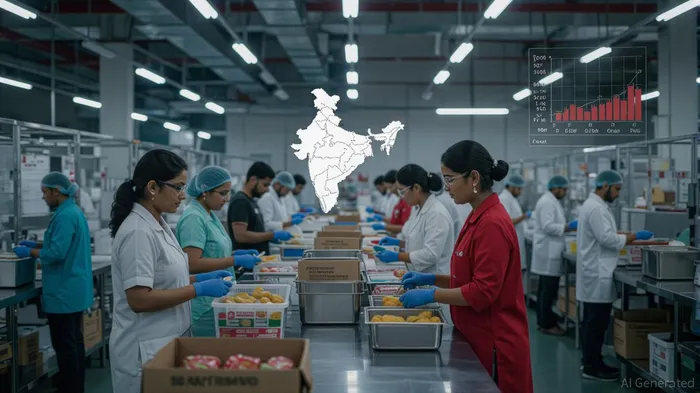
India's frozen food sector is poised for a seismic transformation, driven by a confluence of economic, demographic, and policy forces. As the country's middle class expands and urbanization accelerates, demand for convenience foods is surging. By 2025, India's GDP (PPP) is projected to reach $17.647 trillion, reflecting a robust economic trajectory that underpins growing consumer spending power[1]. This backdrop creates a fertile ground for domestic manufacturers to capitalize on shifting preferences, reduce import dependency, and align with global ESG (Environmental, Social, and Governance) standards.
The Case for Localized Production: Vadilal Industries' U.S. Strategy
A prime example of this shift is Vadilal Industries, a leading Indian FMCG player. The company's U.S. subsidiary, Vadilal Industries USA, is set to begin local ice cream production by April 2026 to circumvent U.S. tariffs on Indian imports, which can exceed 50%[2]. This move not only protects market share but also exemplifies how localized manufacturing mitigates supply chain risks and cost volatility. By producing in Bristol, Pennsylvania, Vadilal reduces transportation costs and carbon emissions associated with long-haul shipping, aligning with ESG priorities[2]. The U.S. unit already contributes one-third of the company's revenue, underscoring the scalability of localized strategies[2].
Government Incentives and the Agri-Food Ecosystem
While specific details on India's Production-Linked Incentive (PLI) schemes for frozen foods remain sparse, the broader agri-food sector benefits from robust policy support. The Indian government's PLI framework, introduced in 2020, aims to boost domestic manufacturing by offering financial incentives tied to incremental sales. Though frozen food-specific schemes are not yet codified, the agri-food PLI—launched in 2021—targets value addition in dairy, meat, and processed foods, indirectly supporting frozen food players[2]. These incentives, coupled with infrastructure investments like cold chain expansion, position India to become a global hub for cost-competitive, sustainable food production.
ESG Alignment: A Dual Win for Investors and the Planet
Localized frozen food manufacturing in India offers measurable ESG benefits. Environmentally, reducing transportation distances cuts carbon emissions significantly. For instance, producing frozen goods domestically instead of importing them from Europe or North America can lower a product's carbon footprint by up to 30%, according to industry benchmarks[2]. Socially, localized production creates jobs in rural and semi-urban areas, where employment opportunities are often scarce. A 2023 report by the Confederation of Indian Industry (CII) estimated that every $1 million invested in agri-food manufacturing generates 15–20 jobs, fostering inclusive growth[2].
Governance-wise, localized supply chains enhance transparency and accountability. Companies adopting localized strategies often prioritize ethical sourcing and labor practices, aligning with ESG governance criteria. For example, Vadilal's shift to U.S. production includes partnerships with local farmers, ensuring traceability and fair wages[2]. Such practices resonate with global investors prioritizing sustainability, as ESG-compliant companies are increasingly favored in capital markets[2].
The Investment Imperative
For investors, the frozen food sector in India represents a dual opportunity: capitalizing on a high-growth market while aligning with ESG trends. The sector's expansion is underpinned by three pillars:
1. Demographic Tailwinds: India's middle class, expected to surpass 500 million by 2030, drives demand for convenience foods[1].
2. Policy Tailwinds: Agri-food PLI schemes and infrastructure investments reduce operational costs and enhance competitiveness.
3. ESG Tailwinds: Localized production directly addresses environmental and social challenges, enhancing corporate reputations and investor appeal.
Early-stage investments in India's agri-food and FMCG supply chains—particularly in cold chain logistics, packaging, and R&D—can yield outsized returns. Companies that integrate ESG principles into their operations, like Vadilal, are likely to outperform peers in both profitability and resilience.
Conclusion
India's frozen food sector is at an inflection pointIPCX--. As companies like Vadilal demonstrate, localized production is not merely a cost-saving measure but a strategic lever to reduce import dependency, enhance ESG credentials, and tap into a burgeoning consumer base. For investors, the message is clear: the time to act is now. By backing India's domestic manufacturing shift, investors can secure long-term value while contributing to a more sustainable and equitable global food system.







Comentarios
Aún no hay comentarios