
India's Green Energy JV Expansion: NLC India and PTC India's 2000MW Initiative – A Strategic Play in the Renewable Energy Boom
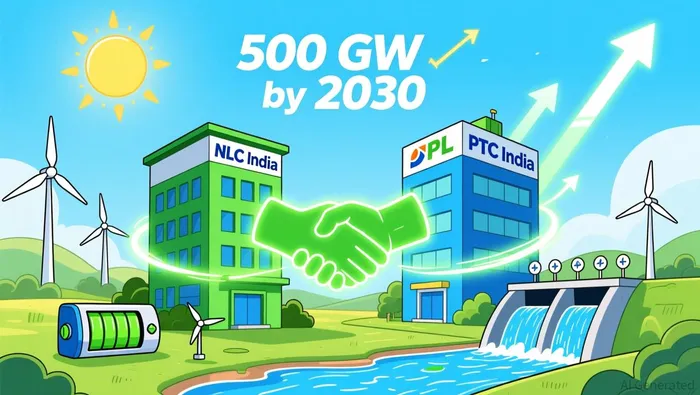
India's renewable energy sector is surging, and the recent 2,000MW joint venture (JV) between NLC India and PTC India is a masterstroke in this high-stakes game. This partnership, , is not just another green energy project-it's a calculated move to dominate a market poised for explosive growth. With India targeting 500 GW of non-fossil fuel capacity by 2030, this JV aligns perfectly with national priorities while leveraging the complementary strengths of two industry heavyweights according to reports.
Strategic Positioning: A Synergy of Expertise
NLC India, a state-owned power producer, brings decades of experience in project development and renewable energy park creation. PTC India, a power trading giant, adds critical expertise in power trading and integrated solutions. Together, they form a formidable duo capable of navigating the complexities of India's energy transition. The JV's focus on solar, wind, hydro, battery energy storage systems (BESS), and green ammonia ensures diversification, mitigating risks tied to single-technology exposure according to industry analysis.
The first phase of 500MW is a smart start. By targeting distribution companies (DISCOMs), government entities, and commercial-industrial consumers, the JV taps into multiple revenue streams. This approach mirrors the success of India's solar sector, which grew from 2.82 GW in 2014 to 100.33 GW by January 2025. The ability to sell power through both competitive and regulated routes under Sections 62 and 63 of the Electricity Act further enhances flexibility, a critical edge in a sector marked by policy shifts according to market reports.
Capital Allocation: Government Support and Diversified Funding
The Indian government's recent decision to grant NLC India Limited (NLCIL) an exemption from standard investment guidelines is a game-changer. , effectively removing the 30% net worth ceiling for Central Public Sector Enterprises (CPSEs) in JVs according to government sources. Such regulatory tailwinds reduce bureaucratic hurdles and accelerate capital deployment-a boon for a project of this scale.
Funding the 2,000MW initiative will likely blend equity contributions from both partners and external financing. NLC India has already tapped overseas green finance, at competitive rates. This signals confidence in the project's viability and aligns with a broader trend: to private capital and credit markets. , the JV is well-positioned to attract diverse investors, including institutional players eyeing according to BNEF data.
Competitive Advantages: Navigating Challenges and Seizing Opportunities
India's renewable sector faces headwinds, notably grid integration bottlenecks and curtailment issues. However, the NLC-PTC JV's emphasis on BESS and -technologies that stabilize supply and store excess energy-addresses these pain points directly according to industry experts. By integrating storage solutions, the JV can offer reliable power to DISCOMs and industrial clients, a critical differentiator in a market where reliability often trumps cost.
Moreover, the partnership's phased approach-starting with 500MW and scaling incrementally-allows for adaptability. This is crucial in a sector where policy changes, interest rates, and technological advancements can rapidly alter the playing field. The ability to pivot ensures the JV remains resilient against macroeconomic volatility according to market analysis.
The Bottom Line: A High-Conviction Play
While specific ROI projections for the 2,000MW initiative remain undisclosed, the long-term outlook is compelling. , coupled with India's aggressive climate targets, suggest robust returns. The JV's strategic alignment with national goals, combined with its diversified technology mix and access to both domestic and international capital, makes it a standout opportunity.
For investors, this is more than a bet on renewables-it's a stake in India's energy future. As the country races to decarbonize, the NLC-PTC JV is not just keeping pace; it's setting the pace.







Comentarios
Aún no hay comentarios