
The India-Germany $8 Billion Submarine Deal: A Strategic Gateway for Defense Investors
The India-Germany $8 billion submarine deal represents a pivotal moment in global defense industrial collaboration, merging India's strategic push for self-reliance with Germany's advanced naval engineering expertise. This landmark agreement, centered on the joint production of six Type 214 conventional submarines under India's Project-75(I) initiative, is not merely a procurement exercise but a catalyst for reshaping defense manufacturing ecosystems and geopolitical alliances. For investors, the deal offers a unique vantage point to capitalize on the convergence of technological innovation, localization strategies, and shifting global defense sourcing dynamics.
Strategic Implications: Geopolitical Alignment and Industrial Synergy
The deal underscores a strategic realignment between India and Germany, driven by shared interests in Indo-Pacific security and industrial modernization. Germany's participation aligns with its broader geopolitical pivot to the region, where it increasingly views India as a critical partner for maritime stability. For India, the collaboration diversifies its defense supplier base, reducing historical reliance on Russian and Western systems while accelerating its "Make in India" agenda. This partnership also reflects the European Union's Strategic Compass, which emphasizes deepening defense ties with Indo-Pacific nations to counterbalance rising Chinese influence.
The geopolitical significance extends beyond bilateral relations. Germany's involvement in India's naval modernization reinforces its position as a key player in global defense exports, while India's growing defense manufacturing capabilities position it as a strategic hub for European firms seeking to access emerging markets. This alignment creates a dual benefit: European firms gain access to India's vast industrial potential, and India secures cutting-edge technology transfer to bolster its self-reliance.
Technological and Industrial Collaboration: AIP and Localization Strategies
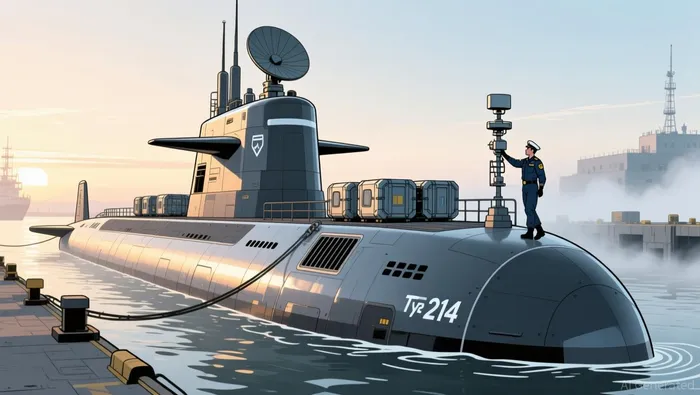
At the heart of the deal is the integration of air-independent propulsion (AIP) technology, a game-changer for submarine stealth and endurance. The Type 214 submarines, designed by ThyssenKrupp Marine Systems (TKMS), will enable the Indian Navy to operate undetected for up to six days-a critical advantage in the Indian Ocean region. This technological leap is paired with a robust localization strategy. While exact figures remain undisclosed, industry sources indicate that the project aims to achieve 45% indigenous content initially, with a target of 60% by the program's conclusion. This localization is facilitated by a joint venture between TKMS and India's Mazgaon Dock Shipbuilders Limited, which will establish a domestic supply chain for submarine components.
The localization framework is further supported by India's "Aatmanirbhar Bharat" (Self-Reliant India) initiative, which incentivizes domestic production through tax breaks and streamlined procurement processes. For European firms, this creates a blueprint for scaling industrial partnerships in India, where defense production is projected to grow from $17.57 billion in FY25 to $34.7 billion by FY29. The deal also sets a precedent for technology transfer, as seen in the recent LiDAR-based obstacle avoidance system agreement between HENSOLDT and Hindustan Aeronautics Limited (HAL), which highlights India's capacity to absorb and adapt advanced European technologies.
The economic and investment opportunities: A Win-Win for Global Defense SourcingThe India-Germany submarine deal is emblematic of a broader shift in global defense sourcing. European defense budgets, projected to grow at 6.8% annually through 2035, are increasingly prioritizing strategic autonomy and joint ventures. For firms like TKMS, Rheinmetall, and Saab, India's $8 billion deal is part of a larger trend: leveraging emerging markets to offset declining European defense demand and diversify revenue streams. Rheinmetall's proposed ammunition manufacturing facilities in India and Saab's expanding influence in the Indian fighter jet market exemplify this trend according to market research.
For Indian investors, the deal accelerates the growth of a domestic defense manufacturing ecosystem. India's defense production has surged by 90% since FY20, driven by initiatives like the SRIJAN portal and iDEX (Innovations for Defence Excellence) program, which have indigenized over 14,000 components. The submarine project will further catalyze this growth by creating a specialized supply chain for AIP systems, sonar technology, and submarine hull construction.
Broader Implications: A Model for Indo-European Defense Partnerships
The India-Germany collaboration offers a replicable model for future Indo-European defense partnerships. The EU's Security Action For Europe (SAFE) Regulation, which facilitates joint procurement and defense spending, provides a framework for scaling such collaborations. For instance, the EU's recent partnerships with Japan and South Korea-alongside its deepening ties with India-signal a strategic pivot toward multilateral defense cooperation. This trend is further reinforced by India's MAHASAGAR initiative, which seeks to enhance maritime domain awareness in collaboration with European allies.
Investors should also note the environmental and operational advantages of the deal. The AIP-equipped submarines align with global sustainability goals by reducing fuel consumption and emissions, while the localization strategy minimizes supply chain vulnerabilities- a critical consideration in an era of geopolitical fragmentation.
Conclusion: A Strategic Investment for the Future
The India-Germany $8 billion submarine deal is more than a procurement milestone; it is a strategic gateway for defense investors. By combining Germany's technological prowess with India's industrial potential, the project exemplifies the future of defense industrialization: localized, collaborative, and geopolitically aligned. For European firms, it offers access to a high-growth market and a foothold in the Indo-Pacific. For Indian investors, it accelerates the nation's transition from a defense importer to a global supplier. As global defense spending shifts toward performance-based contracting and technology integration, early investors in Indo-European defense partnerships stand to reap significant rewards.







Comentarios
Aún no hay comentarios