
India's Fintech Revolution: Regulatory Reinvention and the Gold Rush for Compliance-Driven Innovation
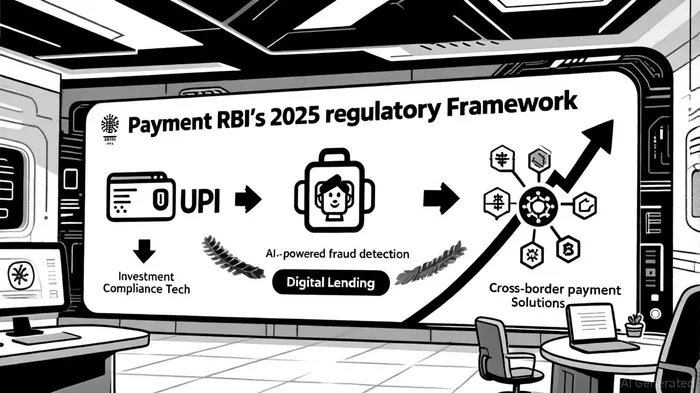
The Reserve Bank of India's (RBI) 2025 regulatory overhaul isn't just a bureaucratic update—it's a seismic shift that's redefining the fintech landscape. For investors, this is a golden opportunity to capitalize on a sector where compliance isn't a burden but a catalyst for innovation. Let's break down why.
Regulatory Reinvention: The New Guardrails for Growth
The RBI's Payments Regulatory Board Regulations, 2025[1] have replaced the 2008 framework, introducing a robust governance model for India's digital payments infrastructure. The new Payments Regulatory Board (PRB) now enforces strict eligibility criteria for members, including age limits, term caps, and mandatory cybersecurity expertise. This isn't just about oversight—it's about building a resilient ecosystem where transparency and accountability are non-negotiable.
Meanwhile, the Master Directions for Payment Aggregators (PAs)[5] have tightened the screws on non-banking entities. With minimum net worth requirements (Rs 15–25 crore), mandatory escrow accounts, and quarterly compliance reporting, the playing field is leveling. These rules are designed to curb fraud and align India's digital payments with global standards like PCI-DSS. For investors, this means fewer “wild west” risks and more room for sustainable, scalable fintechs.
Market Response: Compliance as a Competitive Edge
India's fintech sector, valued at $150 billion in 2025[3], is already adapting. Companies like Razorpay and Paytm are doubling down on AI-driven fraud detection and blockchain-based KYC solutions to meet RBI mandates[5]. The Unified Lending Interface (ULI)[4], a game-changer for credit accessibility, is streamlining data sharing between lenders and borrowers, particularly for underserved segments like MSMEs and farmers. This isn't just regulatory compliance—it's a blueprint for financial inclusion.
The Digital Banking Channels Authorisation Directions, 2025[4] further underscore the RBI's focus on consumer trust. Banks now need prior approval for digital services, ensuring robust cybersecurity and uptime (99.5% minimum). Customers gain explicit control over their digital banking experience, from view-only access to full transactional capabilities. This shift is forcing fintechs to innovate in user-centric design and risk management—areas ripe for investment.
Investment Opportunities: Where Compliance Meets Innovation
- AI-Powered Compliance Tools: Startups leveraging AI for real-time fraud detection, algorithmic explainability, and automated KYC verification are thriving. For example, Slice uses AI-driven credit scoring for its BNPL services, while CRED gamifies credit analytics[1]. These tools aren't just meeting RBI standards—they're setting new benchmarks.
- Unified Lending Interface (ULI) Ecosystem: The ULI's consent-based data sharing is transforming credit appraisal. Fintechs like Lendingkart are already using this framework to reduce operational costs and expand credit access[5]. Investors should watch for platforms integrating ULI with AI-driven risk assessment.
- Cross-Border Payment Solutions: With UPI Global now operational in 40+ jurisdictions[1], India's digital payments infrastructure is going global. Companies like PhonePe and Pine Labs are positioning themselves to dominate cross-border transactions, a market projected to grow exponentially.
The Road Ahead: Why This Is a Buy
The RBI's 2025 framework isn't stifling innovation—it's accelerating it. By mandating self-regulation through FinTech SROs[2] and pushing for AI-driven compliance, the regulator is creating a market where only the most resilient players survive. For investors, this means:
- Reduced systemic risk: Stricter data localization and cybersecurity norms protect against breaches[5].
- Higher returns on innovation: Fintechs that master compliance-driven tech (e.g., real-time KYC, blockchain-based identity verification) are attracting top-tier funding[3].
- Global scalability: UPI Global and interoperable PPIs are opening doors for Indian fintechs to export their solutions[1].
Conclusion: The Compliance Gold Rush
India's fintech sector is at an inflection point. The RBI's 2025 regulations are not just about control—they're about creating a foundation for long-term growth. For investors, the message is clear: Compliance is the new competitive advantage. The companies that thrive here—those that turn regulatory demands into innovation—are the ones that will dominate the next decade.







Comentarios
Aún no hay comentarios