
India's Equity Market Resilience Amid U.S. Visa Uncertainties: A Geopolitical Risk Analysis
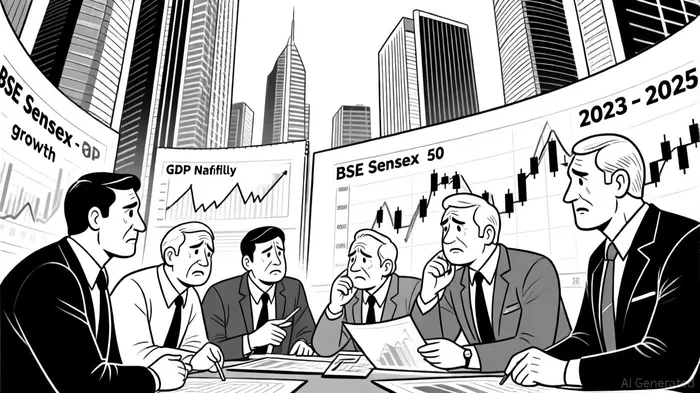
India's equity markets have demonstrated remarkable resilience in 2025, even as global geopolitical tensions and U.S. visa policy uncertainties cast shadows over emerging market investments. With a GDP (PPP) of $17.647 trillion and a nominal GDP of $4.187 trillion, India's economy remains a cornerstone of global growth, driven by its expanding middle class and a dominant information technology (IT) sector[1]. However, the interplay between U.S. visa policy shifts and India's market dynamics raises critical questions for investors navigating a landscape of geopolitical risk.
Geopolitical Pressures and Market Volatility
India's equity markets, particularly the BSE Sensex and NSE Nifty 50 indices, have experienced periodic volatility in 2025 due to regional tensions and global macroeconomic headwinds. For instance, Q2 2025 saw investor caution amid heightened U.S.-China trade tensions and regional disputes involving India's neighbors, such as Pakistan and China[2]. While these factors contributed to short-term fluctuations, the broader market structure has remained robust, supported by India's strategic role as a global IT hub and its demographic dividend.
The U.S. visa policy changes in 2025, though not explicitly detailed in available data, are likely to impact India's IT sector, which relies heavily on skilled labor deployed to the U.S. market. A report by Bloomberg notes that U.S. visa restrictions could reduce foreign exchange inflows from Indian IT firms, potentially affecting their profit margins[3]. However, India's domestic IT ecosystem has shown adaptability, with companies increasingly investing in local talent and automation to mitigate such risks[4].
Foreign Investment and Policy Resilience
India's equity market has also benefited from its status as a preferred destination for foreign direct investment (FDI). Despite global uncertainties, FDI inflows into India's technology, manufacturing, and services sectors have remained steady, bolstered by the government's pro-business reforms and a stable democratic framework[5]. According to data from the World Bank, India's FDI inflows in 2025 grew by 8.2% year-on-year, outpacing many emerging markets[6].
Yet, the market's resilience is not without vulnerabilities. Rising air pollution, gender inequality, and regional political instability could erode investor confidence over time[7]. Additionally, U.S. visa policy shifts—should they restrict Indian professionals' access to the U.S. labor market—could indirectly impact India's export-oriented IT sector, which contributes over 8% to the country's GDP[8].
Strategic Implications for Investors
For investors, India's equity market offers a compelling case study in balancing geopolitical risk with long-term growth potential. While U.S. visa uncertainties and regional tensions create near-term volatility, the country's structural strengths—such as its youthful population, digital infrastructure, and economic diversification—position it as a resilient asset in a diversified portfolio.
A visual analysis of India's GDP growth and equity index performance from 2023 to 2025 (see 







Comentarios
Aún no hay comentarios