
India's Energy Transition and Coal's Persistent Role
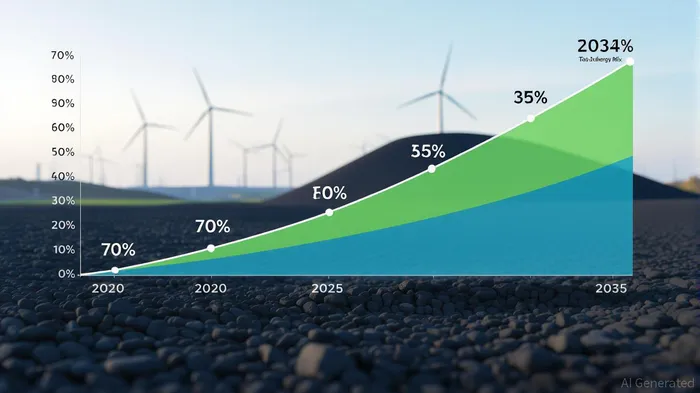
India's energy landscape is at a crossroads, balancing the urgent need for economic growth with the global imperative to decarbonize. As the world's third-largest energy consumer, India faces a unique challenge: meeting the energy demands of its 1.4 billion people while aligning with international climate commitments. Coal, which accounts for approximately 55% to 60% of India's electricity generation in 2025[1], remains central to this equation. However, the country's energy transition is gaining momentum, driven by renewable investments and policy reforms. For investors, understanding the interplay between coal's persistence and the rise of renewables is critical to navigating long-term risks and opportunities.
The Dominance of Coal: Drivers and Constraints
India's reliance on coal is rooted in its abundance, low cost, and existing infrastructure. The country holds over 300 billion tons of coal reserves[2], ensuring energy security for decades. Coal-fired power plants provide stable, baseload electricity at a cost significantly lower than renewables, making them indispensable for industrial growth and rural electrification[3]. Despite these advantages, coal's dominance is increasingly at odds with environmental goals. India's carbon emissions are projected to rise by 50% by 2030[4], driven by coal consumption, raising concerns about air pollution and climate commitments under the Paris Agreement.
The Transition Imperative: Policy and Renewable Momentum
India's energy transition is accelerating, albeit cautiously. The government has set ambitious targets to achieve 500 gigawatts (GW) of renewable energy capacity by 2030[5], supported by falling solar and wind costs. In 2025, renewables contribute around 15% of electricity generation[6], with solar capacity expanding at a record 20% annual growth rate[7]. Policies like the Production Linked Incentive (PLI) scheme for solar manufacturing and the National Hydrogen Mission aim to reduce fossil fuel dependence.
However, the transition is not without hurdles. Intermittency issues with renewables, grid integration challenges, and the high upfront costs of storage technologies mean coal will remain a key player. Projections suggest coal's share will decline to 40% to 45% by 2030[8], but it will still account for a third of the energy mix by 2040[9]. This gradual shift creates a window for investors to capitalize on hybrid models, such as retrofitting coal plants with carbon capture technologies or investing in green hydrogen projects.
Investment Risks and Opportunities in a Decarbonizing World
For investors, India's energy transition presents a dual narrative. Risks include regulatory shifts, such as carbon pricing or coal plant retirements, which could devalue fossil fuel assets. Global decarbonization trends, including ESG (Environmental, Social, and Governance) pressures, may also deter capital from coal-dependent sectors[10]. Conversely, opportunities lie in renewables, energy storage, and grid modernization. The International Energy Agency (IEA) estimates that India's renewable energy market could attract $1 trillion in investments by 2030[11].
Coal, however, is not obsolete. Advanced technologies like ultra-supercritical plants and carbon capture and storage (CCS) could extend the life of coal assets while reducing emissions[12]. Investors who adopt a “just transition” approach—supporting cleaner coal technologies alongside renewables—may mitigate risks while aligning with India's development needs.
Conclusion: Navigating the Energy Transition
India's energy transition is neither abrupt nor uniform. While coal's share will decline, its role in ensuring energy affordability and security cannot be ignored. For investors, the key lies in balancing short-term pragmatism with long-term sustainability. Diversifying portfolios to include both renewable energy projects and coal modernization initiatives offers a pragmatic path forward. As India navigates this complex landscape, stakeholders must remain agile, leveraging policy signals and technological advancements to future-proof their investments.







Comentarios
Aún no hay comentarios