
India's Energy Dilemma: Balancing Russian Oil Dependence and U.S. Trade Incentives
India's energy strategy has become a focal point of global geopolitical and economic tensions. Over the past five years, the country's reliance on Russian crude oil has surged from 2% of total imports in FY2020 to 35% in FY2025, driven by price discounts, energy security needs, and strategic autonomy[1]. This shift has positioned India as the second-largest buyer of Russian oil after China, with imports averaging 1.9 million barrels per day (bpd) in 2024[2]. However, U.S. sanctions targeting Russian oil producers and transport vessels have introduced volatility, forcing Indian refiners to navigate a precarious balance between cost efficiency and geopolitical risks. For investors, this dynamic presents both challenges and opportunities in India's energy and trade sectors.
The Rise of Russian Oil and Its Economic Implications
India's pivot to Russian oil has been fueled by stark price advantages. Urals crude, Russia's benchmark, has traded at a $12-per-barrel discount to Brent and $4 cheaper than Iraqi oil[3]. By 2024-25, Russian crude averaged $78.39 per barrel, significantly below India's overall import cost[4]. These discounts have translated into substantial savings: over $25 billion in foreign exchange during 2023-24[5]. Indian refiners, including Reliance Industries and Nayara Energy, have capitalized on this arbitrage, using discounted Russian crude to produce refined products for export to Europe. In 2023-24, India exported $19.2 billion worth of diesel and jet fuel to the EU, accounting for 16% of Europe's imports of these fuels[6].
Yet this strategy is now under threat. U.S. sanctions, including a 50% tariff on Indian exports if the country refuses to curb Russian oil imports[7], have disrupted supply chains. At least two vessels carrying Russian oil to India have diverted to other destinations in 2025[8]. Analysts estimate that a full disruption of Russian oil imports could cost India $9 billion in FY26 and $11.7 billion in FY27, pushing global oil prices up by 10-15%[9].
U.S. Pressure and India's Strategic Dilemma
The U.S. has intensified its pressure on India to reduce Russian oil dependence, framing it as a matter of global energy security. President Donald Trump's warning of 100% tariffs unless Russia agrees to a peace deal with Ukraine underscores the stakes[10]. India, however, has resisted, emphasizing its sovereign right to source energy at competitive prices. This defiance has strained U.S.-India trade relations but also spurred diversification efforts.
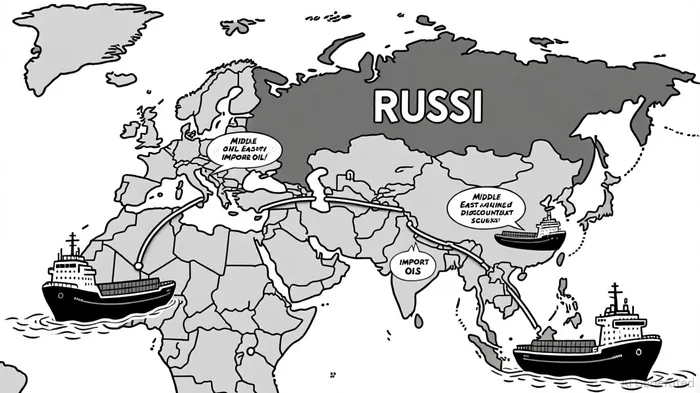
India is exploring alternative crude sources, including the U.S., Brazil, and the Middle East[11]. U.S. crude imports have risen to 218,400 bpd in January 2025, making the U.S. India's fifth-largest supplier[12]. However, Middle Eastern and U.S. crude are now more expensive than Russian oil, potentially increasing India's import bill by $5 billion annually[13]. Meanwhile, EU sanctions on refined products derived from Russian crude threaten to curtail India's lucrative export market[14].
Investment Risks and Opportunities
For investors, India's energy dilemma presents a dual-edged sword. Risks include:
1. Geopolitical Volatility: Sanctions and U.S. pressure could disrupt Russian oil supplies, forcing India to pay higher prices for alternative crude.
2. Refinery Exposure: Indian refiners reliant on Russian crude face margin compression if export markets to Europe shrink[15].
3. Currency Pressures: A larger oil import bill could strain India's current account, increasing rupee volatility.
Conversely, opportunities abound:
1. Domestic Energy Infrastructure: India's Open Acreage Licensing Policy and enhanced oil recovery (EOR) technologies aim to boost domestic production, reducing reliance on imports[16].
2. Green Energy Transition: With a target of 30% electric vehicle (EV) market share by 2030, investments in battery supply chains and renewable energy could hedge against oil shocks[17].
3. U.S. Energy Partnerships: Deeper U.S.-India energy ties, including long-term contracts and the Strategic Energy Partnership, offer stable supply chains and geopolitical alignment[18].
Actionable Strategies for 2025–2026
Investors should prioritize sectors aligned with India's energy resilience:
- Refiners with Diversified Feedstock: Firms like Reliance and Nayara Energy, which blend Russian and U.S. crude, are better positioned to navigate sanctions.
- Renewable Energy and EV Infrastructure: Solar energy firms and battery manufacturers stand to benefit from India's green push.
- Logistics and Transportation: Companies developing alternative oil transport routes (e.g., bypassing the Strait of Hormuz) could gain strategic value.
India's energy strategy will likely hinge on its ability to balance short-term cost advantages with long-term geopolitical stability. For now, the country's defiance of U.S. pressure and its pivot to Russian oil reflect a pragmatic approach to energy security. Yet, as sanctions tighten and global markets shift, investors must remain agile, hedging against volatility while capitalizing on India's strategic pivot.





Comentarios
Aún no hay comentarios