
India's Derivatives Market: Navigating Regulation for Strategic Advantage in Index Options
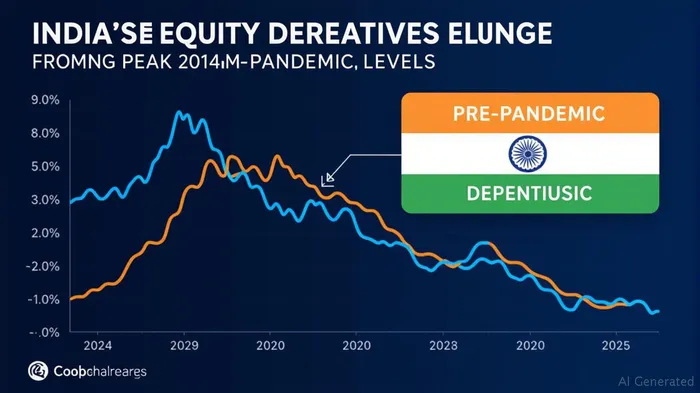
The Securities and Exchange Board of India (SEBI) has reshaped the derivatives landscape with its 2024-25 reforms, targeting systemic risks fueled by retail speculation. While these measures have caused a dramatic drop in trading volumes—75% from peak 2024 to March 2025—the market remains a strategic playground for investors who can discern opportunities amid regulatory headwinds. This article explores how institutional players can capitalize on refined risk frameworks in index options, even as retail-driven volatility wanes.
The Regulatory Reset and Its Paradoxes
SEBI's crackdown—raising minimum lot sizes, limiting weekly expiries, and deploying AI-driven surveillance—has curtailed retail speculation, which once accounted for 41% of derivatives volumes. Yet, despite a 75% YoY decline in options trading by March 2025, activity remains 2.5 times higher than in 2019, pre-pandemic. This divergence reveals a market recalibrating toward institutional-grade liquidity and reduced systemic risk.
The reforms have created a “new normal” where index options, particularly those tied to resilient sectors, offer compelling opportunities. Consider the Nifty 50 and Nifty IT indices: their fundamentals—underpinned by strong corporate earnings and global demand—have insulated them from speculative overhang. Meanwhile, sectors like banking, which faced scrutiny in the Jane Street manipulation case, now face stricter position limits for HFT players, reducing their vulnerability to artificial volatility.
Strategic Opportunities for Institutions
Volatility Reduction as a Hedge Tool
SEBI's measures have slashed intraday volatility in regulated indices. The Nifty 50's historical volatility (HV) dropped to 14% in early 2025 from 22% in late 2023, aligning with global benchmarks. This stability makes index options ideal for hedging equity portfolios or capturing mean-reversion trades.Position Limits: A Structural Advantage
Caps on speculative short positions for foreign HFT firms have reduced the risk of index manipulation. Institutions can now safely deploy larger positions in sector-specific indices like Nifty Pharma or Nifty Infrastructure, which are less prone to retail-driven swings.Arbitrage Opportunities in Reduced Liquidity Gaps
The shift from ultra-short-term expiries to longer-dated contracts has narrowed the liquidity gap between spot and futures markets. For example, the basis spread between Nifty futures and the underlying index—often exploited by speculators—has tightened to 0.2% in 2025 from 1.5% in 2023. This favors systematic traders executing calendar spreads or carry trades.
Sector-Specific Plays
- Healthcare (Nifty Pharma): With global pharma demand rising and domestic reforms boosting industry margins, this sector offers defensive characteristics. Its index options saw a 9% premium contraction in 2025 as speculative bets waned, creating entry points for long-term hedges.
- Technology (Nifty IT): Export-driven IT firms, insulated from domestic liquidity cycles, benefit from reduced HFT interference. Their derivatives liquidity remains robust, offering scope for volatility-based strategies.
Caution: Avoid Retail-Driven Indices
While the reforms have broadened opportunities, certain indices—like Bank Nifty—remain vulnerable due to lingering retail sentiment and structural risks. The Bank Nifty's open interest fell 60% in early 2025, but its volatility persists due to bank-specific macro risks. Investors should avoid overexposure here unless fundamentals improve.
Broader Market Implications
The regulatory pivot has already reshaped market dynamics:
- Brokerages: Firms like Zerodha, which focus on compliance and institutional clients, now dominate.
- Exchanges: NSE's margin-based fee model will benefit as trading shifts toward longer-dated contracts.
Investment Thesis
For institutional investors:
- Go long on index options tied to sectors with durable earnings (IT, healthcare), leveraging reduced volatility and tighter spreads.
- Hedge equity exposure using Nifty 50 options, now priced at a 12% discount to pre-2023 premiums.
- Avoid speculative instruments like weekly contracts or indices with high retail participation (e.g., Bank Nifty).
Conclusion
SEBI's reforms have transformed India's derivatives market into a more stable, institution-friendly arena. While the headlines focus on declining volumes, the reality is one of refined risk management and sector-specific opportunities. For investors willing to navigate the regulatory maze, the path to asymmetric returns lies in indices underpinned by fundamentals—not frenzy.
Final caveat: Monitor SEBI's next steps on position limits and margin requirements. A gradual relaxation could unlock further upside.







Comentarios
Aún no hay comentarios