
India's Defiant Stance on Agricultural Protection: Implications for Emerging Markets and Global Trade Realignment
India's agricultural protection policies have become a defining feature of its economic strategy in 2025, as the government prioritizes the welfare of its 700 million-strong farm sector amid escalating U.S. tariff threats. Prime Minister Narendra Modi's assertion that he is willing to “bear the heavy price” to shield farmers from global market volatility underscores a strategic shift toward self-reliance and domestic resilience. This defiance, however, is not merely a political stance—it is a recalibration of global trade dynamics with profound implications for emerging markets and investment opportunities in alternative corridors and agri-tech innovation.
The Rationale Behind India's Agricultural Protection
India's farm sector, which employs over half the country's labor force, has long been vulnerable to external shocks. The government's 2025 policy framework, including the Dhan-Dhaanya Krishi Yojana, targets 100 low-productivity districts to boost yields through crop diversification, climate-resilient seeds, and improved irrigation. These measures are designed to counteract the risks posed by U.S. agricultural exports, which are often subsidized and could destabilize domestic markets. By maintaining high import tariffs—up to 700% on certain products—India aims to insulate small and marginal farmers from unfair competition while promoting food security and cultural norms, such as restrictions on non-vegetarian dairy imports.
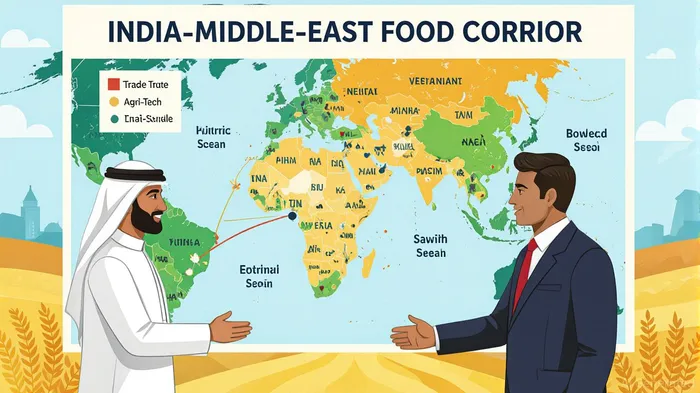
The U.S. has responded with retaliatory tariffs, including a 50% levy on Indian goods, citing “unfair trade practices.” Yet, India's stance reflects a broader geopolitical strategy: leveraging its agricultural surplus to strengthen ties with the Middle East and Israel. The India-Middle East Food Corridor, a $7 billion initiative involving UAE logistics and Israeli agritech, is a case in point. This corridor not only diversifies India's trade routes but also positions it as a global leader in sustainable agriculture.
Strategic Realignment and Investment Opportunities
The U.S.-India trade tensions have accelerated India's pivot to alternative trade corridors. The India-Middle East Food Corridor, for instance, connects Indian farmers with UAE-based processors through platforms like Agriota, creating a $10 billion market for grains, fruits, and dairy. Israeli agritech firms such as ADAMA and ProFit Agro are pivotal in this ecosystem, supplying drip irrigation and hydroponic systems to Indian farms. These partnerships are not just about trade—they represent a reimagining of global supply chains, with India at the center.
Domestically, India's agri-tech boom is attracting significant capital. Startups like iCreate and Start-Up Nation Central are driving innovations in precision agriculture, AI-driven crop monitoring, and off-grid solar irrigation. The government's push for digital platforms like e-NAM (National Agricultural Market) is streamlining trade and reducing transaction costs for farmers. For investors, this translates into opportunities in agri-tech infrastructure, logistics, and climate-smart technologies.
Geopolitical Implications and Emerging Market Dynamics
India's agricultural protectionism is reshaping global trade. By resisting U.S. pressure to liberalize its farm sector, India is reinforcing its strategic autonomy and deepening ties with non-Western partners. The RIC (Russia-India-China) trilateral mechanism and India's growing engagement with the Gulf are examples of this multipolar strategy. For emerging markets, this signals a shift away from U.S.-dominated trade frameworks toward diversified, regionally integrated corridors.
The India-Middle East Food Corridor, in particular, is a blueprint for future trade. With the UAE and Israel providing technological and logistical support, India is not only securing its food security but also creating a hub for agri-tech exports. This corridor is expected to benefit 2 million Indian farmers and generate 200,000 jobs, making it a compelling investment avenue.
Investment Advice for the Agri-Tech Era
For investors, the key lies in aligning with India's long-term agricultural vision. Here are three actionable strategies:
Agri-Tech Startups and Infrastructure: Invest in Indian agri-tech firms developing precision agriculture tools, such as IoT-based monitoring systems and AI-driven analytics. The global agri-tech market is projected to grow at 9.17% CAGR through 2030, with India leading adoption in the Asia-Pacific.
Alternative Trade Corridors: Allocate capital to projects within the India-Middle East Food Corridor, including logistics hubs and processing facilities. These ventures benefit from UAE-India and UAE-Israel trade agreements, which reduce barriers and enhance scalability.
Climate-Resilient Agriculture: Target companies specializing in drought-tolerant crops, soil health management, and renewable energy for farming. India's focus on climate resilience aligns with global ESG trends, offering both financial and environmental returns.
Conclusion
India's defiant stance on agricultural protection is more than a defense of its farm sector—it is a strategic repositioning in a multipolar world. By prioritizing domestic welfare, embracing agri-tech innovation, and forging alternative trade corridors, India is not only safeguarding its economy but also creating new opportunities for global investors. As U.S. tariffs and geopolitical tensions persist, the India-Middle East Food Corridor and India's agri-tech ecosystem will likely emerge as critical assets for those seeking to capitalize on the next phase of global trade realignment.







Comentarios
Aún no hay comentarios